
Walt Stearns offers some sage advice on how to create eye-catching marine macro portraits
Why Macro Portraits Captivate Underwater Photographers
I have seldom met an underwater photographer who did not have at least some interest in macro photography. It’s understandable because the aquatic realm offers an amazing array of small to minuscule critters. Everything from the beautiful and stunning to the weird and downright bizarre are waiting for any diver with a camera, a keen eye and a bit of patience.
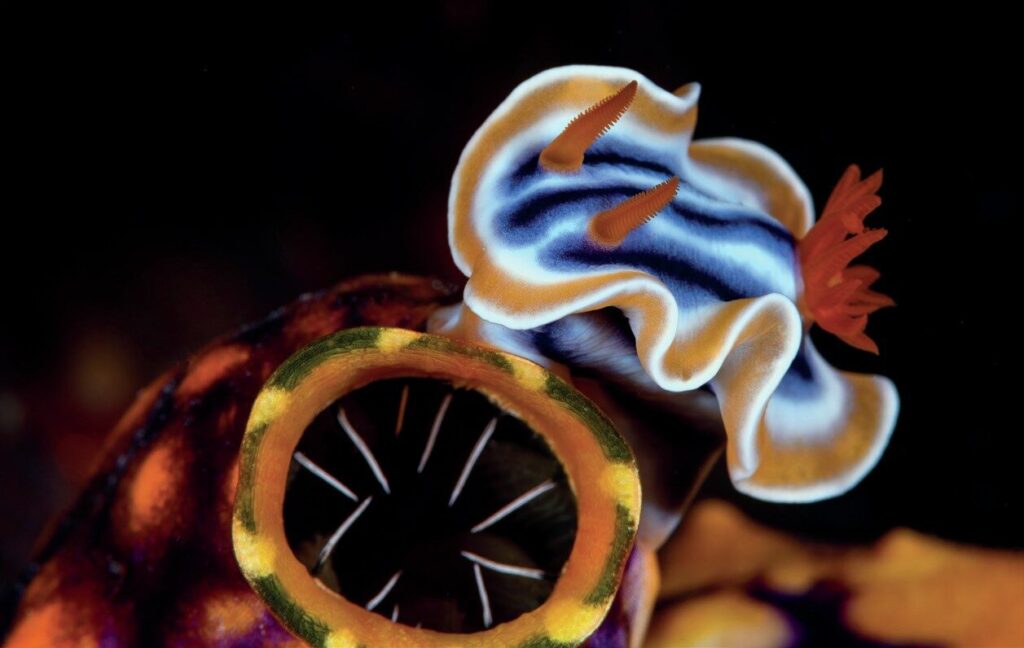
Equipment Used: Nauticam housed Nikon D850 DSLR with Nikon 105mm f/2.8 Macro Lens.
Camera Settings: 1/125 of second with ISO at 400, and aperture at f/27.
Lighting: Two Retra Prime Strobes set on manual at 3/4 power.
There has been a lot said and written about the limitations of not having the ‘proper equipment’ for macro imaging. Undoubtedly, there are a wide number of useful tools like supplemental optics for additional magnification of subjects to achieve a greater than 1:1 ratio and light-shaping devices (snoots) that can create unique lighting. However, great macro photography can be achieved with just basic equipment matched with both the desire and discipline to put work at its fullest.
Essential Gear for Creating Macro Marine Portraits
General wisdom dictates having a housed DSLR or mirrorless camera along with a macro lens in the 40 to 60mm and/or 90 to 105mm range. I will not scoff at any of the Olympus TG-5or TG-6users out there who can only afford a compact system. The reality is that these compact cameras have surprisingly excellent macro capability without the need for additional optics for magnification.
While many photographers have preferential subjects, I consider myself a Photo Omnivore, as I consider most everything underwater to be interesting, and each provides a unique imaging challenge based on how I want my audience to see it. Here are several examples of subjects that can result in the creation of a captivating image.
Octopus brooding eggs
One of my favourite local diving spots for shooting macro is the Blue Heron Bridge in West Palm Beach, Florida. Back in early March of 2022, a reef octopus (Octopus briareus) took up residence inside an exhaust pipe from a discarded boat engine. When word got out that she was brooding eggs, she became the focal point to many macro photographers seeing a great opportunity to capture something special.
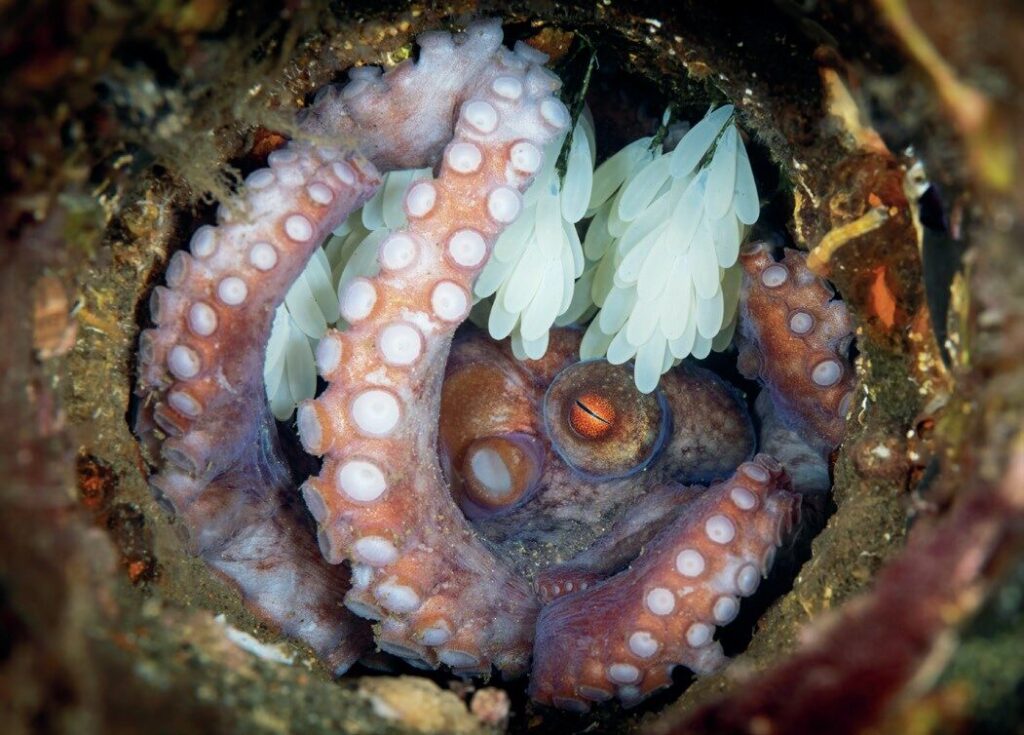
Equipment Used: Nauticam-housed Nikon D850 DSLR with Nikon 105mm f/2.8 Macro Lens.
Camera Settings: 1/125 of second with ISO at 400, and aperture at f/22.
Lighting: Two Retra Prime Strobes set at full power.
This was a wonderful chance to get one of nature’s marvels of a mother octopus ready to fend off all comers while attentively aerating her eggs. The challenge was that she was nearly a foot back inside a pipe scarcely four inches in diameter.
To shoot this shot with my Nauticam-housed Nikon D850 DSLR and Nikon 105mm f/2.8 Macro Lens, I needed the aperture to be stopped down to at least f/22. To get enough illumination on the octopus and her eggs, I positioned both my Retra Prime strobes in as tight as they would go on the left and right side of the macro port. Even with half of each strobe’s flash tube blocked off at the pipe opening I was still able to pull off the shot at 1/125 of a second with an ISO of 280. In addition to the tricky nature of the lighting, the octopus was constantly moving her arms, so it took some patience and repeated effort to get a shot with both the eggs and her eye at the same time.
If the photo looks familiar, it should. This very same octopus was the subject of a shot by taken by Kat Zhou that became the winning photo for both First Place Macro and Best of Show in the Ocean Art 2022 Photo Competition. Equipped with the same camera system as mine; a Nauticam-housed Nikon D850 DSLR, Nikon 105mm Macro Lens, Kat pulled off her winning image through nearly identical settings – 1/250 sec. ISO 250, aperture at f/29. For lighting, Kat likely positioned her two Inon Z330 Strobes set the same full settings as mine.
Shooting straight down, the camera settings on my Nauticam-housed Nikon D850 DSLR were at 1/180 of a second with the ISO at 200. Aperture settings for my Nikon 105mm f/2.8 Macro Lens were stopped down to f/27, as I wanted as much depth of field as possible so that every bulbous tip of the anemone’s tentacles held as much detail as the little fish in the middle. Lighting came from two Retra Prime Strobes set on manual at just below full power.
Lighting Techniques That Make Macro Subjects Pop
Regardless of what camera system you have — DSLR, Mirrorless, Compact — good quality lighting is absolutely essential. Although having one good strobe with a GN of 33 (90 to 100 Ws) or higher and quick recycle time will suffice in a lot of instances, using two is considered the vanguard for serious macro photography when it involves capturing subjects that move.
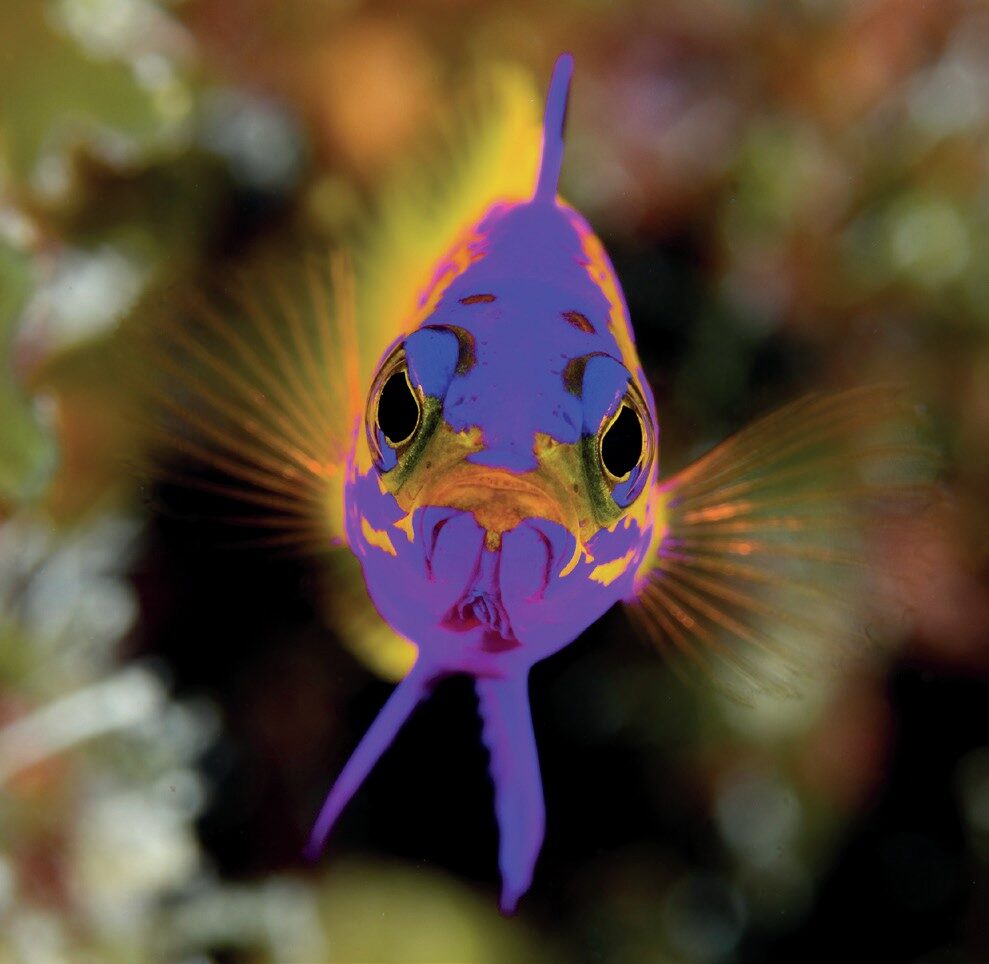
This candid portrait of a golden basslet (Gramma dejongi) looking head-on into the camera lens was illuminated by a pair of Retra strobes. To achieve the desired lighting effect, strobes were set in a 9 and 3 O’clock position to the subject and aimed almost directly at one another. This created a cross-lighting effect that gives this already vibrant purple and yellow fish an added glow by being equally illuminated on both sides. In addition to bringing out wonderful details and contrast, having the light stronger on the foreground helps eliminate distracting clutter in the background.
Everybody loves a clown
No matter how often I see these colourful anemone dwellers when I am diving in the Indo-Pacific, I still find it difficult to turn down a good opportunity for a captivating clownfish portrait. Seeing this peanut-size juvenile spine-cheek anemonefish (Premnas biaculeatus) by the tentacles of a jade green anemone was an opportunity too good to pass up.
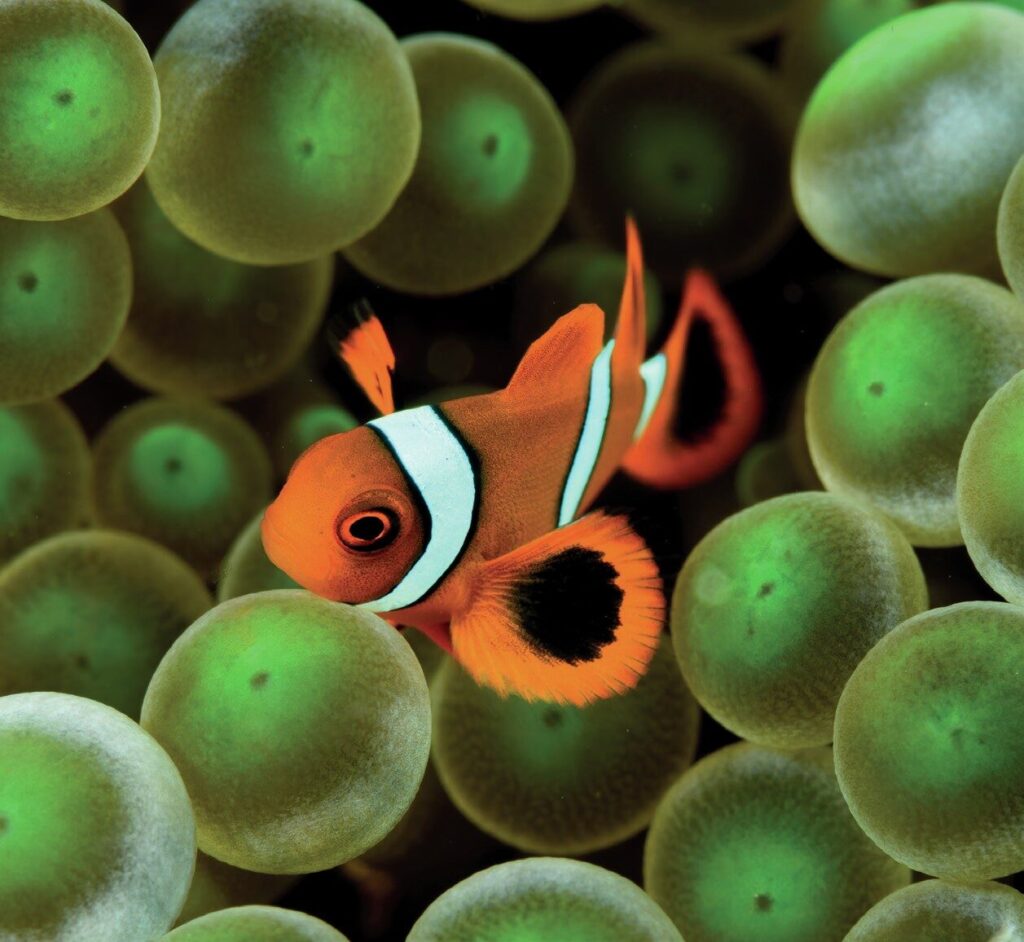
Since I felt that the anemone was just as important as the little fish in it, I cast aside the common boilerplate rule for composition, which is to avoid shooting a subject from above as this can often produce an uncomplimentary image.
Equipment Used: Nauticam-housed Nikon D850 DSLR with Nikon 105mm f/2.8 Macro Lens.
Camera Settings: 1/250 of second with ISO at 200, and aperture at f/19.
Lighting: Two Retra Pro Max Strobes set on manual at half power.
Subject Behaviour and How It Shapes the Perfect Shot
When asked how I can get great portraits of these bottom-dwelling creatures, my answer is that I look for the stupid, lazy subjects first. I am referring to those little beauties that are more prone to staying in place instead of darting away the second you approach. This is macro photography meets fish behaviour 101.
A good example of stupid, lazy subjects is this image of two deep yellow watchman gobies (Cryptocentrus cinctus) with a tiger Alpheus shrimp (Alpheus bellulus) fully outside of the burrow.
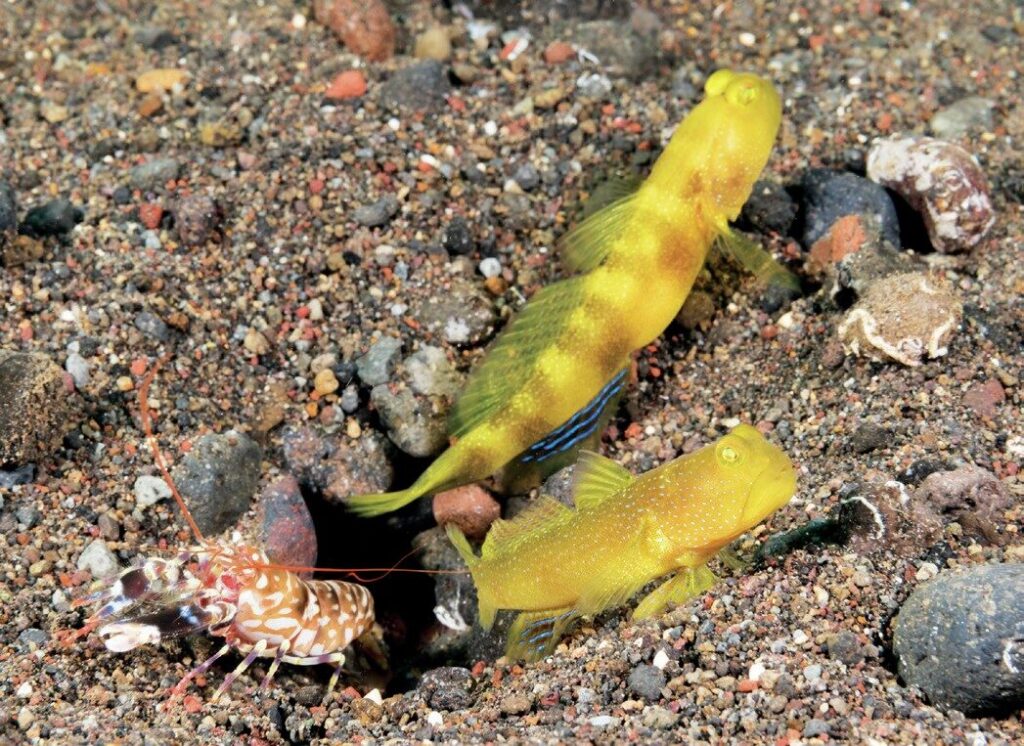
Equipment Used: Nauticam-housed Canon 7D mk II DSLR with Canon EF-S60mm f/2.8 Macro USM Macro Lens.
Camera Settings: 1/125 of second with ISO at 200, and aperture at f/16.
Lighting: Two Sea & Sea YS-250 Strobes set on half power.
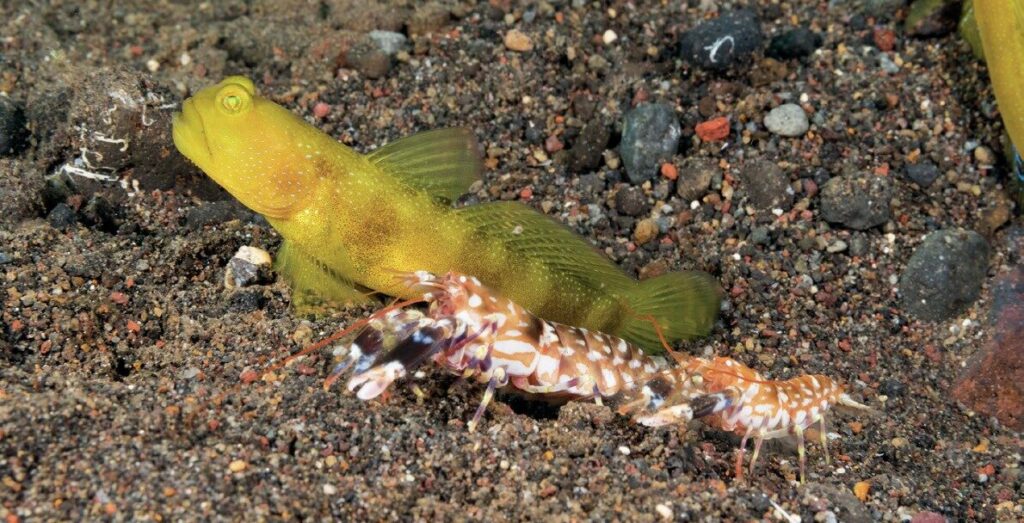

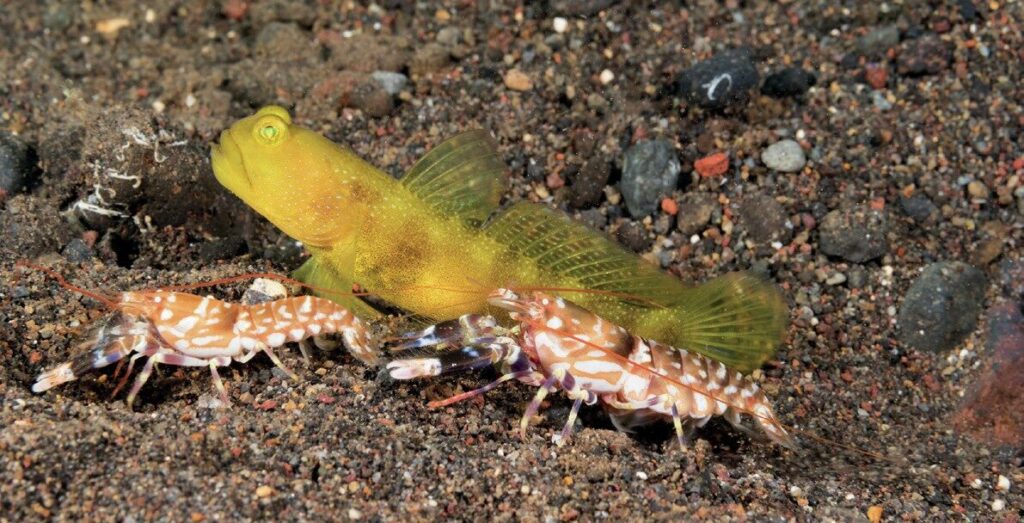
I am always fascinated by the symbiotic relationship between shrimp gobies and their Alpheus shrimp roommates. While the shrimp does all the work to build and keep their burrow clean, the gobies stand look out for any possible dangers; namely a predator that would happily make these shrimp with their poor eyesight an easy meal. Skirting over the dark sand bottom during a shore dive at Tulamben (northeast side of Bali, Indonesia) I started seeing bright-colored gobies standing watch while the Alpheus shrimps labored away.
My DSLR system was set up with a Canon EF-S60mm f/2.8 Macro USM Macro Lens. My 100mm lens would have been a better choice, giving me a bit more breathing room that might keep the little fish from performing a disappearing act in a puff of dust the second I so much as looked crossways at it. But again, you work with what you’ve got.
As luck would have it, I came upon a particular pair of watchman gobies that were either incredibly trusting, or incredibly stupid. One thing was for certain, they acted as if they had little to no regard for my presence. Settling gently to the bottom making my both movements and breathing as slow and deliberate as possible I set to work getting one shot after another. The first round yielded the classic composition with two yellow watchmen gobies standing guard as a lone tiger Alpheus shrimp repeatedly emerges from their burrow.
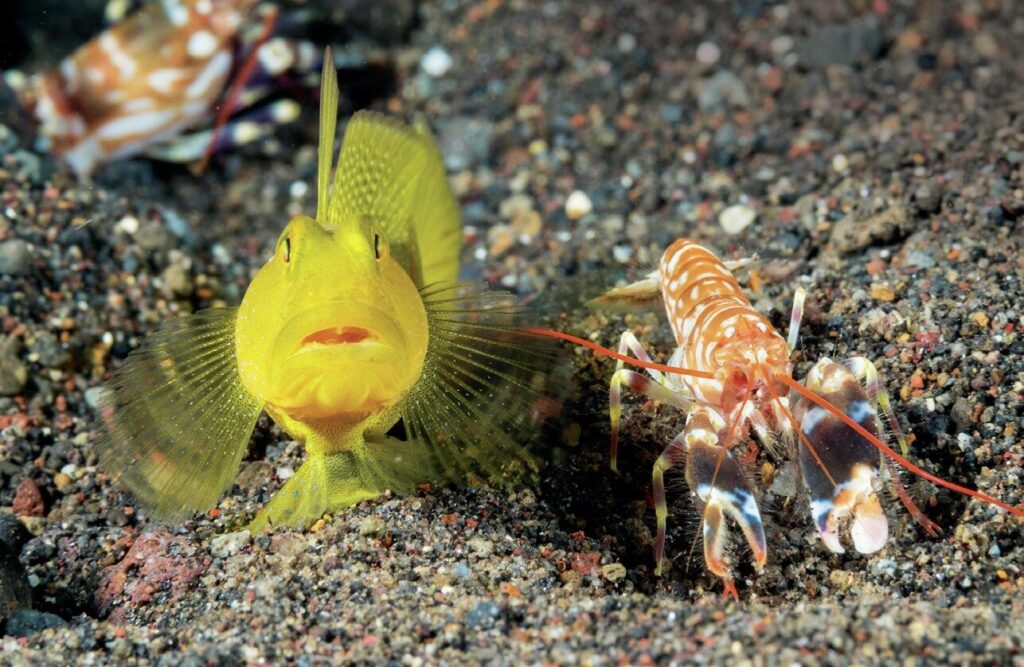
It’s common for a goby to bring a shrimp out for a look. But seeing the same goby lead two tiger Alpheus shrimps out for a walk at the same time was something I had never witnessed before. These particular watchman gobies were either incredibly trusting or incredibly stupid. And the images turned out to be great for representing marine life behaviour.
Food for thought: Practice, Patience and Artistic Vision
It’s important to get comfortable with your system by learning all the features and functions of your camera– from navigating your way around the menu system to developing an intuitive feel to where every function button, dial, and wheel is located.
Harnessing that knowledge allows you to quickly and efficiently manipulate those functions to sort optimum combinations of shutter speed, aperture, and ISO that will work in unison with your underwater strobes to for a proper exposure. These skills will help make you an accomplished technician. Turning all this into art will require you to develop an eye for composition.
There are several rules in composition to help photographers make their images more captivating and compelling. The most proven include the rule of thirds, the golden ratio, the rule of symmetry and leading lines. I will brush on all these in the next column.
Until then, keep shooting and enjoy!
Frequently Asked Questions
What makes a compelling underwater macro portrait?
A strong macro portrait combines sharp focus on the subject’s eyes, clean lighting, and a composition that isolates the creature while revealing its character.
Do I need high-end gear to shoot professional macro images?
Not necessarily. Compact systems like the Olympus TG-6 can produce excellent macro shots. Technique, lighting, and patience matter far more than expensive hardware.
Why is lighting so crucial in macro photography?
Macro subjects are small and often tucked into dark spaces. Quality strobes help shape contrast, illuminate details, and eliminate distracting backgrounds.
How do I photograph fast-moving or skittish macro creatures?
Approach slowly, minimise movement, and prioritise subjects that stay in place longer. Adjust shutter speed and strobe placement to freeze motion effectively.
What camera settings work well for macro portraits underwater?
Macro shooters typically use high apertures (f/19–f/29) for depth of field, low ISOs for clarity, and shutter speeds around 1/125–1/250 to sync with strobes.
This article was originally published in Scuba Diver Magazine
Subscribe today with promo code DIVE1 — enjoy 12 months for just £1!
