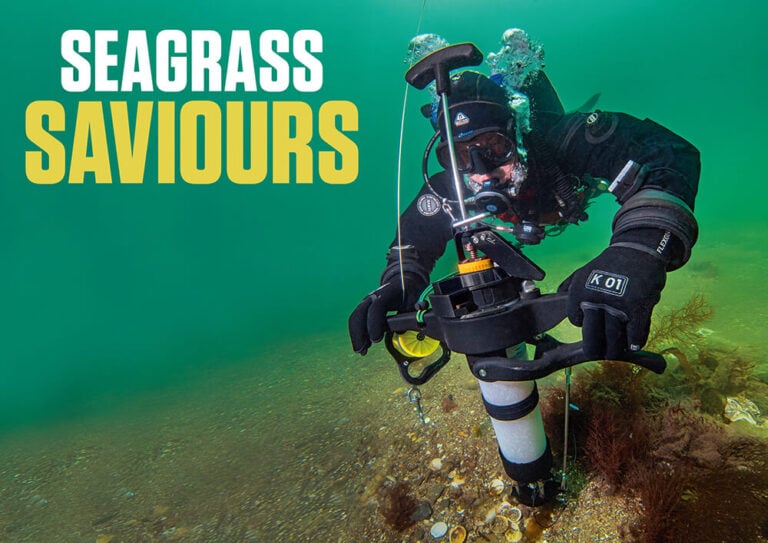
Scientists and divers may seem an unlikely union but it’s paying dividends for marine research projects across the globe. Marcus Rose joined one such project that aims to restore vital seagrass habitats within the UK’s first National Marine Park in Plymouth Sound.
Citizen Science and the Rise of the Everyday Diver
So-called ‘citizen science’ is creating a lot of buzz of late with divers across the globe embracing the opportunity to make a positive contribution to our better understanding of ocean eco-systems. It’s a great way to contribute to our knowledge of the oceans and even collaborate with real-world scientific research. Best of all, you don’t need a lab coat and a PhD to get involved -just a curious mind and a passion for diving are all that is needed.
Science not your strong point? Don’t worry – citizen science projects don’t need to be scary or big. Many citizen science projects are set up by individuals just like you and involve nothing more than simply observing and documenting changes to your favourite dive site.
I’m sure any diver who has dived the same spot over an extended period has noticed subtle (and sometimes not so subtle) changes within that environment. Maybe you’ve seen fish life steadily diminishing or perhaps a change in species? Maybe you’ve noticed more (or less) marine growth or the viz has changed significantly over time? Your observations can provide valuable insights for marine researchers.
From Observation to Real Research
At the opposite end of the citizen science scale, there are projects that involve collaboration with academics in one of a myriad of research projects run by universities, environmental charities and research institutions. Such projects are a deeply rewarding opportunity to contribute to real scientific research that can have a major impact on the oceans we so love. Whatever route you take, citizen science offers you the opportunity to do something genuinely rewarding underwater.
With so much yet to be discovered in the marine environment, there is still a genuine need for extensive scientific research. Like all robust research, reliable data collection is vital and this is where Project Baseline UK (PBUK) comes in. PBUK is a registered charity that utilises the passion and drive of a dedicated team of volunteer divers to collect data for scientific and conservation purposes.
Project Baseline UK and the Blue Meadows Programme
Over the last few years one of the most-prominent projects PBUK has been supporting is the Blue Meadows seagrass restoration programme run by the Ocean Conservation Trust. Based at the National Marine Aquarium in Plymouth, the Trust is a global ocean conservation charity that has been working tirelessly towards a vision of healthy, thriving oceans for almost 30 years. The seagrass restoration project has been running for several years and continues to be a cornerstone project for the Trust. PBUK divers have been privileged to be involved at various stages of their work.

Why Seagrass Matters
So what makes seagrass so special? Let’s cut to the science – seagrass play a key role in habitat creation by slowing water flow and trapping particles between their leaves. Other marine species are attracted to the seagrass as a source of food and protection from predators. This means they support fisheries and are a great nursery for juvenile fish.
If that wasn’t enough to get you cheering for team seagrass, they also provide coastal protection and act as a carbon sink, helping to counter the impact of climate change. All in all, they’re a unique group of flowering plants that are key to the long-term health of many marine habitats. For fans of trivia, there are four families of seagrass and 72 species worldwide. However, they are very sensitive to change. In the UK, they are adversely affected by a number of factors including destructive fishing practices and even recreational activities, such as anchors from pleasure craft. Through its seagrass restoration programme, and the education of coastal communities, the boffins at the Ocean Conservation Trust hope to reverse the decline of seagrass on the south coast of the UK.
One of the key objectives of the Trust is to connect communities with the ocean. They do this in several ways, including engagement with volunteer divers. PBUK has been fortunate to be involved in three of the key stages of the seagrass restoration project – site surveys, seed harvesting and, most recently, the planting of seagrass seeds in designated areas within Plymouth Sound.
Surveying the Meadows
The site surveys were carried out at both existing seagrass meadows and at potential habitat restoration sites. Under the watchful guidance of researchers from the Ocean Conservation Trust, the volunteer divers were directed to observe and report on the reproductive health of the meadows. This involved laying 15 metre transects using tape measures and then counting the number of reproductive leaves in square metre segments along each transect. Reproductive seagrass plants were identified by small white dots (the seeds) in the leaves of the plants.
By taking an average of the number of reproductive leaves across the transects, the Trust’s scientists were able to compare the reproductive health of each meadow and therefore the most suitable site for future seed harvesting.
Harvesting Seagrass Seeds
Once the best sites for harvesting had been identified, the Blue Meadows team waited for the right time of year before again teaming up with PBUK divers, this time to harvest the seagrass seeds. This relatively agricultural task involved divers drifting over the seagrass meadows and picking the seagrass leaves containing seeds. While they are difficult to spot initially it didn’t take long for the divers to get their ‘eyes in’. Whilst science is clearly a serious business there was some competition amongst the divers as to who could collect the most seeds on a single dive. Serious science can be fun!


Once the seeds had been collected into large ‘goodie’ bags, they were taken to the Trust’s laboratory within the National Marine Aquarium. Here the seeds were removed from the harvested seagrass and then cultivated in saltwater tanks until they were ready to be distributed to the restoration sites. Previous restoration efforts have involved distributing the seeds in hessian bags, but this method proved largely unsuccessful. The bags either moved and broke up during storms, or the material broke down in the ultraviolet light too quickly, allowing the seeds to be eaten or washed away with the tides.
Planting the Future – The OCToPUS Seeder
To address this issue, the Blue Meadows team went back to the drawing board and developed a prototype seeder device. Christened ‘(HMS) OCToPUS’ (short for ‘Hydro Marine Seeder (HMS) Ocean Conservation Trust Pressurised Underwater Seeder) by the team, the original design was based on a caulking gun and featured a spring-loaded 1.5-litre chamber loaded with seeds, held in suspension using an algae-based goo. The divers use this device to inject the seagrass seeds about 40mm into the substrate. It is hoped that this will keep the seeds in place long enough for them to germinate and for the seagrass to take hold.
The seeding process started with more site surveys to confirm the target site was suitable for seagrass. While wide area, computer-generated suitability studies had been conducted prior to dive operations taking place, divers were still needed to eyeball the area to ensure that there was sufficient sand or fine sediment for seagrass planting. Once a suitably sandy spot in about 10m of water had been found, the position was marked with a shot line and its GPS position was recorded by the project dive vessel. From here the divers marked out a 20-metre square zone using a compass and line to mark the seeding area. To allow the researchers to record the exact location of seeding and enable follow on visits to check on progress, the diver team trailed an SMB with a GPS tracker around the marked area.


With the target area for seeding marked out, the divers entered the water with the mechanical seeding devices and conducted seven dives over two days. With the seeding device still in prototype stage, the seeding process involved an element of trial and error. The Blue Meadows team very quickly discovered that there was a fine balance between the viscosity of the ‘media’ used to keep the seeds in suspension and the speed at which the seeds were discharged.
If the media is thinner the deployment is easier and faster, however, the seeds drop out of suspension more easily. When it is thicker it holds the seeds in suspension more effectively but makes deployment a much slower process.
Initial efforts took approximately 40 minutes per device, but, once the ideal viscosity had been found, we got that down to about ten minutes per device over the course of the later project dives. With all 12 seeders emptied and several thousand seeds deposited, the long wait begins while we wait to see if the seeds germinate, and the seagrass takes hold.
Did you know?
Seagrass injection, also known as hydro-marine seeding or dispenser injection seeding (DIS), injects a mixture of seeds and sediment into the seabed. It is an alternative method to broadcasting seeds or using seed bags, which can typically have lower success rates.
Why Citizen Science Matters
“The divers from Project Baseline UK were incredibly helpful in assessing the suitability of a restoration site that hadn’t previously been explored. Feedback from divers on the Hydro Marine Seeder was invaluable enabling the team to adapt and conduct various trials during the day as well getting a lot of seeds back into the ocean. We look forward to returning in four months time to look for any initial signs of growth in the area. We’ll be reporting back to the valuable volunteer dive team at Project Baseline UK,” commented Miriam Webborn of the Ocean Conservation Trust.

It’s safe to say that Project Baseline UK’s involvement has been really motivating for all divers involved. It has allowed divers to use their privileged access to the marine environment to contribute to the greater cause of ocean conservation. Any volunteer diver can get involved with citizen science efforts like Project Baseline. While the diving was not deep or particularly challenging, the discipline required to conduct tasks underwater shouldn’t be underestimated. If citizen science interests you, it is worth investing time nailing down those basic skills to ensure that you have the comfort and in-water capacity to contribute safely and effectively.
For more information
Project Baseline UK www.projectbaselineuk.org and the Ocean Conservation Trust www.bluemeadows.org/our-work/why-seagrass
Frequently Asked Questions
What is citizen science in diving?
Citizen science in diving involves recreational divers collecting observations and data to support marine research and conservation projects.
Why is seagrass important to marine ecosystems?
Seagrass provides nursery habitats, supports fisheries, stabilises sediment, protects coastlines and stores large amounts of carbon.
Where is the Blue Meadows seagrass project based?
The Blue Meadows seagrass restoration programme operates in Plymouth Sound, the UK’s first National Marine Park.
How do divers help restore seagrass?
Divers assist with site surveys, seed harvesting and planting using specialised underwater seeding devices.
Can any diver take part in citizen science projects?
Yes. Many projects welcome trained recreational divers who are comfortable with buoyancy control and task-focused diving.
This article was originally published in Scuba Diver Magazine
Subscribe today with promo code DIVE1 — enjoy 12 months for just £1!
