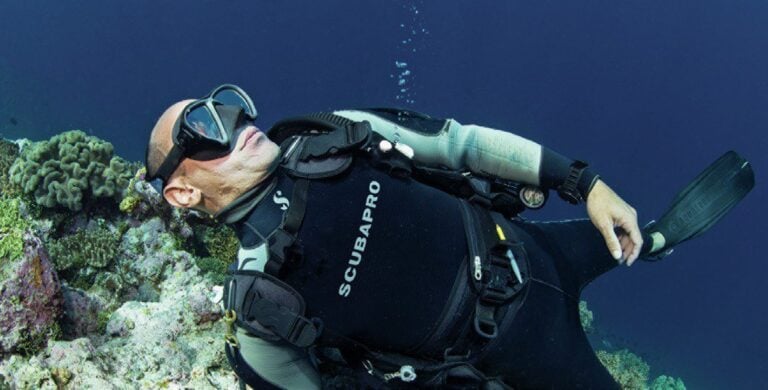
Emergency ascent: the words every diver hopes never to put into practice.
Emergency Ascent on Osprey Reef
The big cloud of bubbles told the captain something was wrong before we even surfaced. Down below on Osprey Reef, northeast of Queensland, a diver had apparently run out of air and was panicking.
I’ve been diving for 16 years, but I never expected to use the skills I’ve learned to save a life. Before we got in the water on that beautiful blue day on the Great Barrier Reef, I was filled with anticipation about seeing hammerheads, mantas and reef sharks. But soon I would find myself at the right place at the right time.
We were on our way to a bommie to check out a cleaning station when we heard banging on a tank. We assumed someone had spotted a shark or manta, but none was visible — nor could I see a diver banging on his or her tank.
The banging continued insistently until finally I spotted a diver ascending diagonally toward my friend Heidi. Just as he reached her, he froze and went limp. Heidi later said, “I saw his mouth open a few times and take in water.
I saw him go unconscious and have a full-body seizure and then slump.” I quickly started finning toward the lifeless diver, hoping to not lose too much time.
The diver was pale, open-eyed and unresponsive. There was a little bit of water in his mask, and his mouth hung slack without his regulator.
Not a single bubble came out. I knew that the top priority upon finding an unresponsive diver at depth was getting him to the surface as quickly as possible.
Rescue and Emergency Medical Response
Energised and acting on instinct, I grabbed the diver, who was much bigger than me. We were slowly sinking when my friend Rod showed up by my side.
We couldn’t inflate the diver’s BCD at first, but as we kicked upward in an emergency ascent, Rod reached for the diver’s tank valve and turned the knob — that’s when we realised the tank was only partially open.
At the surface I yelled and used my Dive Alert audible signalling device as Rob and I worked to keep the diver afloat with his head above water. Fluid and blood were coming from the diver’s mouth.
The tender reached us quickly, and we were able to get the unresponsive diver on board without too much difficulty.
As soon as we reached the liveaboard, the crew positioned the diver on the deck, began administering oxygen and hooked him up to a defibrillator. Two doctors who were on board, one from Singapore and one from China, also helped.
The diver regained some degree of consciousness but was not very responsive and had bright red blood coming out of his mouth. The captain had called emergency medical services, and the diver was soon airlifted to the hyperbaric chamber facility at Townsville Hospital.
I was traumatised by the whole event. It’s hard to explain what it felt like to have had someone’s life in my hands. Immediately after the rescue I couldn’t help but think that if I had messed up, the diver would have been gone.
The doctor who treated him was very generous and spoke to me on the phone on several occasions. He helped me through the trauma and the mixed bag of emotions that overwhelmed me.
Lessons Learned for Scuba Diving Safety
The fact that the diver’s tank valve was barely open meant he had enough airflow to descend but that once he was three atmospheres underwater, his nearly closed tank couldn’t provide him with sufficient air.
He did not approach his buddy or dive guide but panicked and bolted for the surface, banging on his tank as he finned. Later it was discovered that he had failed to disclose that he was taking three medications that could possibly affect his well-being while diving.
Hiding the truth is a dangerous game. It is a blessing that the diver lived, and fortunately he did not suffer a lung overexpansion injury. Salt-water inhalation, however, damaged his alveoli (the air sacs in the lungs).
There are reasons why specific rules and guidelines were developed for scuba diving: The rules reduce the likelihood of dive accidents. No one is exempt — it is imperative that all divers follow protocol.
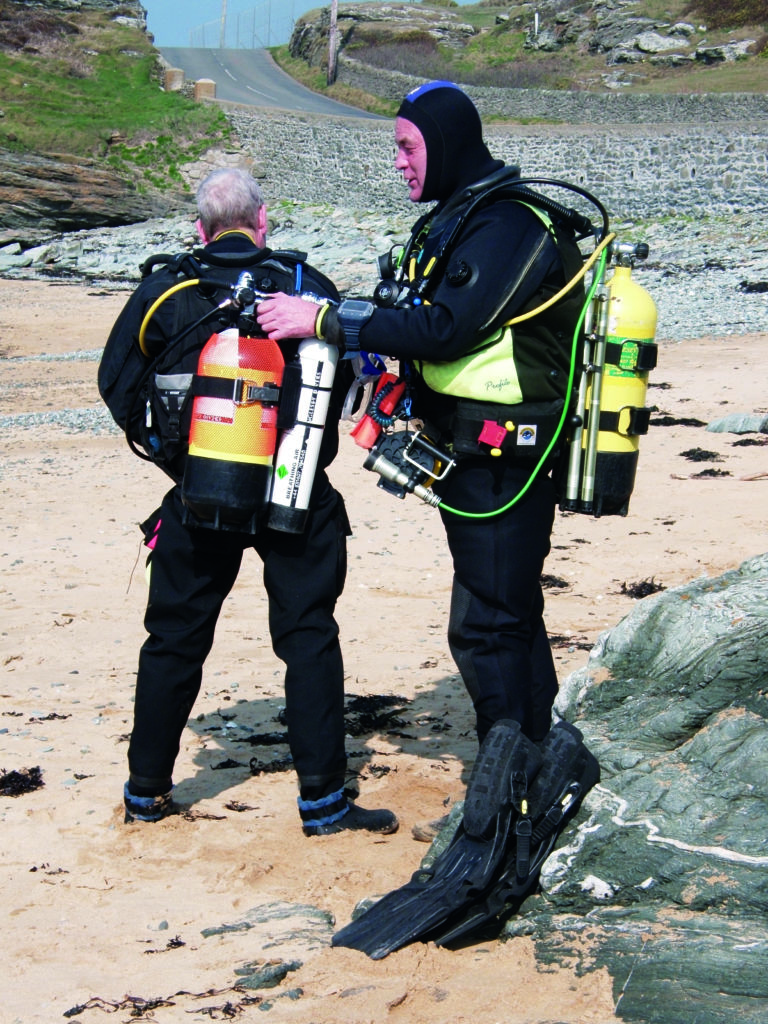
The purpose of the predive safety check is to give our dive buddies a chance to catch anything we might have missed. Never be in a hurry before a dive.
World.DAN.org
For an extensive range of diving health and safety information and downloadable resources, research studies, incident summaries, and free e-Learning courses, take the time to explore DAN World’s new website: https://world.dan.org/
FAQs
What is an emergency ascent in scuba diving?
An emergency ascent is a rapid, controlled ascent to the surface when a diver runs out of air or faces another critical situation underwater.
How can quick action save a diver’s life?
Recognising a diver in distress and acting immediately — as in this story — can prevent drowning or severe injury.
Why did this diver run out of air?
The diver’s tank valve was only partially open, restricting airflow at depth. Combined with panic, this led to an emergency ascent.
What safety checks help prevent scuba diving accidents?
Thorough pre-dive safety checks, including confirming tank valves are fully open, greatly reduce emergency risk.
Where can divers find more information on dive safety?
Divers Alert Network (DAN) World offers extensive dive safety resources, studies, and free e-learning courses at world.dan.org.
This article was originally published in Scuba Diver ANZ #64
Subscribe today with promo code DIVE1 — enjoy 12 months for just £1!

were you able to dump his weights?