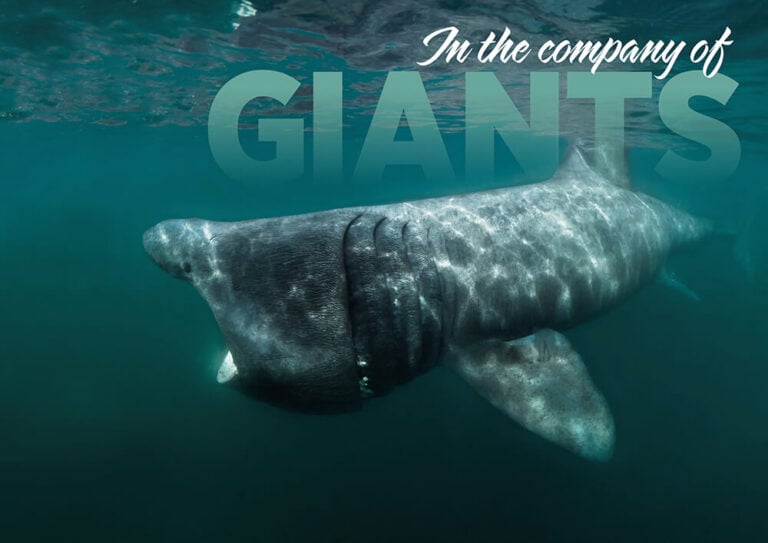
Claudia Weber Gebert makes a pilgrimage from her native Germany to snorkel with basking sharks, the spring guests of Blasket Island, off the coast of Ireland.
Wildlife Beyond the Green Fields
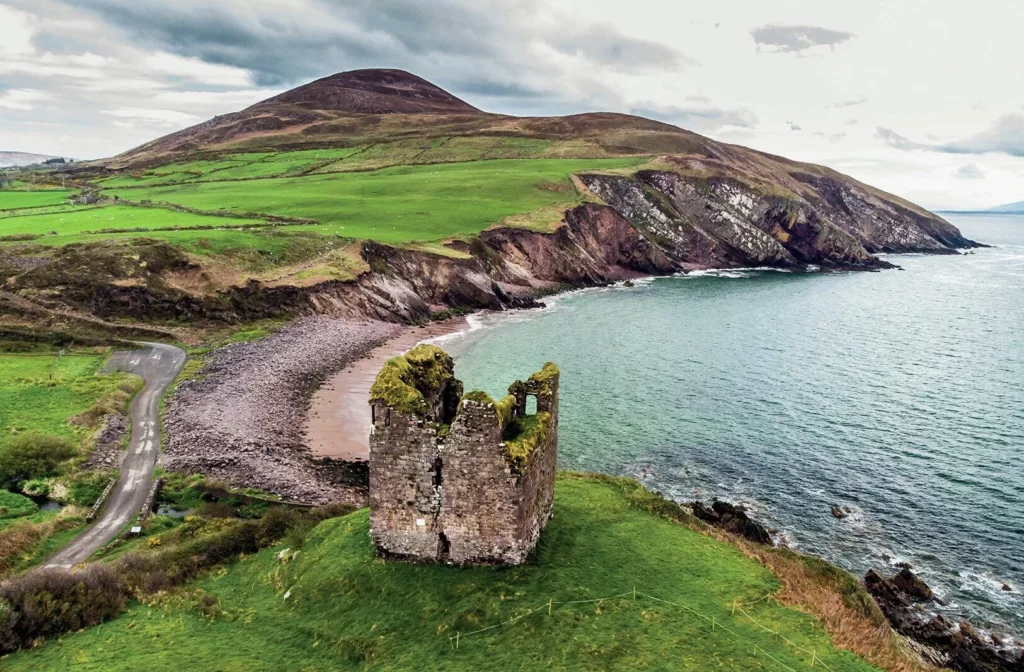
Ireland, more precisely Kerry in the southwest of Ireland and even more precisely, the last tip of the Dingle Peninsula… Blasket Island, and different smaller islets. And with animals in Ireland, everyone inevitably associates cuddly sheep and happy dairy cows on lush green meadows with rugged natural stone walls. But this region has much more to offer. Wildlife at its finest -animals that can be seen all year round, such as the grey seals, or a great diversity of seabirds that go in search of food in the open Atlantic.
Seasonal Giants of the Blasket Islands
But there are also summer guests, such as the humpback whales and the special spring guests – the very cute puffins, minke whales and basking sharks (Cetorhinus maximus). While the puffins come here only to breed and the pairs find each other every year to raise their young in caves on the cliff walls, the basking sharks and minke whales come here in April for a completely different reason.
Why Basking Sharks Arrive Each Spring
An upwelling current develops on the coast, which transports a large amount of plankton to the water surface in April. A laid table for the big filter feeders. Both the whales and the sharks then only have to push themselves through the water with their mouths wide open. However, the minke whales are rather shy, you hardly see them. Just a short blow and then they disappear again under the water surface, and only a trained eye even perceives their presence.
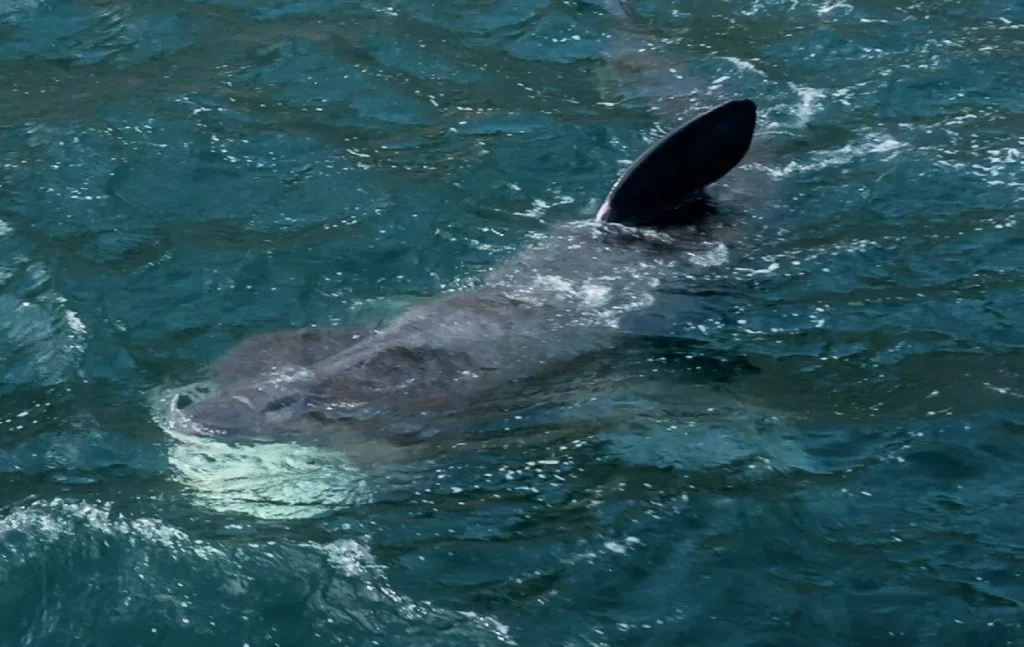
The basking sharks are completely different – they make no secret of their presence and are visible on the water surface in sunny weather. Then the nose, dorsal fin and the tip of the caudal fin stick out of the water. And that’s exactly why they are called basking sharks – ‘sunbathing’ sharks. However, they are by no means interested in the warming rays of the sun, but only in the plankton that can then be found directly and very concentrated on the water surface and below. Tour boats from Dingle that take tourists around the Blasket Islands also specifically target these areas where the basking sharks can be seen.
Getting in the Water with Basking Sharks
However, this wasn’t enough for us just to see the basking sharks from the boat. We wanted to take a closer look at these huge animals up close and, of course, take photos underwater. This was possible with our private guides and skippers, Nick and Terry. There is no tourism in this area, so we are alone with the basking sharks and enjoy this freedom. But if you then think that you just drive there and jump into the water with the animals, you have not dealt with the Irish weather and the tidal currents around the islands. The wind often throws a spanner in the works, depending on the direction the waves can be quite high. And the fierce wind blows very frequently, even with a bright blue sky! The combination of wind direction and water flowing in or out due to the tide do the rest, so it can be very uncomfortable on a small boat. Water temperature and outside temperature are around 10° C in April. The waves alone weren’t really dramatic, but that’s when the sharks are hard to spot. Although they are there even in bad weather, they stay below the surface of the water and are hardly visible. Only the basking sharks can answer whether it is because the plankton can also be found deeper, or whether the sharks don’t like the cold wind on their dorsal fin either.
Face to Face with a Gentle Giant
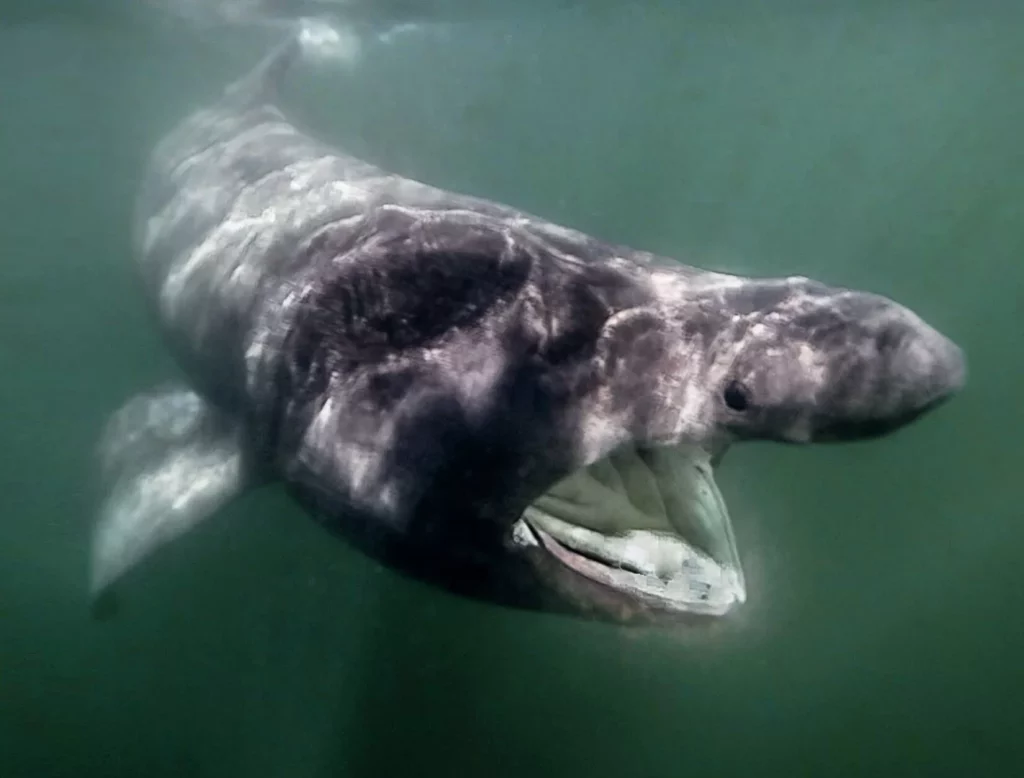
We are lucky and find good conditions and the basking sharks are friendly to us. The first contact in the water is very close and I am gently pushed aside by a huge male, because these animals swim along the surface in patterns to collect the plankton in their funnel-shaped mouths and don’t let anything throw them off course. Whatever is there in the water is simply pushed aside -including photographers. In the murky water you can only see something huge and white coming at you, the open mouth of the six- to eight-metre animals.
We could recognize different movement patterns in which these giants plow through the water – 100 metres one direction, turn, back, turn again, etc, or zigzag, or in ever-widening circles. Once you could recognize such a pattern, it was easy to position yourself in the water and wait for the shark to come by again. Our guides also gave information from the boat where the nearest basking shark was and in which direction it was best to swim.


Photographing Sharks in Plankton-Rich Water
Diving equipment is not necessary here, a mask and snorkel are sufficient to get close to the harmless animals, which stoically swim their course with their mouths open. The water is enriched with phytoplankton and zooplankton, tiny jellyfish that can be seen with the naked eye. They have a diameter of almost 10mm. Just photographing and identifying this plankton would be an exciting task in itself. But that’s exactly why taking photos is difficult, because plankton = floating particles = backscatter! It means getting as close as possible and having as little plankton as possible between the lens and the shark. Sunshine is nice, but the sun also shines on the plankton below the water surface, making it extremely bright and visible in photos.
As Nick explains to us, there is a database in Ireland with a photo catalogue to record the animals. Unfortunately, identification with photos of the fins is not easy, since the sharks often have no special identifying features or marks. All sightings are reported to the Irish Whale and Dolphin Group IWDG, who work in partnership with the Irish Basking Shark Group. And since this year, the basking sharks are also on the Irish list of protected animals.
Every morning Nick drives to Slea Head, a spotting point at the tip of the peninsula overlooking Blasket Island and the surrounding islets, and keeps an eye out for whales, dolphins and then in April also the basking sharks, and shares his data. Despite this, nothing can be said about the numbers since the total number of the population is not known. Overall, these sharks are considered endangered, plastic debris in the water is a major threat because they cannot distinguish between jellyfish and plastic bags. Ship collisions, bycatch in fishing and entanglement in nets and lines are also threats to these beautiful animals. Some sharks were also tagged by the IWDG in the hope of learning something more about them, but after the tagged sharks left the Blasket Island region, they scattered in all directions and each animal had a different behaviour. Thus, nothing further could be found out about the transmitters.

Understanding the Basking Shark
Basking sharks (Cetorhinus maximus) – from the order of the mackerel sharks – have existed on Earth since the middle Eocene, i.e. a good 40 million years, and has been classified as an endangered species since 2005. Size is approximately six to eight metres, making it the second largest fish species after the whale shark. They are cartilaginous fish. Basking sharks have a large number of small teeth in their mouths that plankton literally stick to while swimming with their mouths open. The water is drained backwards through the five gills. After some time of filtering, they close their mouths and actively swallow their food.
More to Explore on the Dingle Peninsula
However, as you often have to wait for the best weather in Ireland, there are plenty of other things to do on the Dingle Peninsula. If you can drive to the islands, you can of course also photograph the numerous species of seabirds there or the grey seals, whose numbers have increased again in recent years.

But the peninsula is also steeped in history, so you can see prehistoric round buildings there, the beehive huts -round and made entirely of stone, they look like beehives. Castle ruins and towers are also interesting destinations. Most of the routes pass near the sights anyway. A drive over the Connor Pass in the direction of Mount Brandon, the second highest mountain in Ireland, is also impressive, though the narrow, winding road is not suitable for all vehicles. The view down the valley with various loughs is overwhelming. Just enjoy nature. Outside the larger towns such as Dingle and Trallee, the landscape is rather sprawled, with many detached farmhouses with sheep or cattle breeding characterizing the landscape. The cities with their colourful houses are cozy and invite you to stroll and eat.
Frequently Asked Questions
When is the best time to see basking sharks in Ireland?
Basking sharks typically arrive off southwest Ireland in April, following plankton-rich upwelling currents.
Where are the Blasket Islands located?
They lie off the tip of the Dingle Peninsula in County Kerry, southwest Ireland.
Can you snorkel with basking sharks?
Are basking sharks dangerous to humans?
No. Basking sharks are harmless filter feeders that eat plankton.
Why are basking sharks endangered?
Major threats include plastic pollution, fishing bycatch, entanglement, and ship strikes.
This article was originally published in Scuba Diver Magazine
Subscribe today with promo code DIVE1 — enjoy 12 months for just £1!
