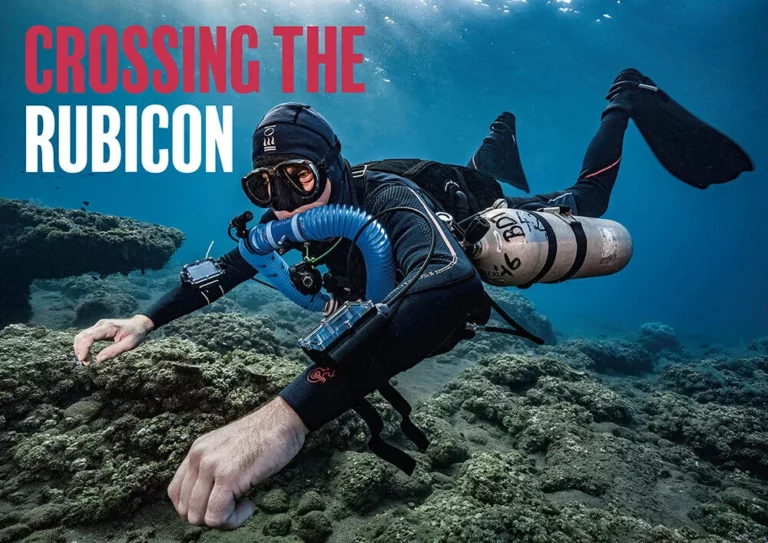
Don Silcock recounts his experiences of his first week getting to grips with his closed-circuit rebreather training in Bali.

Making the Leap to Closed-Circuit Rebreather Diving
After decades of diving open circuit and thousands of hours underwater with scuba tanks, I finally decided to cross the line that divides recreational diving from full-on technical diving -rebreathers.
Closed-circuit rebreathers (CCRs) have always kind of intrigued me, with their seductive promise of silent diving, extended bottom times, and no bubbles. But they also come with complexity, risk, and a steep learning curve. For years, I viewed CCRs as just too temperamental and dangerous. But eventually, a mixture of curiosity and necessity tipped the scales, and I committed. The price tag was eye-watering, but the time had come.
And so, in early March, I set off to Amed in northeast Bali to begin formal training.
Packing for Your First CCR Course
I travel frequently for underwater photography, so I’m used to the complex ritual of packing with its gear lists, back-ups, batteries, spares, etc. Dive kit is usually the easy part as it’s the camera equipment that’s time-consuming and stressful. But packing for your first CCR course? That’s next level.
Suddenly, I had a mountain of new equipment – much of which I didn’t even recognize yet. Sensors, scrubbers, oxygen cells, loops, counter-lungs, oxygen bottles – the sheer volume of stuff was both exciting and intimidating.
Why I Chose the Triton II Rebreather
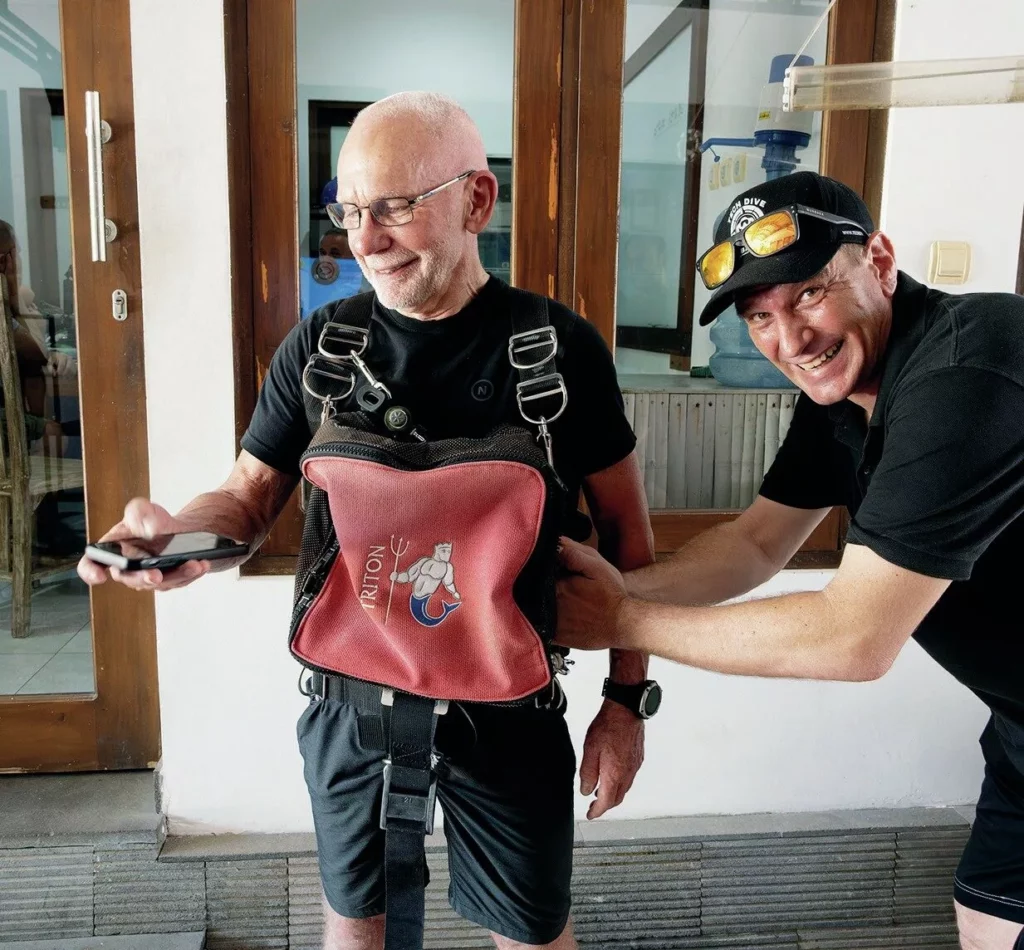
I had decided on the new Triton II manual (mCCR) rebreather, as its chest-mount design and low weight (15lb optimized for travel and possible carry-on) fitted my needs best.
What I hadn’t fully realized was that CCR courses are specific to each unit. Because the Triton II was so new, instructors themselves were still being trained.
In fact, my course doubled as an instructor development session – with two senior Triton instructor-trainers certifying five instructors on the new unit. That was where Mark Kouwenberg (the other student candidate) and I came in – and we were going to get a lot of attention over the next seven days as we went up the Triton II learning curve!

Training With Bali Dive Trek in Amed
My instructor was Antoine Martin, who runs Bali Dive Trek in Amed. I had done my TDI Extended Range and CCR familiarization courses with him previously. Antoine is a highly experienced technical diver, and his facility includes a dedicated, air-conditioned rebreather room housing no fewer than seven different CCR units – all of which he regularly dives.
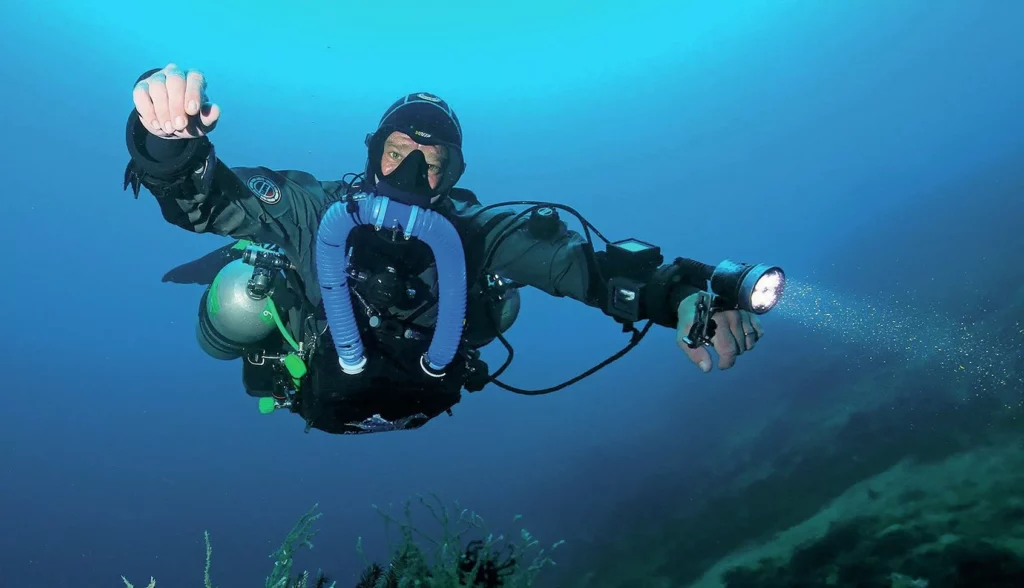
By the time I arrived, the full training team had assembled from various parts of the world. Introductions were fascinating – and a little humbling. These were highly experienced people with deep technical credentials and serious dive achievements. I felt like the rookie in the room, because I was…
Did you know?
Rebreather diving is practiced by recreational, military and scientific divers in applications where it has advantages over open circuit. The main advantages of rebreather diving are extended gas endurance, low noise levels, and lack of bubbles.
Understanding the Real Risks of CCR Diving
As with all dive training, theory comes first. And if you thought physics and physiology in recreational diving were tough, CCR theory makes it look like a warm-up lap. There is a tremendous amount to absorb and process, all of which started with the three biggest dangers associated with CCR diving – hyperoxia (too much oxygen), hypoxia (too little oxygen) and hyopercapnia (too much carbon dioxide). These aren’t minor inconveniences, they are potentially lethal and damn scary as there is no sugar-coating of the dangers.
But as the days went on, I realized that as intimidating as it may seem, the only way to be able to manage those risks is to fully understand them, be able to recognize their onset and to safely deal with them underwater.
Checklists, Drills and Crisis Management Underwater
The first practical skill you must master is assembling and testing your unit. Miss a step here, and you could be in real danger. At first, it felt impossibly complex – hoses, valves, sensors, loop checks! But with repetition and a checklist-based approach, it began to stick. By the end of the course, I could assemble and prep the Triton II in a fraction of the time it took on day one.
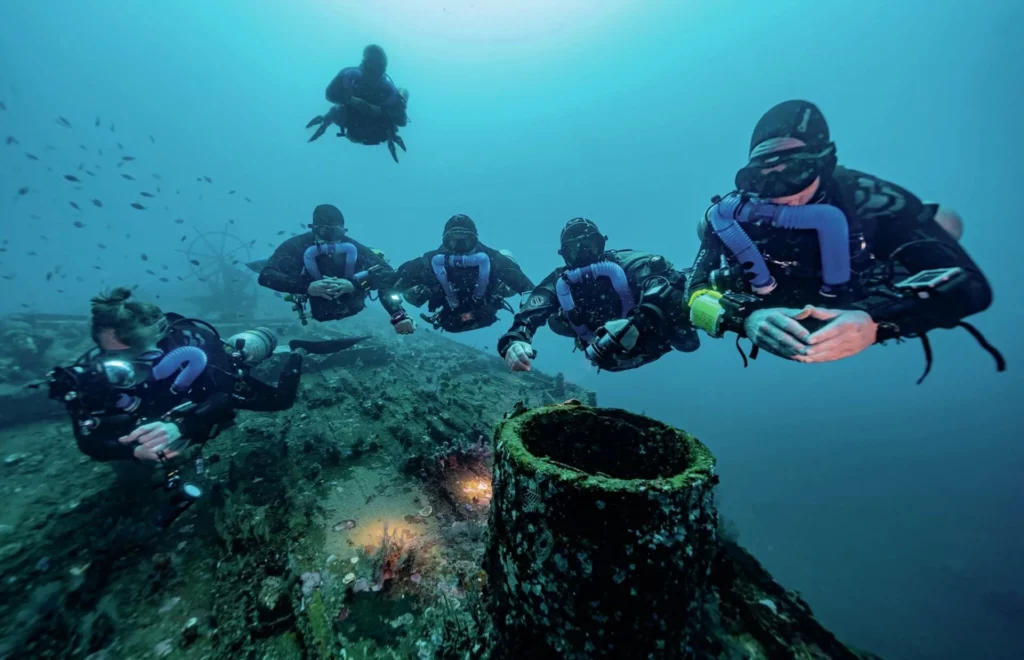
From there, we moved into handling emergency scenarios underwater – managing oxygen spikes, scrubber failures, loop floods, and bailout switches. These are not simulations you can afford to gloss over and they must become second nature. The training was relentless. Every error, no matter how small, was spotted and with so many instructors watching, there was nowhere to hide and no room for shortcuts.
Long Days, Steep Learning Curve and Mental Fatigue
Each day stretched to 12 hours or more with lectures, drills, dives, debriefs. It really was full-on. I remember talking with Mark around Day 3 – both of us completely spent and wondering if we’d made a terrible mistake. The cognitive load was enormous. The physical challenge, real. It felt overwhelming. But gradually, something shifted.
By Day 6, muscle memory kicked in. Chaos gave way to confidence. What had felt alien now felt familiar. And by the final day, I no longer saw the Triton II as a fragile, mysterious contraption – it was a reliable tool, one I could trust.
Lessons Learned From My First Week on CCR
I can honestly state that my Triton II CCR training was the single biggest physical, mental, emotional and sustained challenge I have ever encountered!
On the way back down south, my regular driver Putu looked in the mirror at me and said “what’s wrong Pak?”. I said nothing but smiled knowing that as exhausted as I was, the door was now wide open for some incredible underwater adventures! n
Don Silcock
Don is Scuba Diver’s Senior Travel Editor and is based from Bali in Indonesia. His website has extensive location guides, articles and images on some of the best diving locations in the Indo-Pacific region and ‘big animal’ experiences globally.
Frequently Asked Questions
What is a closed-circuit rebreather (CCR)?
A CCR recycles breathing gas by removing carbon dioxide and adding oxygen, allowing longer dive times with minimal bubbles.
How dangerous is CCR diving?
CCR diving carries serious risks, including hypoxia, hyperoxia and carbon dioxide toxicity, which is why extensive training is essential.
How long does CCR training take?
Initial CCR certification typically takes 5–7 intensive days, depending on the unit, agency and diver experience.
Is CCR training unit-specific?
Yes. CCR courses are specific to each rebreather model, meaning divers must train on the exact unit they plan to dive.
Why switch from open circuit to a rebreather?
Divers choose CCRs for longer bottom times, silent operation, gas efficiency and reduced decompression obligations.
This article was originally published in Scuba Diver Magazine
Subscribe today with promo code DIVE1 — enjoy 12 months for just £1!
