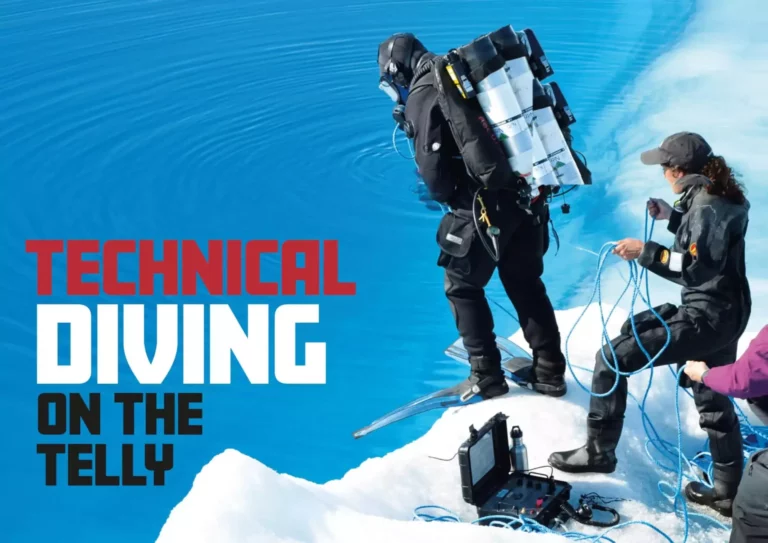

Andy Torbet discusses some of the main challenges that come with filming technical diving on TV productions.
Photographs courtesy of Andy Torbet
Technical diving, be it mixed-gas, closed circuit, overhead environment or a combination of all of these, requires a great deal more skill, knowledge, equipment, time and logistics compared to non-technical diving. When you add to that the requirement to produce a shot list of broadcast-standard footage often in dark, difficult locations, the technicality and planning rises dramatically.
Filming Technical Diving on TV Productions
In the world of TV documentaries, I have tended to be wheeled in for the more-technical and extreme filming projects. Be it free-climbing, ice-caving, high-altitude skydiving, wingsuiting, paramotoring or white-water kayaking. But diving has always been the thing I do most – and the thing I do best. So, I have been fortunate to be involved with many diving and filming projects since I first stepped foot in front of a camera back in 2011. And I have found the main problems we have faced while filming have fallen into two broad categories – time, and light.

Time Constraints in Technical Diving Shoots
When filming, whether dramas. movies or documentaries, you always want more time. One more shot, one more dive. On a larger scale, how much time you have to film is constrained by budget. We would all like weeks to ensure we have what we need, but we inevitably have days, or only a few dives. Or, more often, a single dive to achieve it all. The dive or dives themselves are further chronologically constrained by a number of factors that are more pronounced, or only applicable to technical diving.
Extreme Case Studies: From Greenland to Britannic
Time in the water is a consideration due to a number of factors and I have often found myself limited in filming time simply due to how cold the water was. On a science and filming expedition to Greenland, we were filming in a blue lake. These large pools of water form in depressions on the glacier where meltwater trickles in like hundreds of tiny rivers draining into a freshwater sea.
The water is only just above freezing (our dive computers actually read zero degrees C), crystal clear and from above look a spectrum of blues. The Arctic sun penetrates the translucent water and reflects offthe white lakebed. The difference in depth give blues from bright electric azure in the shallows to dark indigo in the deep sections. And we did get a view from above. The only way to reach these lakes with your dive kit is by helicopter.
“On a larger scale, how much time you have to film is constrained by budget. We would all like weeks to ensure we have what we need, but we inevitably have days, or only a few dives”
The second part of the expedition took us into the Arctic Ocean. Saltwater freezes below zero and at 30m, the waters around the iceberg read -2 degrees C on our gauges. Whether it was the zero degrees C of the Blue Lake or the -2 degrees C of the iceberg-cooled ocean, the extreme cold, coupled with the remote nature of our locations, forced us to keep dive time conservative with a 45-minute limit. As an example of how cold it was, and what a difference glove selection can make, on our first dive I wore 7mm mitts. My hands were relatively warm, even at the end of the dive, but working cameras and the sampling bottles I carried was difficult, so I swapped to 5mm gloves thinking I’d sacrifice a little comfort for the increased manual dexterity. I received nerve damage to the third and fourth fingers in both hands that left them numb for about six months. I went back to wearing the 7mm mitts on dive three.
But in some cases we could not carry out the filming within a short dive time. For the filming of Dive Odyssey 2018, we had to reach Hell’s Gate and Lucifer’s Pillar deep within Ojamo Mine. Ojamo is a deep, man-made complex of tunnels and chambers in Finland. The water clarity is incredible but is at its best in winter. A Finnish winter can be very cold. The air temperature only got down to around -18 degrees C, but it was enough to freeze the surface of the lake that is the entry point. Hell’s Gate and Lucifer’s Pillar are landmarks within in the mine that lie deep within, both in terms of distance from the entrance and in depth. To get there, even by DPV, film and return meant we were clocking up around two hours of dive time in 2 degree C waters and another two hours of deco in zero degree C waters (the nature of the freshwater in winter created a reverse thermocline). In fact, we often had to re-break the ice from beneath to get back out. These long run times in such frigid waters were only possible due to a number of logistical factors. Dry gloves, heated undersuits, a dry habitat at 6m for decompression, warm rooms on the surface and the use of rebreathers. Rebreathers were essential to reach the distances and depth, but they also have the benefit that, due to the breathing gas being warmed by your body and the exothermic reaction within the CO2 scrubber, the gas is warmer than that breathed from scuba. Every little helps.
The final chronological consideration, touched upon previously, is decompression. The number of dives you can make may be restricted by how much time of a filming day you’ll have to write offto simply hanging on the shot line or require between dives. We can, and have performed, five days a day in shallow, scuba shoots, being able to show the director what we have, discuss changes and go back in to gather more footage. However, deep, technical diving requires a more-planned response. Myself and the cameraman have to be very clear when we need to get in terms of shots. We may not get another chance.
While filming a BBC special on Britannic we had to undertake a dive to 120m. An hour on the ship meant around six hours of decompression. With the preparation beforehand this clearly meant one dive per day. Weather, budget and schedules created the circumstance where we only one day. So, one dive. Both myself and the camera operator had slated with multiple notes and shot-lists to ensure we got everything we needed in our 60-minute window.
“The number of dives you can make may be restricted by how much time of a filming day you’ll have to write off to simply hanging on the shot line or require between dives”
But sometimes this level of planning is not possible. On another BBC shoot we dived an unknown, undived shipwreck in the English Channel. We could make broad plans but we had no idea if it even was a ship since the mark had been discovered during a Coastguard survey and could have been an unusual-shaped rock. On the dive to 70m, on what turned out to be a World War Two merchant ship, we were forced to improvise. This is where an understanding of how a film is put together becomes essential. What shots do we need to tell the story. We knew we’d need to identify the ship to complete our tale, so focused on capturing footage of key diagnostics, e.g. me hovering by the anchor, sweeping shots to give an indication of the shape and size of the ship, as well as any stand-out features. And this all had to be completed in the 40-minute bottom time decompression and tides allowed us. But time wasn’t our only obstacle on this and other technical dive shoots.

The Challenge of Lighting the Depths
A camera, like the human eye, needs light to operate. Whether you’re 120m in the Aegean Sea filming Titanic’s twin or deep inside an abandoned mine or beautiful cave, one thing remains constant. It’s dark down there. Lighting the subject, whether myself, a wreck, mine or cave formation, can be one of the most-challenging issues we face. When we filmed Britannic, the cameraman carried large filming lamps but this 275-metre-long shot needed more than that and we were supported in this by a three-man submersible which hovered off the wreck and flood lit the area we were operating in.
In smaller caves and mines, myself and the camera operators I work with regularly have got into routines about where to places torches and lights to illuminate the environment for shots. We’ll often plan this in advance when we know the site or have had a chance to recce it.

This work tends to be shared between the camera operator and me as this type of technical diving, whether deep or cave, does not allow for the usual protocol of having multiple safety divers to assist. In the world of technical dive shoot, we need to streamline the team even if the equipment and time logistics have risen exponentially. Of course, there is always an exception.
In Ojamo, some of the chambers are huge. This was also an independent shoot, a group of friends creating something together rather than a job, so budgets were not an issue. For some scenes we had nine divers in the water. Two on cameras, two ‘actors’ in front of the camera and five divers acting as lighting, often carrying two large torches each with other torches being dropped in strategic places to light the background. Big, dark space, like big shipwrecks, need a lot of light.
I have always loved the technical, logistical and even mathematical challenges of technical diving. The insertion of filming requirements into this mix just makes the job harder and therefore, for me, even more interesting and attractive.
Why Technical Diving on TV Matters
It also has allowed me to showcase some of our incredible underwater landscapes, wildlife and heritage, from deep shipwrecks to flooded, subterranean labyrinths, to people who would otherwise never get a chance to see them.
Frequently Asked Questions
What makes filming to show technical diving on TV so difficult?
Challenges include limited bottom time, extreme cold, decompression obligations, and the lack of natural light at depth.
How is lighting managed during deep or cave dives for TV?
Divers use powerful lamps, strategically placed torches, and even submersibles to floodlight large wrecks or caves.
What safety measures are needed when filming technical dives?
Safety requires rebreathers, dry habitats for decompression, heated undersuits, and detailed shot planning to minimize risks.
Why is decompression such a major issue for filming dives?
Filming deep technical diving on TV often involve hours of decompression, which limits the number of dives per day and forces strict planning.
Has Andy Torbet filmed in extreme conditions?
Yes, his projects include dives in sub-zero Arctic lakes, deep shipwrecks like Britannic at 120m, and flooded Finnish mines.
Subscribe today with promo code DIVE1 — enjoy 12 months for just £1!
