PIERRE CONSTANT teams up with an instructor he introduced decades ago not only to diving but to swimming, and together they explore Japan’s volcanic Ryukyu island chain, commonly referred to as Okinawa
Kirin always loved the water. At the age of four he was brought along on one of the cruises I organised in the Galapagos Islands, and was not afraid to jump into the waves off the beach and splash around like a little puppy dog.
A few years later, he could swim 10m under water on a single breath. I introduced him to scuba diving in the Galapagos in 2005 when he was 17, and it opened a window on a new dimension for him.
Kirin decided to become a scuba-diving instructor. He worked for some time as a guide for Japanese divers on the Great Barrier Reef in Australia, learning English in the process. Because he was living in Japan with his mother, my son and I lost track of each other for many years after that. Life moved on irreversibly.

Japan is situated at the crossroads of four major tectonic plates: the Okhotsk (North American) Plate, to the north, the Amur (Eurasian) Plate to the west, the Philippine Plate to the south and the Pacific Plate to the east.
The Pacific Plate subducts beneath the Okhotsk Plate at the Japan Trench, creating a conspicuous earthquake epicentre on the east coast.
The Philippine Plate subducts beneath Central and Southwest Japan at the Sagami Trough, Nankai Trough and the Ryukyu Trench. This oceanic trench is found along the south-eastern edge of Japan’s Ryukyu Islands, in the Philippine Sea, extending from north-eastern Taiwan to southern Japan. This, in short, explains the volcanic nature of Japan.

It was a long overnight flight from Amsterdam. The plane landed at Tokyo Narita Airport in mid-morning. Expecting my arrival, Kirin was accompanied by his lovely seven-year-old daughter, all smiles. He was now 37, a professional underwater photographer and videographer, a rising star from Japan with many followers on social media.
Tokyo was an intimidating monster-city of concrete, steel and glass, with surprisingly clean and tidy streets, dotted with several parks and green areas. Our planned destination was Okinawa.
The dive-centre
It is 2,120km from Tokyo’s Haneda Airport to Okinawa in the south-west of Japan, a 150min flight on ANA’s B737. Away from continental Japan, this tropical world is part of the Ryukyu Islands chain, on the same latitude as the Philippines.
The climate is hot year-round, the ocean blue and sea surface temperatures average 27-29°C. There is no need for a wetsuit, although Japanese divers usually wear one.
Run by friendly Aki, Sawasdee Dive Centre was located in the heart of Naha, Okinawa’s capital city. The island was well-known for its various US military bases, though people didn’t really speak English there, but its development as a major international port was conspicuous.

I was to spend four days in Okinawa, including three full days of diving. Having worked in Okinawa years ago, Kirin was my guide and interpreter, and knew Aki very well.


Chibishi Islands
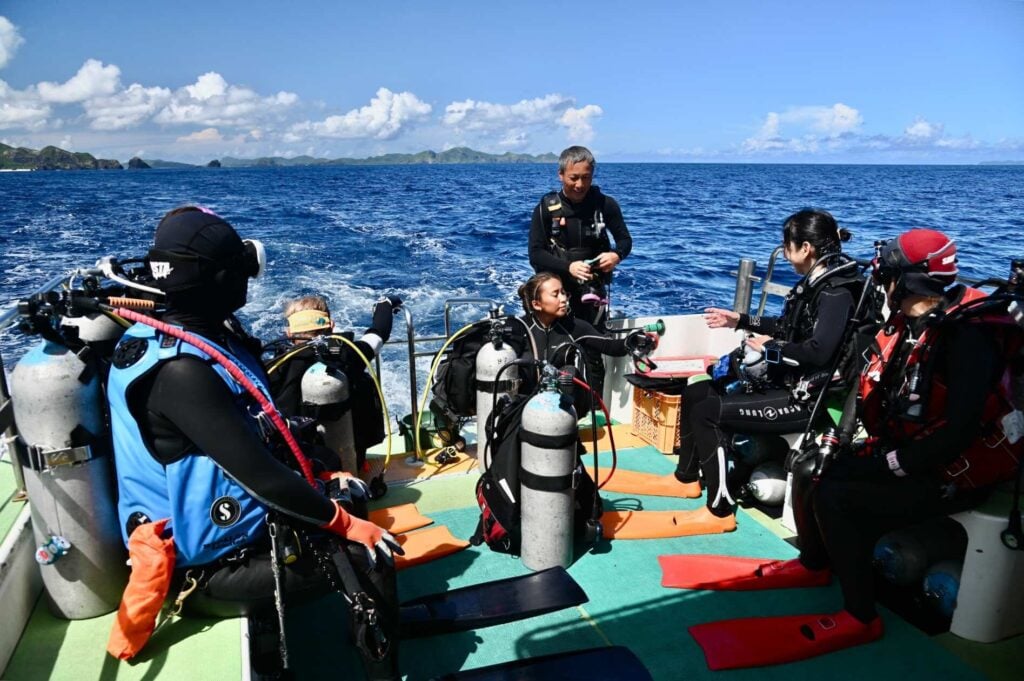
We set off to the Chibishi Islands on Sawasdee’s dive-boat, which could carry 10 divers. The Watermelon site was a succession of parallel coral ridges between white sandy channels at a maximum depth of 20m.
I immediately realised that the fish-life there was poor, consisting mainly of small reef fish, and probably the result of overfishing for the past 50 years, the big city being only half an hour away.
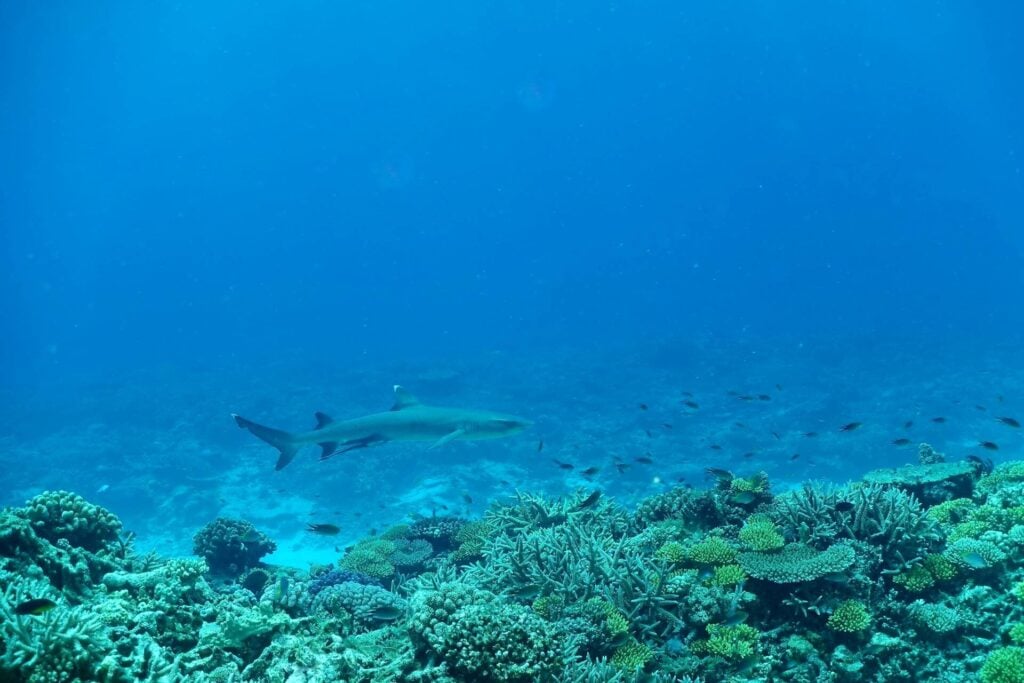
The coral was luxuriant, however, very healthy and colourful, with lots of table and staghorn corals among others, and the occasional gorgonian and soft corals. Whitetip reef sharks (Triaenodon obsesus) cruised by.


Particularly exciting was the presence of numerous Chinese sea kraits (Laticauda semifasciata, or irabu in Japanese), hunting on the reef and oblivious of divers. Although they carry venom stronger than that of a cobra, these light blue and grey-banded sea snakes are harmless to divers.
They might be attracted to you out of curiosity, but just give them space and avoid disturbing them. Because of their small mouth, the only place where they could possibly bite you is between the fingers!


Two dives took place in the morning, followed by a break on the boat. Everybody had brought their own bento box of lunch. A third dive was conducted in the afternoon, with charming guide instructor Anna, or with Aki himself. Most of the divers were women, except for Chohé, an energetic 83-year-old man.

Nagannu Island
Day two saw us travel further away, to the Kerama Islands, with a first dive at Nagannu Island, a white sandbar emerging above the surface.
I was graced by an encounter with a harlequin tuskfish (Cherodon fasciatus), a wrasse with grey and red bands, at the Nippulu Max site. An inquisitive Chinese sea krait foraging over sand provided photo opportunities with Kirin.


Kuroshima Island, on the next dive, was volcanic and rose picturesquely above the ocean. Its notable black cliffs were topped by green vegetation and grasses.

Under water the scenery was quite different, with walls covered in small orange soft corals, circular red sponges and gorgonians decorated with featherstars.
There were schools of yellowfin goatfish (Mulloidichthys vanicolensis), orange-rimmed batfish (Platax pinnatus), pinktail triggerfish (Melichthys vidua), clouds of damselfish, orange scalefin anthias (Pseudanthias squamipinnis) and parrotfish. The site seemed popular with other dive-boats.


Utchisan was a low-lying emerging rock near Kuroshima Island. It offered great visibility under water, with two very inquisitive giant jack (Caranx ignobilis) that had been fed in the past. “I almost lost a finger to one of these…” confirmed Aki, warning us to be cautious.

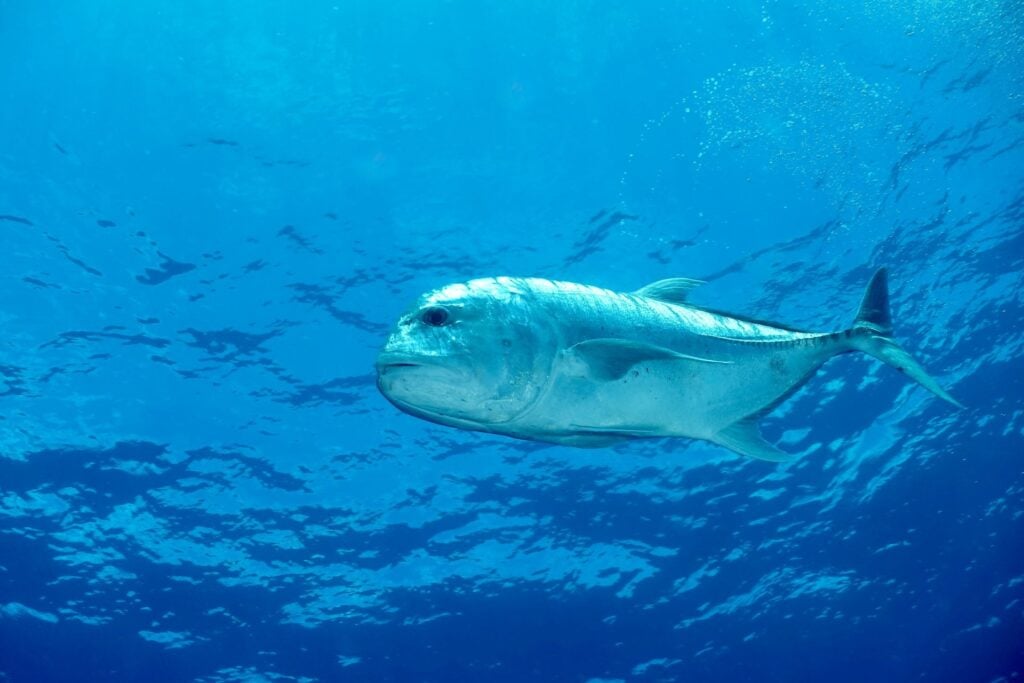

The highlight was a bommie, apparently a cleaning station for various species of fish. Approaching very closely without scaring them, I could see Pacific drummers (Kyphosus pacificus), oriental sweetlips (Plectorhinchus vittatus), eyestripe surgeonfish (Acanthurus dussumieri) and spotted knifejaw (Oplegnathus punctatus).

There was a yellowfin goatfish school, and a large school of paddletail snapper (Lutjanus gibbus) hovered in the background. My camera battery suddenly went flat, and I missed out on several good shots!

Back to Chibishi
A light rain welcomed us the next morning, and the ocean south of Naha was a bit choppy. Aki decided that our dives would be at the Chibishi Islands again, the coral garden on ridges with sandy channels between them.
We visited the Tachu site, where I took decent shots of the ringtail wrasse (Oxycheilinus unifasciatus) and the barred thicklip (Hemigymnus fasciatus), and the north side of Kuefu, the smallest of the three Chibishi islands.


Clockwise Okinawa
Before our return to Tokyo, the last day was dedicated to a little clockwise tour of Okinawa Island, with Kirin driving the minivan that Aki had provided for the occasion.
Travelling along the west coast, our first stop was at Cape Maeda. Cliffs of uplifted coral limestone, carved by sea action, were clearly visible, partly covered by green vegetation and pandanus trees. This was a popular shore-diving site for Japanese divers.

A little rain fell as we followed a trail to a viewpoint overlooking the ocean, complete with rainbow. A suggestive signboard warned of possible encounters with venomous snakes in the area.
The shoreline of Okinawa is very developed but a haven of peace is found on the east coast, with its fjords, saltwater lagoons and lush green forest.

A mangrove trail with a boardwalk skirted the coast, allowing the discovery of local fauna including birds, mudskippers and little red crabs with black claws. We ordered Okinawa soba noodles for lunch at a local place.


The farewell dinner with Aki, Kirin and the dive-group took place at the convivial Hamasaki restaurant, sharing the Okinawa rice wine Awamori and snacks before a selection of exquisite dishes and local specialities.
Okinawa might be a proudly independent part of Japan, but this was a memorable evening at a location in which enjoying good times is simply a vital part of Japanese culture.

Pierre Constant organises and leads trips with his company Calao Life Experience. Find many more of his extended dive-adventure features on Divernet.
Sawasdee Dive / Akinobu Tsuji, Naha, Okinawa (sawasdee-dive@hotmail.com)