
Dr Terry and Cathie Cummins embarked on a trip to Papua New Guinea’s on the liveaboard MV Oceania to experience Milne Bay diving, in search of some incredible diving opportunities – and they were not disappointed.
Why Milne Bay Is One of the World’s Most Diverse Dive Regions
After several trips to Papua New Guinea’s Walindi Plantation Resort in Kimbe Bay, we heard one of their liveaboards, MV Oceania, was heading to Milne Bay. We had no hesitation in booking flights through Port Moresby to Alotau, the capital of PNG’s southeastern province, which is nestled in a lush tropical landscape on the northwestern shore of Milne Bay. Here, after we boarded Oceania, we were about to experience incredible diving.
Milne Bay hosts one of the most-biodiverse coral reef systems in the world, with 253,000 km2 of sea country, which is largely protected by mountain ranges. So dives commonly take place in relatively calm waters, with unprecedented blends of reef, wall, drift, wreck and muck diving on offer. Topside we were constantly greeted by alluring islands with white sandy beaches, the ever-present locals in their dug-out canoes, and magical sunrises and sunsets.
Milne Bay Diving on the MV Oceania Liveaboard
Our first two dives were at Sullivan’s Patch. From this early beginning, we realized the startling diversity of marine life the region has to offer. In particular, the number of brittle stars, crinoids, sponges, nudibranchs and shrimp species we encountered on every dive was astonishing. At Sullivans, we dropped in on top of a sleeping epaulette shark and along with brittle stars, etc, we encountered magnificent coral cover, schools of anthias, damsels, fusiliers, chromis, coris, butterflyfish, several species of angelfish and crocodilefish.
After a wonderful lunch, our afternoon dive was at Wahoo Point. This proved be another very satisfying dive due to the multitude and various species of marine life we encountered.
Our buddy, John Russell, was a great addition to our underwater team as he constantly kept an eye out into the depths to sight any pelagics, sharks and manta rays that might appear. Meanwhile, John’s wife Linda was a wizard at finding scorpionfish, bubble coral shrimp, nudibranchs and other small critters for us to photograph.


Wall and Reef Diving in Milne Bay
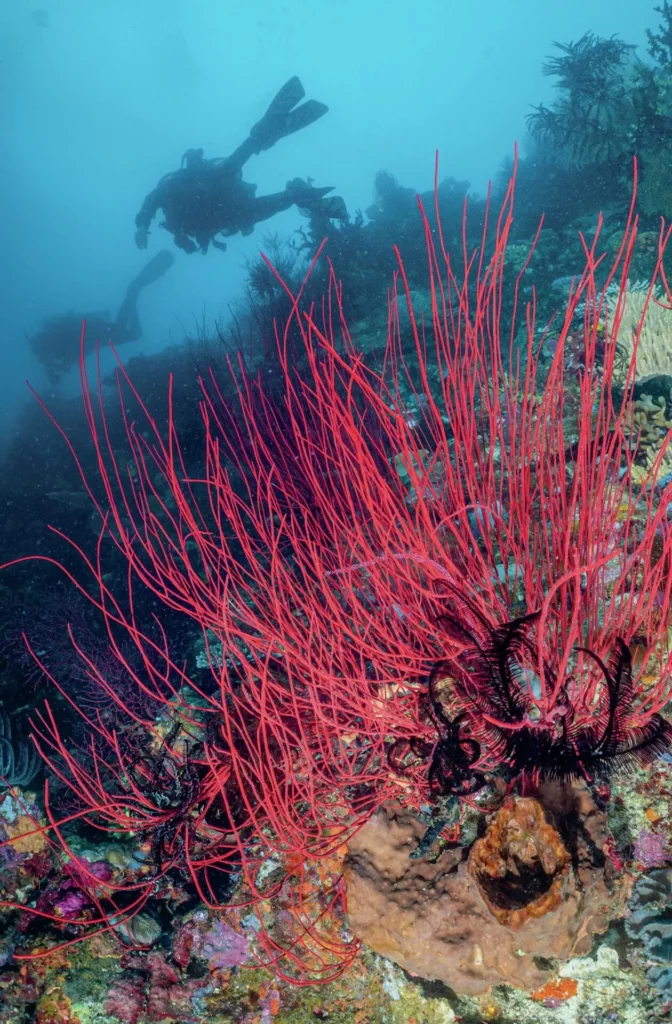
The afternoon found us moored at the Tawali Leisure and Dive Resort’s jetty. Here we enjoyed our first experience with a combination of muck and night diving. We needed to be cautious as the entire jetty was home to numerous lionfish and needle urchins and consequently not a place you want to be careless. However, what had our attention was the variety of nudibranch, shrimp species, small fish and colourful sponges that colonized the jetty poles. A rare treat was finding a pair of mandarinfish darting in and out of some coral rubble and on the sand, a mantis shrimp that is yet to be identified. The next morning we found ourselves at Deacons, named after diving icon Kevin Deacon. It is a fantastic wall dive characterized by large gorgonian fans, soft corals, giant barrel and elephant ear sponges. Some divers also call this site Barracuda Point because of the number of encounters with barracuda they have experienced.
The rest of the day progressed with more wall diving at sites like Sponge Heaven, with its small caverns harbouring a huge array of small fish species. Apart from the large sponges and gorgonian fans and magnificent coral cover, there were massive schools of various small fish species.
Did you know ?
Milne Bay is a world-renowned dive destination offering a diverse range of underwater experiences. It is well known for the excellent muck diving on offer, particularly at sites like Observation Point and Dinah’s Beach, which are teeming with macro life.
The next morning we were back on the reef at Waterman’s Ridge which has a beautiful arch and swim-through at 28m covered in gorgonian fans, whip and soft corals
John’s vigilances paid off with the sighting of a large hammerhead which appeared to be heavily pregnant.


Wall diving continued into the next day at Tanis Reef, Cobbs Cliff and Boia Boia Waga. At Tanis we encountered the usual flotilla of fish life but on one of the large gorgonian fans we found a pygmy seahorse, among a black coral a long-nose hawkfish, and a painted crayfish hiding in a crevasse. At Cobbs some of the divers came upon another hammerhead and had a passing glimpse of a swordfish as it zoomed across the shallows looking for a meal. The next day we had an open deck at Little China and a follow-up muck dive at Naukata. Apart from the usual marine life, at Little China we encountered stargazers, stonefish, rockmovers, and a pair of crocodilefish. While at Naukata, we were amazed by the variety of Nemos and coral shrimp species.
The next day we experienced a great dive among the giant fans at Shortland and while at Grant Island Bommie we experienced some of the best dives of our adventure. The 20 metre visibility made for a great vista composed of schools of rainbow runners, anthias, damsels, fusiliers, chromis, coris, butterflyfish and angelfish darting in and out of the giant gorgonian fans and barrel sponges. We also found a couple of moray eels hiding among the very healthy coral cover. In the afternoon we dived P38 – a World War Two USAF Lightning fighter that ditched after engine failure on a flight to Port Morsby in November 1942.
The next morning we were back on the reef at Waterman’s Ridge which has a beautiful arch and swim-through at 28m covered in gorgonian fans, whip and soft corals. A resident batfish and schools of rainbow runners also greeted us as we kept an eye out for the ever-present lionfish. Later that morning we dived Pinnacles which is a series of majestic peaks rising from 30m, with large gorgonian fans dominating the walls.
Milne Bay Muck Diving and Macro Life
After lunch we headed to Deka Deka, which could also be called Macro Heaven. Here we did two dives including a night dive. We photographed several flamboyant and broadclub cuttlefish. We also found several species of sea spiders, along with the illusive smooth beak crinoid and emperor shrimps.
The next morning excitement was running high as we reached Gona Bara Bara Island Manta Station. The station at 15m had a very slight current running so we comfortably squatted on the sand and waited. We passed the time by watching little hermit crabs, sand gobies and shrimp dart in and out of their communal home. A blue-spotted ray circled us that seemed to herald something was about to happen. Then a manta ray accompanied by several large remoras arrived, and wrasse and various chaetodons fed off micro parasites on his back and around his mouth. Remaining still, we spent over five minutes with this majestic creature.


Later that morning we continued diving in the Gona Bara Bara Island area. A portrait photographer’s dream as we encountered peacock mantis shrimp, pufferfish, banded pipefish, hermit crabs and had a rare encounter with a flying gurnard. Again Nemos, nudibranchs and lionfish were plentiful.
In the afternoon we dived P38 – a World War Two USAF Lightning fighter that ditched after engine failure on a flight to Port Morsby in November 1942
Next, we headed for another muck dive at The Baths on Samarai Island. Here we found flamboyant cuttlefish, stonefish, scorpionfish, pipefish and again numerous species of nudibranchs and Nemos among the decades of garbage thrown from the wharf.
The next day, more muck diving with an open deck at Bottle Shop also at Samarai. There we found more flamboyant cuttlefish, stonefish, scorpionfish, numerous species of nudibranchs and Nemos among the rubbish. We also found juvenile sweetlips, banded pipefish, flounder, an eagle ray, a wobbegong shark and the wreck of a small boat. Then it was back to The Baths for an afternoon and a night dive where we encountered the illusive coconut octopus, ornate and common cuttlefish, a false Mombosa lionfish, batfish and a school of razor fish.
Our last day of diving came far too fast and given some of the divers had flights the next day, we had scheduled only too early dives. So it was back to manta ray hunting at Gona Bara Bara and Kei Island. Both dives were full of wonderful encounters with the local marine life, including beautiful gardens of yellow soft corals, blue-spotted rays, sweetlips and a large cod. By now Oceania had all but circumnavigated Milne Bay and we were back at Alotau before dark to over-night before heading home. We cannot speak more highly of the entire Oceania experience and the wonderful old and new friends we had the pleasure of diving with. Next, we are planning to take the trip on Oceania from Rabaul back to Walindi Plantation Resort. n
Frequently Asked Questions
Where is Milne Bay located?
Milne Bay is in southeastern Papua New Guinea, near the provincial capital Alotau, and is known for its calm waters and rich marine biodiversity.
Why is Milne Bay considered a top dive destination?
Milne Bay offers an exceptional mix of reef, wall, drift, wreck and muck diving with both macro and pelagic species.
What marine life can you expect when diving Milne Bay?
Divers encounter manta rays, hammerhead sharks, pygmy seahorses, nudibranchs, cuttlefish, reef fish and rare macro species.
Is Milne Bay good for muck diving?
Yes. Sites such as Naukata, Samarai Island and The Baths are renowned for world-class muck diving and macro photography.
What is the best way to dive Milne Bay?
A liveaboard is the best option, allowing access to remote dive sites and a wide variety of underwater environments.
This article was originally published in Scuba Diver Magazine
Subscribe today with promo code DIVE1 — enjoy 12 months for just £1!
