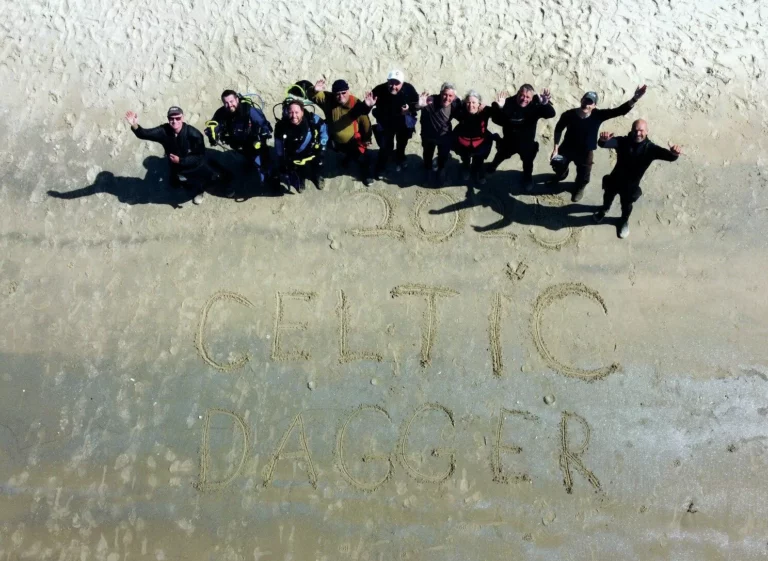
Monty Halls continues his inaugural Celtic Dagger Expedition to explore the origins of the British Commandos up in the wilds of Scotland, and Dean Martin was part of the team.
Read Part One of the Celtic Dagger Expedition 2025
Day Three – Where the Commandos Were Born
This was a trip out to see the actual house where the Commandos were formed. Inverailort House was requisitioned in June 1940 from a Mrs Cameron Head for the sole use as a training house, her one condition was as they were also going to bring a railway in from Fort William, she wanted her own stop on the line, and this was granted.
This train line was used on the first night of the selection process as the new recruits would arrive from wherever in the UK they were from, dressed in civilian clothes with suitcase in hand. The train would be made to come to an urgent stop miles away in the dead of night, they were bundled off the train and told to get themselves to the house in double quick time. If they were late, then they were immediately put back on the train and it was over.
Inverailort House and the First Selection
The house itself was chosen for its location of not only being at the top of the loch, but surrounded by hills and out of the way, so they could get on with the training and under the radar of the general population. The house has now fallen into a sad state and the current owner is trying to raise funds to bring it back to its former splendour. Just for reference, to show the calibre of recruits that went through this training for Commando selection, these guys were at the top of their game. Commando training consisted of an intensive regime of physical fitness and instruction in survival, orienteering and vehicle operation. This was alongside instruction on different weapons systems, demolition skills, close-quarter combat as well as amphibious and cliff assault. Any prospective Commando who failed to meet the standard was returned to their parent unit. The training was conducted with live rounds to simulate battle as effectively as possible. This realistic training led to the deaths of several trainees.

The Men Behind the Blade
Some of the names who are founders of the Commandos are William E Fairburn, Eric Sykes, Brigadier ‘Mad Mike’ Culvert, Lord Lovat, David and Bill Stirling, who would go on to form the SAS, and Alick Cowieson, who was instrumental in the creation of the Dark Mile training route.
It was at this house that the recruits were first introduced to William E Fairburn and Eric Anthony Sykes, the namesakes of the iconic Fairburn Sykes Commando knife. These two middle-aged gentlemen looked very unimposing, but little did the new recruits know that these two guys had, for the last 30 years, worked for the Shanghai Municipal Police in China. Close armed combat was their speciality, and the now-famous dagger was inspired by the fighting knives used in Shanghai.

The Origins of the Commando Dagger
All this was made clear on our return to the great house, as David had prepared a little history lesson on the Commando knife’s origin by laying out part of his vast collection. He went on to explain how Fairburn and Sykes went to see Wilkinson and Sword to show them a prototype to see if they could mass produce these knives, and the progression was made to version two, and then on to what is used today, version three.
After the presentation and history lesson of the conception of the Commando dagger, we were then invited into the dining room for what can only be described as a feast, not only to the eyes but also the palette. David had laid on a banquet of some of the very best on offer, all locally sourced seafood and amazing claret. We were truly spoilt. Great conversations and in such an amazing setting.


The Celtic Dagger expedition team
Monty Halls, Greg Lander Williams, Dean Martin, Michael and Nicola Slade, Luke Hammond, John Davis, Damien Love, David Rae, and Mike Sheedy.
Day Four – A Moment to Breathe
Today was all about just getting on the water and the team having a day out to enjoy the scenery of the west coast of Scotland. We loaded up the cars and truck and made our way over to Lochaline to meet up with Malcolm of Lochaline Boat Charters and his boat Peregrine – ropes off at 9am, so not such an early start. We loaded the boat and headed up the Sound of Mull to the dive site, with sea eagles above and the rolling hills all around.
Diving the Sound of Mull
The dive site was a nice little reef, easy and not taxing in any way. There was very little current and just a small amount of detritus in the water, but on entering the visibility was an easy 15 metres. The dive was a gentle one, with a silty seabed prime for those famous king scallops we all know and love, so it wasn’t long before both my drysuit pockets were full. I was hoping some of the other divers had the same idea and had a catch bag with them should the opportunity arise – and of course they did.
The dive was such a scenic one and as Monty was carrying his camera, right at the end of the dive, I noticed a huge barrel jellyfish just mid-water and with the great visibility, the light penetrated straight through, lighting it up. It was stunning to see and almost hung around waiting to be captured on film. We made our safety stop and surfaced under our SMB to the boat on its way over under Malcolm’s trusty hands. We motored up to go past Tobermory and to see the sights of apparently famous Tobermory Waterfall – sadly, as May was such a dry month, this year it was barely a trickle, but we did laugh at Malcolm’s enthusiasm. Or was he just pulling our legs?


As we made our way back to Lochaline, Malcom dropped a fishing line in with a few feathers on and quickly pulled in three large trout. He kept these to one side and informed everyone to keep a look out for sea eagles and, if we spotted one, to let him know. Not long after one was spotted overhead and Malcolm stopped the boat, informing everyone to get their phones and cameras out. He threw a fish into the air, and it landed not even eight metres from the side of the boat. We watched as the sea eagle made its approach, swooped down and, in one movement, grabbed the fish from the water and then flew away with it gripped tightly in its talons to its nest to feed its young. Not long after another two did the same, and to see this up so close was an amazing sight. Just the sheer size of their sometimes up to two-and-a-half metre wingspan was awe-inspiring.
Then it was back to base for dinner. The evening was finished off by Greg with an insight into what it took to film the BBC series Commando, as he spent time with new recruits and old members alike learning what it meant to them to be a Commando. He was even given a green beret from Monty as an achievement, as he not only did the big runs and marches with the recruits, but he did it filming them along the way with camera in hand.


Day Five – Paying Respect
A little later start today as first we had to get some more filming with the Dacia Dusters and team shots, then on to Achnacarry and the Commando Memorial. Achnacarry Castle is the ancestral seat of Sir Donald Walter Cameron of Lochiel and was brought into use as part of the new Training and Holding Wing for the Special Training Centre Lochailort, due to the imminent closing of STC Lochailort and the realisation that a centralised training establishment was needed to train the potential Commandos.
We started the walk from the Cameron Museum adjacent to Achnacarry Castle and then walked along Loch Locky to the Commando Memorial at Spean Bridge, a walk of just under six miles. We even had an attempt at speed marching on the way, and let’s just say I like a stroll, but that is next level to keep up that pace.
The Commando Memorial at Spean Bridge
On reaching the Commando Memorial, I was lost for words. For one, it’s a very impressive sight, with three Commandos in full battle dress – one even has his Commando dagger on his right leg and each has an Enfield rifle over their shoulder. The monument plaque states ‘In memory of the Officers and Men of the Commandos who died in the Second World War 1939-1945’, and it has the inscription of Unite We Conquer.

What the Celtic Dagger Revealed
We spent a little time reflecting on what we had learnt over the past week, from the time exploring on the beach and running the surveys of the seabed, to the presentations from Monty on the history of the Commandos, the film from Greg on his insight into the current training that exists for the Commando selection having spent time filming series for the BBC, to the talk from David on the Commando dagger. It put it all into perspective of the part of the story that is missing from history.
Join the 2026 Expedition with Monty Halls
With thanks to: www.dacia.co.uk | www.kinlochmoidart.co.ukwww.lochaline-boats.co.uk | www.dynamicnord.com
Frequently Asked Questions
Where were the British Commandos originally formed?
The first British Commandos were formed at Inverailort House in Scotland in 1940, where recruits underwent extreme live-fire training.
Who designed the Commando dagger?
The Fairbairn–Sykes Commando dagger was developed by William E Fairbairn and Eric Sykes, drawing on their experience in Shanghai.
Why was Commando training so dangerous?
Training was conducted with live ammunition to simulate battlefield conditions, resulting in injuries and fatalities among recruits.
What is the significance of the Commando Memorial?
The Commando Memorial at Spean Bridge commemorates the officers and men who died serving as Commandos during World War Two.
What was the aim of the Celtic Dagger Expedition?
The expedition sought to uncover physical and historical evidence of early Commando training through diving, research and exploration.
This article was originally published in Scuba Diver Magazine
Subscribe today with promo code DIVE1 — enjoy 12 months for just £1!
