
We chat to Stephen Frink, undoubtedly one of the world’s most-frequently published underwater photographers, about some of his most-memorable exploits, and what it is like to be at the helm of DAN’s Alert Diver magazine.
Early Years: From Competitive Swimming to Scuba Diving
Q: As we always do with these Questions and Answer sessions, how did you first get into scuba diving?
A: Accidentally, as is the case with many good things in life. I grew up in Illinois, far away from water. Unless you count the Mississippi River and its six inches of vis. But I was a competitive swimmer all the way through college, so all things aquatic had appeal. Especially scuba diving, with that hook planted by watching the exploits of Mike Nelson on the old TV series Sea Hunt. It wasn’t a motivating passion, though, at least not enough to go get certified until I was in graduate school in California. Each day I drove by the Long Beach Marina on my way to classes, I saw a sign. Scuba Duba. I didn’t know what they did, but I needed a part-time job, so I stopped in. They were a service that cleaned boats, and they needed some help. But, in order to be hired, I had to be a certified scuba diver. I took the course and got the job. I became a scuba diver in 1971 for the 25 cents a linear foot they paid me to scrape the barnacles off boats.

Discovering the Camera: Stephen Frink’s Path Into Underwater Photography
Q: When did you first get into underwater photography? Were you already a land photographer and took your interests with you as you entered the realm of diving?
A: My Master’s degree is in Experimental Psychology, but honestly, I wasn’t all that interested in it by the time I got to graduate school. I’d finished up my course work but was still working on my thesis, which meant I had some time to spare. I enrolled in an elective class in basic photography, with an emphasis on black and white and darkroom work. The alchemy of it all intrigued me, working under the amber safelight and seeing a print emerge while gently rocking a tray of Dektol. Photography became my passion, and in the year I had left to finish my thesis, I took every photo class they offered.
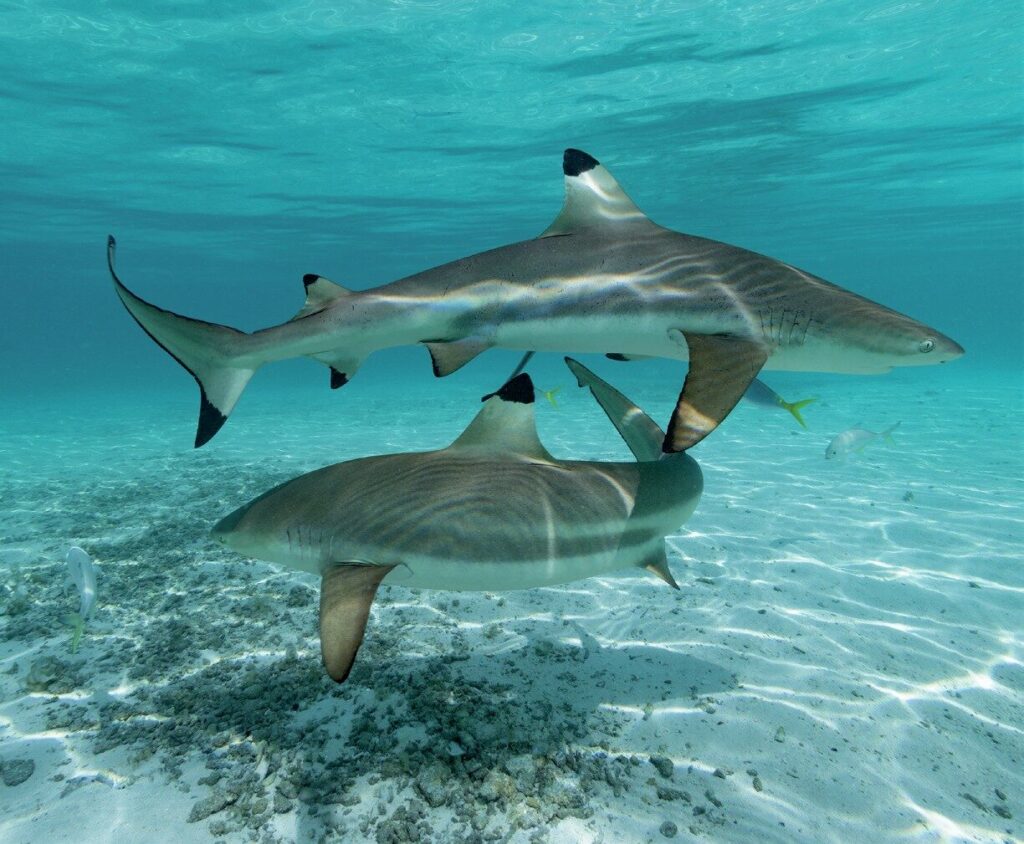
As a curious aside, my thesis advisor took me aside one day and told me he knew I wasn’t into psychology and seemed to be more interested in scuba diving and photography. I still needed a thesis topic and he said he could arrange an interdepartmental program with Dr Don Nelson, who I later found out was a very famous shark researcher. In our interview I asked what he needed his research assistants to do. He said he had a hypothesis that when sharks are poised to attack, they dropped their pectoral fins and arch their backs, and to study this behaviour they were chumming for blue sharks in the open ocean near Catalina. I had the thought that being the guy in the water whose job it was to piss off a shark wasn’t all that bright. Of course, I’d do it today, but at the time that seemed a scary prospect. So, instead I studied the effects of ‘Acoustic Confusability on Short Term Memory’. After the numbing boredom of that, most any job would have been better.
Film, Darkrooms and the Nikonos Era
Q: You started in the world of underwater photography way back in the late 1970s, in the days of film cameras and E6 processing, and have seen digital technology from its infancy to where it is now. What have been the biggest changes for you as a professional shooter?
A: My early career was more in the darkroom end of things. After I got out of graduate school I moved to Kona, Hawaii for a while and had a job at night shooting tourists at luaus. I’d take the pictures of a Polynesian model putting leis on the necks of tourist. Someone else would make prints at night. Someone else would have them for sale the next morning in the hotel. That gave me the whole day off so I would go shore diving. By then I had a Nikonos II and a 35mm lens, but no strobe. Your can imagine my photos in the era were pretty monochromatic and miserable, but just taking a camera underwater was a revelation.
We didn’t know each other then, but Chris Newbert was in Kona at the same time. He was waiting tables at night and doing underwater photography with his Canon F1 in a housing and Oceanic strobes. He was coming home with the seminal photos that eventually became ‘Within a Rainbowed Sea’. I was shooting roll after roll of crap.
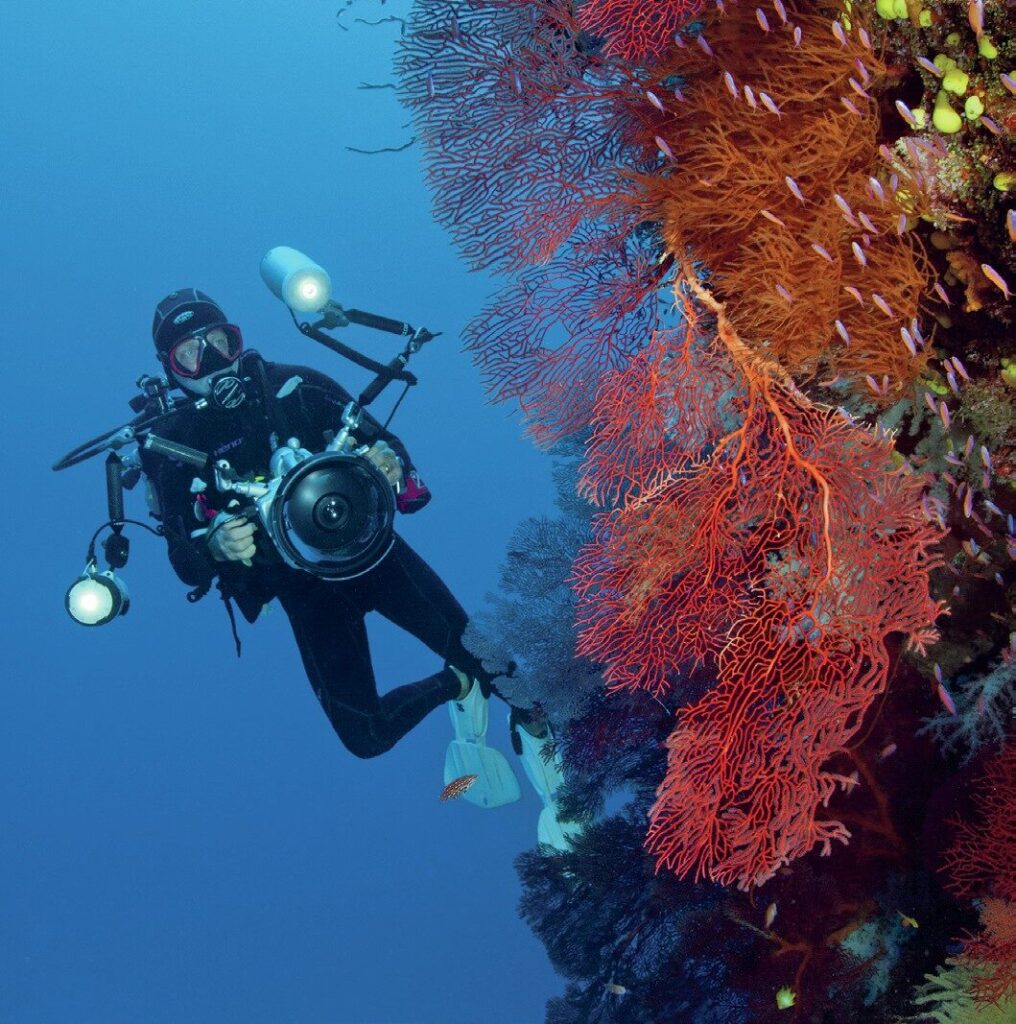
Actually, I pretty much dropped out of diving after that. I moved to Colorado and got a job as a custom colour printer at a commercial and advertising photography studio, making large Type C prints. But, a buddy of mine from the swim team who came to dive with me in Hawaii wasn’t ready to be done with diving. He moved to Key Largo, Florida and got a job as a salvage diver on the shipwrecks of the 1733 Spanish Fleet. They were still finding silver on the wrecks at the time and employed grunt divers to go fan sand and hope to locate a coin. I came to Key Largo to visit him in 1978 and looked around the town. No one was renting cameras to the tourists and I also saw an opportunity to process E-6slide film for them. Underwater photography was a novelty then and for the most part, people didn’t own their own cameras and E-6could be done the same day, unlike the Kodachrome process that had to be mailed away. I met the guys at Ocean Divers and asked them if I could come back and rent a corner of their dive shop for a darkroom and retail counter. They said OK, and by November of 1978 I had moved to Key Largo to give underwater photography a try.
The Digital Turning Point in Underwater Imaging
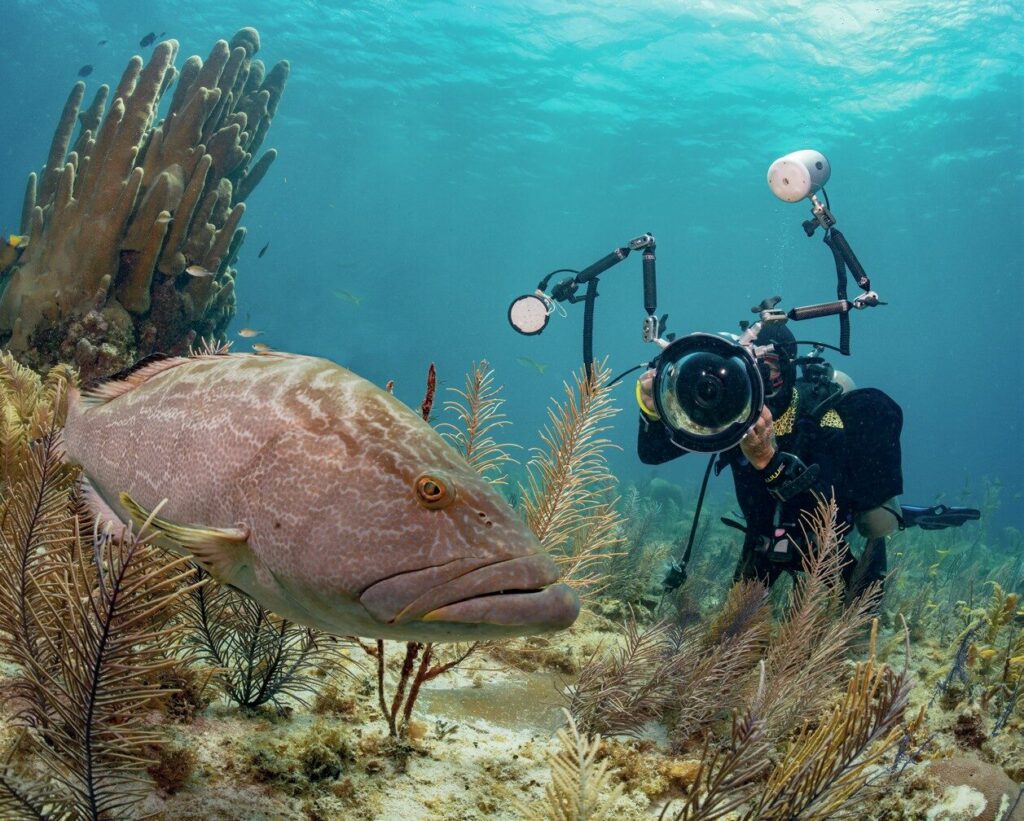
But, that’s not the question you asked. You asked about digital technology. That was the watershed moment in underwater imaging, as it provided immediacy of review. I had that in a small way when I was learning underwater photography in Key Largo. Remember that when I moved there it was for camera rentals and film processing. I wasn’t a pro shooter. I’d never shot macro or wide angle or even used a strobe underwater, But, I did have the opportunity to dive any time I wanted to with my pals in the local dive industry – Ocean Divers, Quiescence, and Atlantis. So, I could shoot a lot, process my film right away, and learn to do it better the next day. That’s what digital brings to the (light) table. You can see it at the point of exposure, and easily study and improve it on the computer screen immediately. RAW photos have far more exposure latitude than slide film, and there is no ‘range anxiety’ (to use an electric vehicle metaphor). My first serious housed camera was a Sea and Sea for a Bronica C, a 2 ¼ x 2 ¼ format that gave me 12 exposures. 12 exposures on a dive versus the virtually unlimited capacity from a digital capture system. That alone is another huge benefit.
I migrated to 35mm film eventually, using EO (Electro Oceanic) connectors on each camera so I could carry three cameras on a dive but only a single strobe that I could wet-connect underwater. But even so, 36 x 3 = 108 exposures isn’t much compared to what a digital shooter will get these days. The whole package of immediacy of review, shoot capacity per dive, exposure forgiveness of RAW, and ease of archiving so thoroughly subsumed any value there might be to film. Plus, the ecological waste of film and chemicals was pretty clear to me by having a film processing lab and worrying about what waste might do to the fragile corals offshore. I wasn’t the earliest adapter. I give the nod to James Watt for that. But, by 2001, the digital die was pretty well cast for me.
From Local Assignments to Global Dive Travel
Q: You spent many years on assignment for Skin Diver magazine, and later Scuba Diving, as well as contributing to many other titles – including my old title Sport Diver UK. What have been some of your favourite destinations, and why?
A: Actually, my first magazine gig was with another Sport Diver, the old title published by Richard Stewart in Miami. They had been blown out with gusting winds while shooting Marathon for a Florida Keys article, and I think they assumed that if I had a photo studio I must know something about underwater photography. I’d never shot wide angle by then, and certainly never with a model. But, I knew the magazine and what kind of photos they expected. So, I borrowed a Seacor 21mm lens from a friend, and a dive instructor from Ocean Divers travelled with me to Marathon to shoot. When I took the vis sheet of processed slides to Miami for review they liked them and asked if I could go to the Caymans for them the next month. In that moment I transitioned from operating a retail store with film processing to being a freelance underwater photojournalist. I did both, but eventually photojournalism and stock photography became my emphasis. With Miami as my gateway, my beat was the Caribbean. Cayman, Bahamas, Roatan, St Lucia, Bonaire, and obviously the Florida Keys. I did that for three years until the magazine folded and then I called Bonnie Cardone at Skin Diver to see if they had any work for me. They did, for the next 17 years actually, and then for Rodale’s Scuba Diving for another ten years. My beat remained much the same. I travelled the Caribbean quite regularly, and the diving was pretty amazing back then. The Florida Keys had the fish, but everywhere else had the visibility and walls.
They had been blown out with gusting winds while shooting Marathon for a Florida Keys article, and I think they assumed that if I had a photo studio I must know something about underwater photography
Yet, there was still a ‘sameness’ to it. The same fish anyway. No one was going to send me to the overseas exotics on assignment, and I couldn’t really afford to go on my own as a tourist. So, I took the plunge. In 1982 I chartered the Sunboat in the Red Sea for my first commercial travel project. I don’t know how I sold it out, but I did, and with even the first splash I was blown away. I had in mind I wanted to photograph a clownfish, a lionfish, and a model with red soft coral like the photos I’d seen from Rick Frehsee and Sari Gains back in the day. I had a week to make that happen.
On my first dive in the Red Sea I had opportunities for all three subjects, and that started a decades-long fascination with global tropical dive travel. My travel company, WaterHouse Photo Tours, typically hosts three exotic trips each year to the most-iconic general dive destinations… Indonesia, Palau, Philippines, Maldives, etc. But, we also do species-specific trips. Moorea or the Silver Bank for humpbacks. South Australia for great white sharks. That kind of thing. Typically we identify a target, it could be macro, beautiful coral reef, megafauna, etc. Once we decide what we want to shoot, we pick the best places on the planet that present those photo-ops.
Read Part II of this interview
Frequently Asked Questions
Who is Stephen Frink in the diving world?
Stephen Frink is one of the most-published underwater photographers in history and a former Editor-in-Chief of Alert Diver magazine.
When did Stephen Frink start scuba diving?
He began scuba diving in 1971 while working on cleaning boat hulls in California during graduate school.
How did Stephen Frink get into underwater photography?
He started with basic photography classes, later combining diving and photography after moving to Hawaii and Florida.
What cameras did Stephen Frink use before digital photography?
Frink used Nikonos cameras, medium-format Bronica systems, and later 35mm film with underwater strobes.
How did digital photography change underwater shooting for professionals?
Digital allowed instant review, higher shot capacity, RAW flexibility, faster learning, and eliminated chemical waste from film processing.
This article was originally published in Scuba Diver Magazine
Subscribe today with promo code DIVE1 — enjoy 12 months for just £1!
