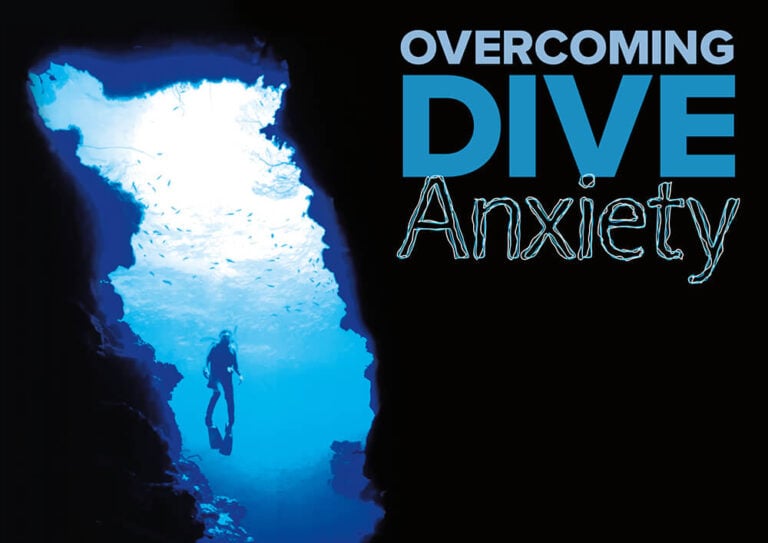
Dale and Kim Sheckler offer some sage advice on building your confidence underwater,and overcoming any dive anxiety.
We live in a world of worry. Society has never been so anxious. We are constantly bombarded with messages promoting worry. Underwater, the world melts away. Gliding through a forest of kelp, over colourful coral reefs or moving along with the fish -it can all be so relaxing.
Anxiety, Fear and the Diver’s Mindset
Another way diving brings us away from a stressful world is the excitement it can provide. There are those dives where we are well within our skill and comfort level and we just cruise along in a state of bliss. But then there are also dives where we push the envelope.
We may be going deep or hit heavy currents. It can be very thrilling and get the heart racing. But always in a controlled fashion. Diving can also be an extreme sport depending on your tolerance and skill level.
Does fear have a place in diving? Yes. Fearfulness must be controlled and minimized but just a very small touch heightens the senses, peaks mental awareness and makes you proceed with proper caution and preparedness. But fear and anxiety are NOT the same thing. Does anxiety have a place in diving? No. Whether you are in it for the thrill or for peace, or both, worry need not be a part of it. Anxiety robs us of diving pleasure and thrill. Let’s make sure that does not happen. Here are a few tips to eliminate anxiety in your diving:
Preparing Properly Before the Dive
Being anxiety-free in the water begins out of the water. Pre-dive prep is important. Take your time packing. Get a good night’s sleep. Hydrate. And arrive at the boat early. Assemble your gear early, preferably even before the boat leaves the dock. And take proper seasickness actions.
Training and Skill Development
Up your skill level
If you are just a basic Open Water certified diver, and you plan on diving more, it is time to enroll in an Advanced Diver certification class. Advanced classes are not commandolike training. It will simply put you into more complex diving situations that not only increase your skill level, it will give you an increased level of confidence in the water. And all of this under the watchful eye of a qualified instructor.
Other classes to consider after an Advanced Diver course would be Deep Diver, Nitrox (less worry about the bends), and Rescue Diver.
Practice makes perfect
Or better stated, perfect practice makes perfect. Review your skills in a controlled environment, either in a very calm shallow location or preferably in a pool. Ideally an instructor should be supervising and providing tips.
For a better golf game, you hire a golf pro for tips on form. The same goes for tennis. Even veteran professional sport athletes understand the value of a coach to analyze batting and pitching. A ‘coach’ in the form of a dive instructor or Divemaster is invaluable.
If it has been a few years since your last dive, and especially if you are only a basic Open Water certified diver, there are some skills very much worthy of review. They include, but not limited to, mask flooding and clearing, kick style, and neutral buoyancy techniques. A brief refresher course is your best option.
Dale and Kim Sheckler offer some sage advice on building your confidence underwater, and overcoming any dive anxiety

Choosing and Using the Right Dive Gear
A lot divers experiencing anxieties in the water are for the simple fact of equipment problems. Probably the most-critical piece of gear that causes more anxiety in the water than any other is a dive mask. A mask must fit properly. The best place to choose a mask that fits you properly is at a professional dive store with the help of a good pro.
You should be able to press the mask to your face to form suction. And this is done without the strap on or without sucking in through your nose. The mask should stay on for several seconds even if you face downward looking at your feet.
Many divers get the right mask but do not defog the mask ahead of time. Not being able to see out of your mask is not just an annoyance, it can cause safety problems. Give your mask lenses a good initial treatment with toothpaste and then use defog between each dive. Other equipment must fit properly as well. Wetsuits should fit close to the body but not constrict the chest or around the neck. Too tight a wetsuit and breathing will be restricted, and a tight neck will limit circulation. If it has been a while since you have been diving and perhaps gained some weight, you might want to consider a larger wetsuit or having your wetsuit let out by a custom wetsuit manufacturer.
Make sure your BCD is properly fitted. Too sloppy and the benefits of using your BCD on the surface for flotation will be lost. To tight and it will constrict movement or breathing.
Ill-fitting fins are murder over multiple dives causing cramping and chaffing. Too many divers skimp on fins. Function is nearly as important as fit. Get out your wallet and spend a little extra on quality fins. You won’t regret it, especially if you find yourself in a heavy current or during a long swim back to the boat or shore.
Keep your gear simple
Keep your dive gear simple, especially when you are getting accustomed to new tasks and conditions underwater. For example, do not purchase a tremendously complicated dive computer when you start and all you plan on ever doing is a basic sport diving profile. The computer should be user intuitive much like a simple phone app. While you need to thoroughly review and understand the manual, you also should be able to flip through the computer’s functions with little mental effort. Don’t over-equip. Too much gear clutters your body and your mind. Do you really need that light clipped to your chest? Carefully consider what accessories you truly need.
Know how to use your gear
Rental gear is usually simple and easy to use, but even so you must know where everything is and how it functions. You usually do not have the luxury of pool trial grounds, but you can most certainly do a dry run-through.
A surprising number of divers simply do not know how their dive gear operates. This is most prevalent in how to use a dive computer. Read the manual. While still dry run through each feature. Some computers even have a simulated dive mode.

Most divers, however, get uncomfortable during a dive in that they do not understand how their BCD functions. And the most-important function with a BCD is simply knowing how to inflate and deflate it. Again, a dry run through before you ever hit the water is a must. Pool trials are best. If a pool is not available, get thoroughly familiar with your BCD first in a shallow calm water ocean dive.
Equipment Organisation and Familiarity
You might be very familiar with how your BCD functions but if you can’t find the inflator when needed it does you no good. Keep that inflator close to your body, not floating over your head. The same is true for your gauge console. Again, keep it close to your body so that at a moment’s notice you can find it to check your remaining breathing gas, computer or compass. And especially critical is having your safe second in the same spot every time, ready and handy.
Other items that need to be properly secured in good locations are your snorkel and DSMB.
Weighting, Buoyancy and Physical Control
One of the least-understood techniques and skills in sport diving is proper buoyancy. For maximum comfort and efficiency you need to be neutrally buoyant at the surface at the end of your dive with 50bar left in your tank. This means the water surface should be, as you are vertical in the water column, at eye level. You will rise slightly with inhalation and sink slightly when you exhale. This is the ideal but frankly not always possible. There are a number of mitigating factors that make this difficult. First, with a new or unfamiliar wetsuit it is difficult to estimate proper weighting as a starting point.
There is an old rule that states that, with a full 7mm wetsuit (typical to California diving), you start with 10% of your body weight. If you weigh 90kg, start with 9kg of lead. But this an extremely rough estimate. Many other factors come into play — type and size or tank, body composition and make up of dive gear. Trial and error is usually the case, but the point is you need to fully understand your weighting needs in controlled, easy and calm conditions before heading off into more-complicated underwater excursions. The temptation here is to overweight yourself. Use caution.
Staying Within Your Comfort Zone
If you can think you can handle yourself in metre-high surf, cut that in half to 50cm… or maybe even just 25cm. Generally a basic Open Water Diver certification limits the diver to 18m deep. Stay within 12m. Diving less than your certification level multiple times will make it easier and calmer to take it to that 18m level.
Keep it slow
While there is no reason to dilly-dally, you should take your time before hitting the water. Do not let the boat crew or your buddy rush you, even if that means you are the last ones off the boat. Pace yourself. Once in the water take the time to regain your composure after your giant stride. Breathe. Take your time.
Thoroughly check all your gear making sure it is still in the right place before you descend. Relax your breathing and descend slowly so as to equalize. Once on the bottom pause and again relax your breathing. Take several minutes if needed. No need to rush. Check all your gear if it still in place. Yes? Enjoy your dive.
Fitness, Experience and Focus
Get in shape
Cardiovascular is the most important, and for the diver there is not better activity than swimming. It is low impact and works the muscles that are most needed by divers. Second choice is simply brisk walking.
Dive a lot more
This may sound obvious but do so in the right circumstances. Gain experience by diving with experienced divers. There are two places to gain this. Join a dive club and sign up for group specially dive classes.
Focus on the task at hand
It is here that a dive plan is critical. What is the goal of your dive? What is your ‘task’ underwater? Once are you are settled comfortably at your spot hovering over the reef move into task. Photography? Find a subject, even if it is a simple one, and shoot away. Go on the hunt for lobster. Move toward your compass destination. With a plan and proceeding forth with that planned task, it will occupy your mind in such a way that there will be little time for an anxiety attack.
For the anxious diver it is usually what is rolling around in your brain, not all those other components that make up a dive. Slow down and take your time but at the same time be focused. Clear your mind of what is worrying you – take it slow, but dive with a purpose and a plan. n
Frequently Asked Questions
Is anxiety normal when scuba diving?
Mild apprehension is normal, but ongoing anxiety has no place in safe or enjoyable diving and should be actively addressed.
What is the difference between fear and anxiety in diving?
Fear sharpens awareness and caution, while anxiety undermines confidence, enjoyment and decision-making underwater.
Can better preparation reduce dive anxiety?
Yes. Proper preparation, rest, hydration and early gear setup significantly reduce stress before entering the water.
Do advanced dive courses help with anxiety?
Advanced and specialty training improves skills, situational awareness and confidence, reducing anxiety in challenging conditions.
How does equipment affect underwater anxiety?
Ill-fitting or unfamiliar equipment is a major cause of anxiety. Proper fit, simplicity and familiarity are essential.
How does experience help anxious divers?
Regular diving in appropriate conditions builds confidence through familiarity and controlled exposure.
This article was originally published in Scuba Diver Magazine
Subscribe today with promo code DIVE1 — enjoy 12 months for just £1!
