The Wildlife Photographer of the Year competition is a much-anticipated annual treat for nature-lovers. Underwater photographers have done well in scooping top prizes in recent years, although this year it is a ghostly shot of a rare hyena that has pulled off the big prize and topside photographs predominate among the winners.
Fortunately the competition organiser London’s Natural History Museum (NHM) has also shared with Divernet a number of Runner-up and Highly Commended underwater images that go to make up its 61st portfolio – and the exhibition that opens shortly.
Winning shots were selected from a record-breaking 60,636 entries from 113 countries and territories. The 19 category winners and overall winners of the contest were announced at an awards ceremony at the museum last night (14 October).
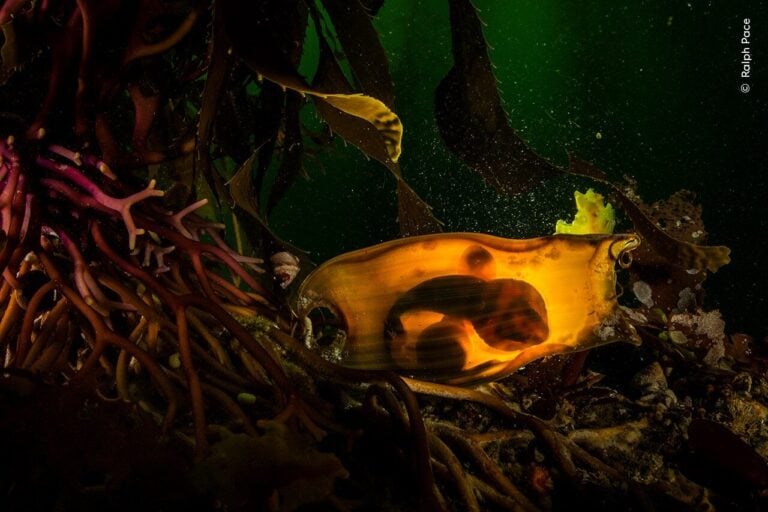
US photographer Ralph Pace won first place in the Underwater Images category with Survival Purse, his “beautifully illuminated” swell shark eggcase tethered to the base of a giant kelp, shown above.
In the strong currents of California’s Monterey Bay, Pace says he struggled to keep steady enough to photograph the mermaid’s purse, but by lighting it from behind managed to reveal the embryo within, its gill-slits and yolk sac clearly visible in the dark kelp forest.
Researchers estimate that the bay’s kelp forests have declined by more than 95% over the past 34 years. With swell sharks dependent on kelp to lay their leathery eggs they are especially vulnerable to such losses.
(Taken with a Nikon D850, 28–70mm f/3.5-4.5 lens, Nauticam housing; two Sea & Sea strobes. 1/125th, f/14, ISO 640)
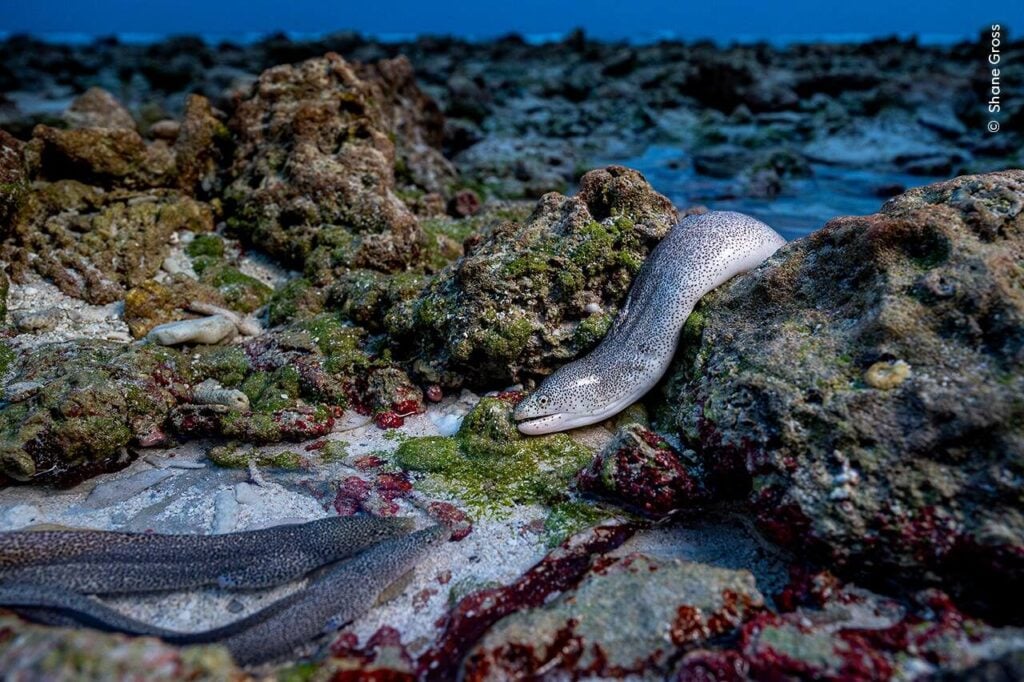
Like An Eel Out Of Water by past winner Shane Gross from Canada topped the Animals in their Environment category and, while not an underwater image, will intrigue divers more accustomed to seeing moray eels leering from holes in the reef.
In the photograph peppered morays provs very much in their element as they scavenge for dead fish at low tide. According to Gross it took numerous attempts over several weeks on D’Arros Island, Amirante in Seychelles to document this rarely photographed behaviour.
His patience was rewarded when three peppered moray eels appeared, well-equipped to hunt both above and below the water’s surface using their keen senses of smell and sight. Sometimes they would stay out of water for more than 30 seconds.
(Taken with a Nikon Z6, 24–70mm lens at 24mm; Godox AD400 Pro flash with 24in diffuser; light stand. 1/250th, f/5.6, ISO 2500)

Another hard-to-resist shot featuring extraordinary fish behaviour but above the waterline won the Behaviour: Birds category. Synchronised Fishing by Qingrong Yang shows a ladyfish snatching its prey from under a little egret’s beak. The Chinese photographer was near his home at Yundang Lake in Fujian province.
(Taken with a Nikon Z9, 400mm f/2.8 lens (1/2500th, f/5, ISO 110)
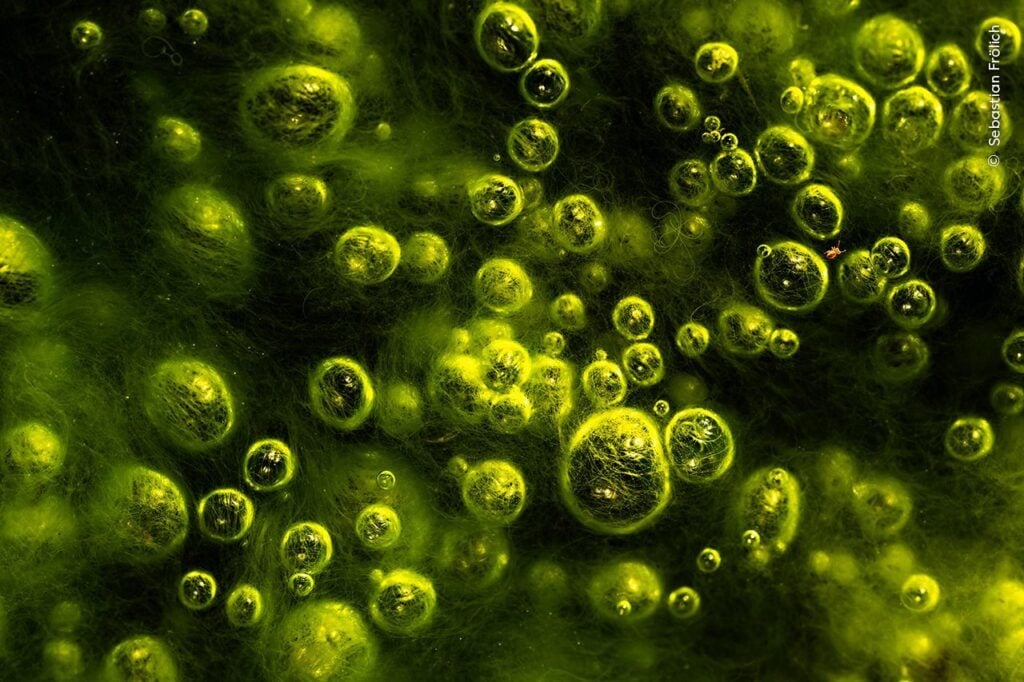
And in the category Wetlands: The Bigger Picture, Sebastian Frölich from Germany found a tiny springtail hexapod among a galaxy of neon-green gas bubbles in Austrian moorlands, calling his shot Vanishing Pond.
He was visiting the fragile wetland ecosystem to highlight its importance as a vast store of carbon dioxide and diverse wildlife habitat. Austria has lost 90% of its peat bogs, and only 10% of those that remain are in good condition, including Platzertal high in the Austrian Alps.
(Taken with a Nikon Z7, 105mm f/2.8 lens. 1/800th, f/9, ISO 400)
Category winners and the full 100 images selected for the competition’s 61st portfolio were selected anonymously by an international panel of experts across the disciplines of wildlife photography, film-making, conservation and science. They were looking for originality, technical excellence and creativity.
Underwater Images category: Highly Commended
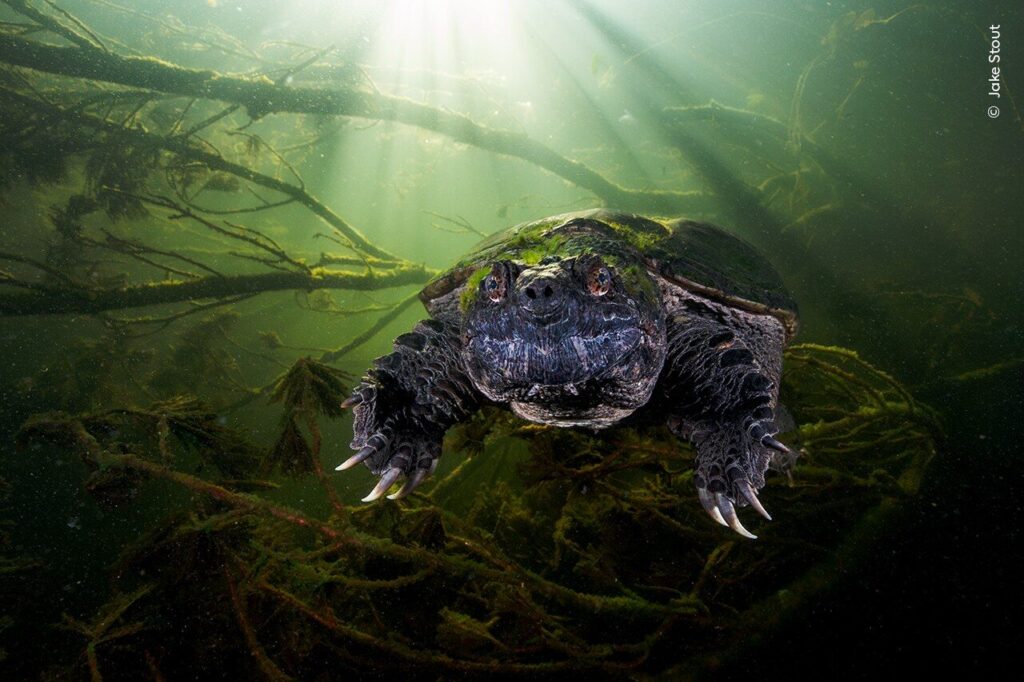
Other shortlisted underwater images set to feature in the WTOPY exhibition include The Welcoming Turtle by US entrant Jake Stout, depicting a snapping turtle gliding over lake vegetation in New Hampshire.
The turtles, which can weigh up to 20kg, have a powerful bite and strike at speed. Despite their fearsome reputation, Stout says he has always found them to be calm and inquisitive, having photographed them in the lake for the past four years.
(Taken with a Canon EOS 5D Mark III, 16–35mm f/4 lens at 16mm. Aquatica housing, two Sea & Sea YS-D2 strobes. 1/125th, f/11, ISO 400)

Former winner Greg Lecoeur from France was also Highly Commended for A Monk’s Life, showing a wide-eyed monk seal at the entrance of a sea cave.
He was documenting the work of seal biologists in Greece when he had this intimate encounter with one of the world’s most elusive and endangered marine mammals though, thanks to dedicated conservation programmes and increasing public awareness, their numbers are now increasing.
(Taken with a Nikon D500, Tokina 10–17mm lens, Ikelite DS161 strobe. 1/250th, f/9, ISO 200)

Highly Commended for A Closer Look was Swiss underwater photographer Hussain Aga Khan, who framed this wild Amazon river dolphin, also known as a boto, near a pontoon on the Rio Negro river in Manaus, Brazil. Tourists can pay to feed the animals which, though it might help to boost conservation interest, can cause harm if the botos grow reliant on hand-outs.
In Brazil’s Mamirauá Reserve, the boto population declined by 70% in the 22 years to 2018.
(Taken with a Canon EOS R5, 8-15mm f/4 fisheye lens. 1/125th, f/6.3, ISO 2000)

Apart from winning the Underwater category, Ralph Pace was also Highly Commended for Jelly Smack Summer, where he found himself in the middle of a mass or ‘smack’ of Pacific sea nettles in Monterey Bay, California, as previewed on Divernet in August.
Some biologists argue that more frequent smacks are a sign of rising ocean temperatures, though removal of predators and competitors through overfishing is another contributing factor.
(Taken with a Nikon D850, 28-70mm f/3.5-4.5 lens, Nauticam housing, two Sea & Sea strobes. 1/5th, f/13, ISO 125)

Similarly previewed in August, Fragile River of Life by US photographer Isaac Szabo was Highly Commended in the Wetlands: The Bigger Picture category. Szabo watched this female longnose gar with several males during mating season in a clear Florida river, the photographer’s feet wrapped around a drowned tree.
(Taken with a Sony α7R II, Nikonos RS 13mm f/2.8 lens, Inon Z-240 strobes. 1/30th, f/8, ISO 200)
Young photographer

Two images by young photographer Tinnapat Netcharussaeng from Thailand scored in the 15-17 age group. He was Runner-Up with his Jellied Meal, taken while scuba diving off Koh Losin, a small rocky islet in the Gulf of Thailand.
Seeing the green sea turtle biting chunks out of a lion’s mane jellyfish he approached carefully, mindful of the nearly invisible tentacles dispersed through the water.
(Taken with a Sony α1, 28–60mm f/4-5.6 lens, Nauticam housing; Nauticam WACP-1 wide-angle conversion port, Seacam 160D strobe. 1/125th, f/22, ISO 640)

Another shot by Netcharussaeng, Blue Streak, was Highly Commended in the same age category. He says he had spent years planning an expedition to Mexico to photograph his favourite shark but it took several days there before he got to swim alongside this one off Cabo San Lucas, Baja California Sur.
(Taken with a Sony α1, 12–24mm f/2.8 lens, Nauticam housing, Seacam Superdome port, Seacam 160D strobe. 1/5th. f/22, ISO 50)

Another Thai photographer, Sirachai Arunrugstichai, was Highly Commended in the Oceans: The Bigger Picture category for his unusual Baring The Bones.
He used X-ray imaging of tropical fish specimens preserved for study at Chulalongkorn University to “visualise the potential loss of marine biodiversity, particularly from coral reef ecosystems” threatened by ocean warming and acidification, destructive fishing practices, pollution and coastal development.
(Taken with a Poskom PXM-40BT hybrid battery-powered portable X-ray unit, Mars1417X wireless digital flat panel detector)
Exhibition, book and symposium
The photographs above are among the 100 showcased in the exhibition that opens at the NHM this Friday (17 October).
The show will also provide insight into some of the habitats pictured by including the museum’s new Biodiversity Intactness Index (BII), which measures how much of a region’s natural biodiversity remains on a scale of 0 to 100%. BII has now been adopted as an official Global Biodiversity Framework indicator for decision-making.
The exhibition runs in London until 12 July 2026, as well as embarking on its usual UK and international tour. Tickets cost from £15.50 for adults off-peak, with concessions available.
The Wildlife Photographer of the Year Portfolio 35 is available from the NHM for £28.
Tickets for the one-day photography symposium WildPhotos 2025 at London’s British Library and online on 17 October are still on sale. The event is organised by Wildlife Photographer of the Year and Wildscreen.
Enter the next WPOTY contest
The next Wildlife Photographer of the Year Competition, WPY62, opens for entries at 11.30am GMT on 20 October and closes at 11.30am GMT on 4 December, 2025.
Adults (27 and over) can enter up to 25 images for a £35 fee; those aged 18-26 can enter the same number of images free, and entrants aged 17 and under can enter up to 10 images free.
Photographers from 114 countries across Africa, South-east Asia and South America can also enter for free. Find more details and enter here.