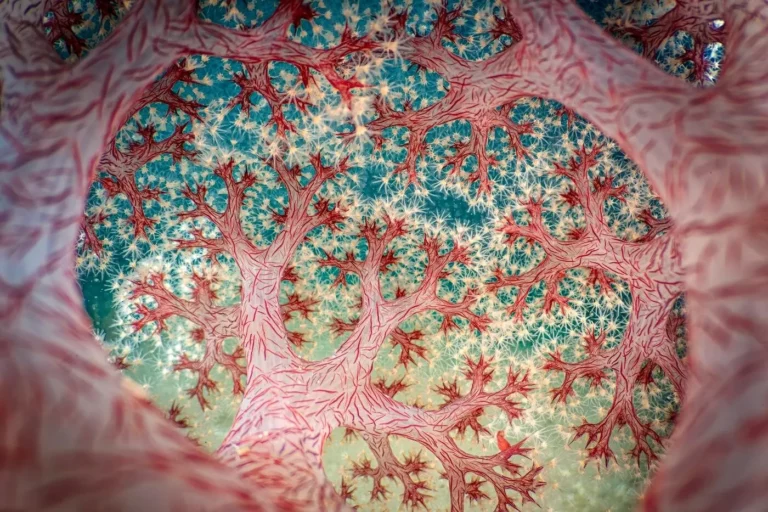
An underwater photographer has won the Grand Prize in the UK-based Close-up Photographer of the Year (CUPOTY) international competition, which embraces macro, micro and close-up photography across 11 wildlife categories.
Fractal Forest, a view of a cauliflower soft coral’s interior in Indonesia’s Lembeh Strait, earnt Australian photographer Ross Gudgeon the title Close-up Photographer of the Year 7 as well as a £2,500 cash prize.
“This soft coral is made up of countless small, rounded polyps that give it a puffy texture,” says Gudgeon. “I wanted to explore a perspective that isn’t possible with conventional lenses, and an underwater probe lens allowed me to do that.”
The photographer used a Nauticam EMWL (Extended Macro Wide Lens), an underwater version of the probe or insect-eye lens. Its long length, small diameter, close focus and wide field of view are designed to allow for perspectives not possible to achieve with conventional lenses.
“I decided to experiment with the EMWL on the soft coral to capture a different view of a common life-form,” says Gudgeon. “I carefully threaded the end of the EMWL through the branches of the soft coral so as not to damage them, creating an image looking from the inside out.”
The seventh edition of the competition attracted more than 12,000 entries from 63 countries. A jury of 22 expert photographers, naturalists and editors spent more than 20 hours on Zoom calls to select their top 100 images.
“This was the toughest competition yet,’ says CUPOTY co-founder Tracy Calder. “The winning image embodies everything close-up photography can achieve – it shows us a perspective we’ve never seen before and reveals hidden beauty in a familiar subject. The judges were captivated.”
Gudgeon’s image came top in the Underwater category and the second- and third-placed and other seven finalists in that section are shown below.
2nd place: Ethereal Frogfish by Daniel Sly (Australia)

Also captured in Lembeh Strait was this orange painted frogfish (Antennarius pictus) motionless on the black volcanic sands, ready to ambush unsuspecting prey.
“This image captures the unusual stillness of these masters of camouflage, predators that rely on patience rather than speed,” says Sly. “To highlight the frogfish against the dark seabed I used a narrow beam of light, combined with a slow shutter-speed and intentional rotational movement of the camera.
“This technique allowed the blue ambient water to bleed into the frame and created the ethereal swirl of the surrounding sand substrate, turning a moment of complete stillness into something otherworldly.”
3rd place: Featherhome by Luis Arpa (Spain)

“I’ve always been fascinated by the smallest creatures of the reef, those that most divers overlook,” says Arpa. “In Tulamben, Bali, while exploring featherstars, I came across this crinoid shrimp (Laomenes amboinensis).
“Perfectly camouflaged in both colour and pattern, it clung tightly to its host, spending most of its time motionless, relying on the featherstar for protection and food drifting in the current.
“With the help of a ‘bug-eye’ wet lens, I was able to get very close and still keep most of the crinoid in frame. That unusual perspective gave exactly the feeling I was hoping for, a view that pulls you inside the shrimp’s fragile, hidden world, where beauty and survival depend entirely on blending in.”
Finalist: Fully Loaded by Chris Gug (USA)

“West Palm Beach [in Florida] is a hotspot for blackwater diving, where we jump off a boat in the middle of the ocean in the middle of the night, and the sea floor is hundreds or thousands of feet below,” says Gug.
“Drifting around in the open-ocean blackness with a torch gives the opportunity to observe interspecies relationships that get broken up when scientists use nets to drag them to the surface.
“One of the cooler relationships is when a larval-stage (known as a phyllosoma) slipper lobster captures stinging creatures to use for its own defence; in this case, siphonophores, which have long, trailing tentacles loaded with nematocyst stinging cells.
“It’s the perfect defence for the lobster [Scyllaridae sp] which, during the phyllosoma stage of life, lives drifting in the open ocean where there’s nothing to hide behind.”
Finalist: Ghost Of The Reef by Simon Biddie (UK)

“Small reef fish like this ghost goby are unassuming and often unseen, yet they contribute to 70% of fish biomass, making them critical to reef food-chains,” says Biddie, who captured this example of Pleurosicya mossambica on coral in Marsa Alam, Egypt.
“These ‘cryptobenthic’ fish evade predators by hiding in crevices or using camouflage. Growing to about 2cm long, ghost gobies are perfectly adapted for concealment among coral. Their transparent bodies, suction-cup fins for grip and low-set gills minimise movement, while their large, angled eyes scan for plankton.
“As a diver, you need to attune your vision to spot them. Using a macro housing set-up with flashes on either side, a slow approach is essential not to scare these tiny fish into hiding.”
Finalist: Kraken by Andre Johnson (USA)

This juvenile sharpear enope squid was another subject photographed on an open-ocean blackwater dive off Florida’s West Palm Beach. “Divers drift in the Gulf Stream to witness the nightly migration of planktonic, larval, and juvenile stage marine life,” says Johnson. “For this photo, the most challenging part was holding my position in the strong current while keeping the camera steady in complete darkness.
“The squid’s translucent body shimmered with iridescent speckles as it hovered and posed, just long enough to take the shot, a rather unusual behaviour since most dart away quickly.
“The most rewarding part of blackwater diving is the fleeting moments of connection with the rarely seen stages of marine life. Every dive is different, and you never know what you will see on any given dive.”
Finalist: Ladybug Amphipod by Richard Condlyffe (USA)

This 3mm ladybug amphipod (Cyproideidae sp) was captured on a blue sea squirt on a wall at a depth of about 12m in Horseshoe Bay, Komodo National Park, Indonesia. “The tiny size of this subject makes it challenging to photograph, but the reward of a successful shot is clearly evident in its ornate beauty,” says Condlyffe.
“Careful buoyancy control was critical to being steady enough to focus the camera and take the shot. By using a super-macro converter and open aperture I was able to fully blur the pinkish-red soft coral background to create this simple composition.”
Finalist: The Octomom by Gabriel Jensen (USA)

Taken with a Sony α6500 + FE 90mm f/2.8 Macro G OSS, Nauticam housing, Backscatter MF-1 strobes. f/20, 1/125th, ISO 100 (© Gabriel Jensen / CUPOTY)
“’In the spring of 2021, a mother Caribbean reef octopus (Octopus briareus) settled into an abandoned pipe under an urban South Florida bridge [on Riviera Beach], transforming it into a nursery for her clutch of eggs,” says Jensen.
“For weeks she remained in near darkness, tirelessly cleaning and fanning them with fresh water until her final days, since all female octopuses die shortly after their young hatch. Her unusual choice of a man-made den turned her into a local phenomenon, drawing divers back week after week to witness her devotion.
“Photographing her was an adventure in itself; the ripping tide allowed only brief access for a couple of minutes each day, and she lingered half a metre back inside a pitch-black 6in-diameter silty pipe where light barely reached.
“By carefully manoeuvring strobes and using manual focus through the haze, I was able to record this moment of new life and maternal sacrifice in one of the ocean’s most intelligent invertebrates.”
Finalist: Baby Sitting by Ross Gudgeon (Australia)

A yellow clown goby (Gobiodon okinawae) guarding its eggs in Anilao, Philippines gave Grand Prize-winner Gudgeon another high-placed shot in the competition. Native to the western Pacific, the fish grows to a maximum length of 35mm.
“The combination of a relatively wide aperture combined with a close-up lens gave me a paper-thin depth of field which I used to highlight only the eyes of the parent and its growing eggs,” he says.
Finalist: Guardian by Lilian Koh (Singapore)

“A tiny whip-coral goby (Bryaninops sp) stands guard over its eggs laid on a transparent tunicate, their golden specks clearly visible on the delicate surface,” says Koh, who took the picture in Tulamben, Bali.
“This intimate glimpse into reef life highlights the goby’s remarkable parental care. Using careful torch-lighting and patience, I was able to capture both the fish’s vivid details and the fragile eggs it protects.”
The 11 CUPOTY categories are Animals, Insects, Butterflies & Dragonflies, Arachnids, Invertebrate Portrait, Underwater, Plants, Fungi & Slime Moulds, Intimate Landscape, Studio Art and Young Close-up Photographer of the Year (for entrants aged 17 or under). All the CUPOTY 7 winners can be seen here.
Entries for the eighth Close-up Photographer of the Year competition will open in May 2026.
Also on Divernet: Divers get up close and competitive