It can get pretty cold at home in Britain. And this can mean extra layers under drysuits, dry-gloves and even consideration about making sure we can keep people warm on long boat trips back to shore. But as bleak as British winter diving gets,you usually don’t have to deal with your regs freezing up, icebergs, polar bears or temperatures plummeting to -28 degrees C…
Into the Blue
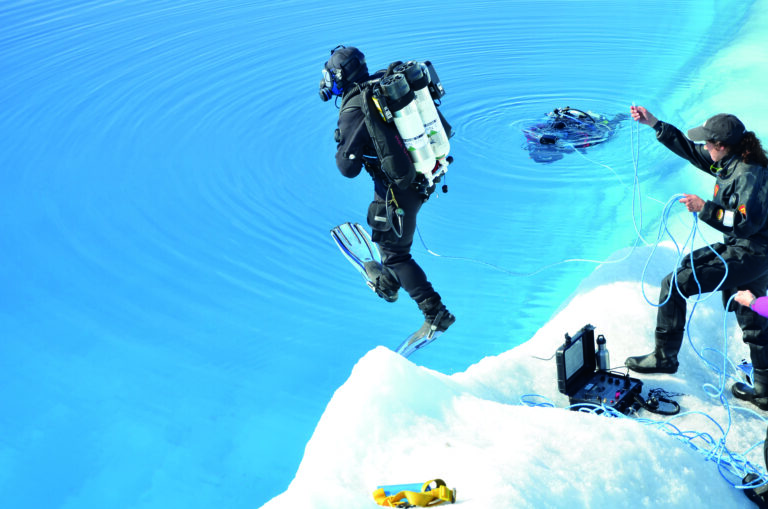
On ascience and filming expedition to Greenland,myself and cameraman Doug Allan were tasked to take samples from, place probesonand film the bottom of a Blue Lake. These large pools of water form in depressions in glaciers where meltwater trickles inlike hundreds of tiny rivers draining into a freshwater sea. The water is only just above freezing (our dive computers actually read 0degreesC), crystal clear and from above look a spectrum of blues.
Hence the name. The Arctic sun penetrates the translucent water and reflects off the white lakebed. The difference in depth give blues from bright electric azure in the shallows to dark indigo in the deep sections, which just scraped past 20m. And we did get a view from above. The only way to reach these lakes with your dive kit is by helicopter.
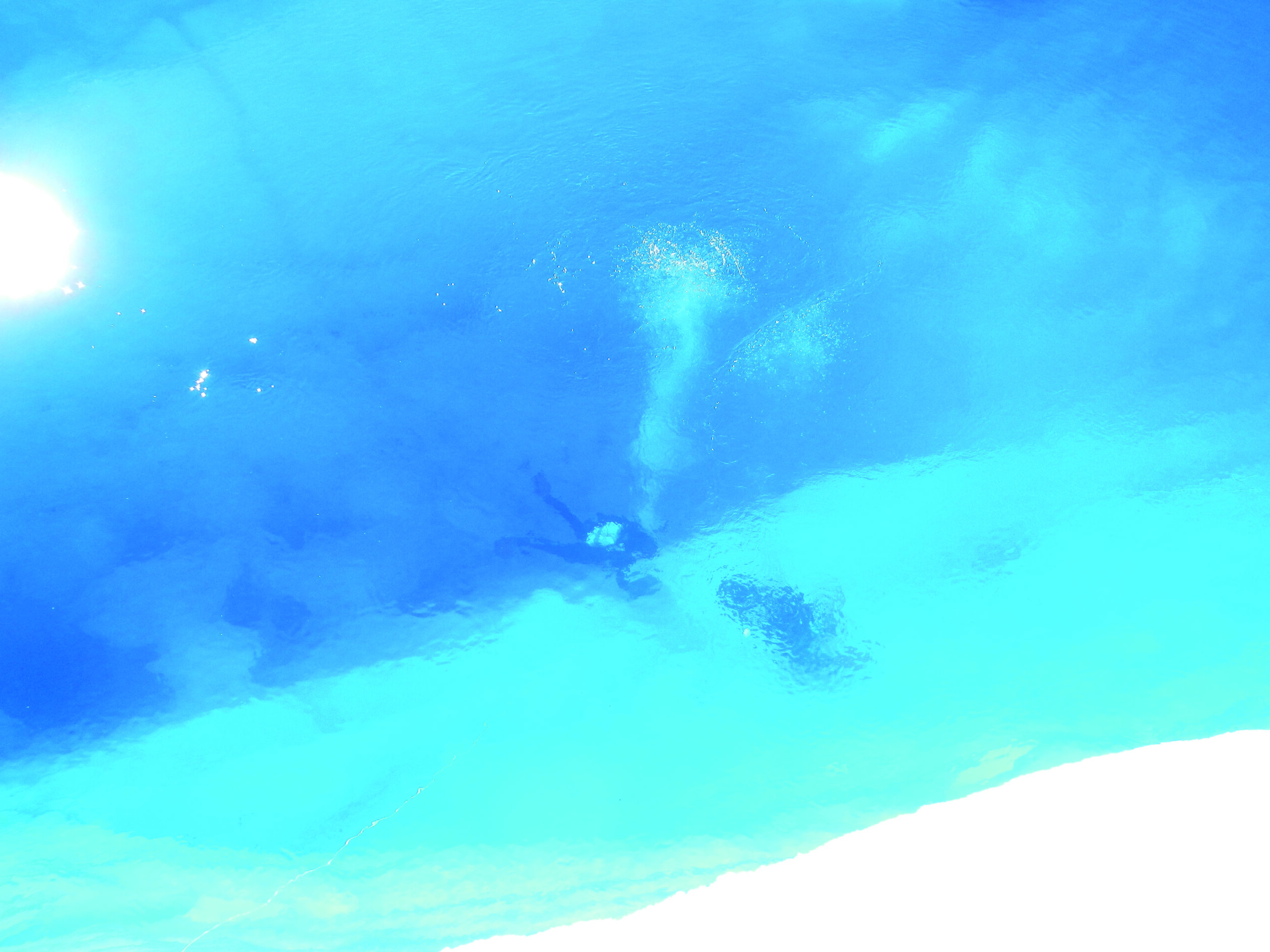
After landing and kitting up, we giant-strided from the icy shore and that was when the problems started. The cold water and heat from my face was causing my full-face mask to steam up like never before, and I could not clear it. I could see absolutely nothing so dense was the coating.
I found out later Doug was frantically signalling me, directing me to swim in various directions for shots and becoming more and more irate at my lack of response. Those stood on the surface could see his gradually more animated gesticulation 20m below.
Then my full-face mask stopped providing me with air… something, I think you’ll agree, that is not ideal. Normally regulators won’t freeze underwater, but we think some water may have got in on the surface, frozen, and then my purging to try and clear the mask may have closed the last gap. I wasn’t particularly concerned.
I fingered my drysuit inflation valve ready to ascend if necessary. We’d been down only a few minutes and at this depth I knew, even blind, I could ascend at a safe enough rate. I was literally punching myself in the face trying to clear the mask and inhaling with as much force as I could generate. Suddenly the mask gave, I got a face full of ice crystals… and a deep, satisfying breath.
After surfacing and sorting the mask out, we dived again to witness a landscape of hillocks and humps, crevasses and cracks, and Dali-esque ice sculptures like thinly stalked mushrooms as much as two metres high. I even found an ice cave that, despite Doug’s refusal to follow me, I couldn’t help but have a quick exploration down into the heart of the glacier…
Of Icebergs And Polar Bears
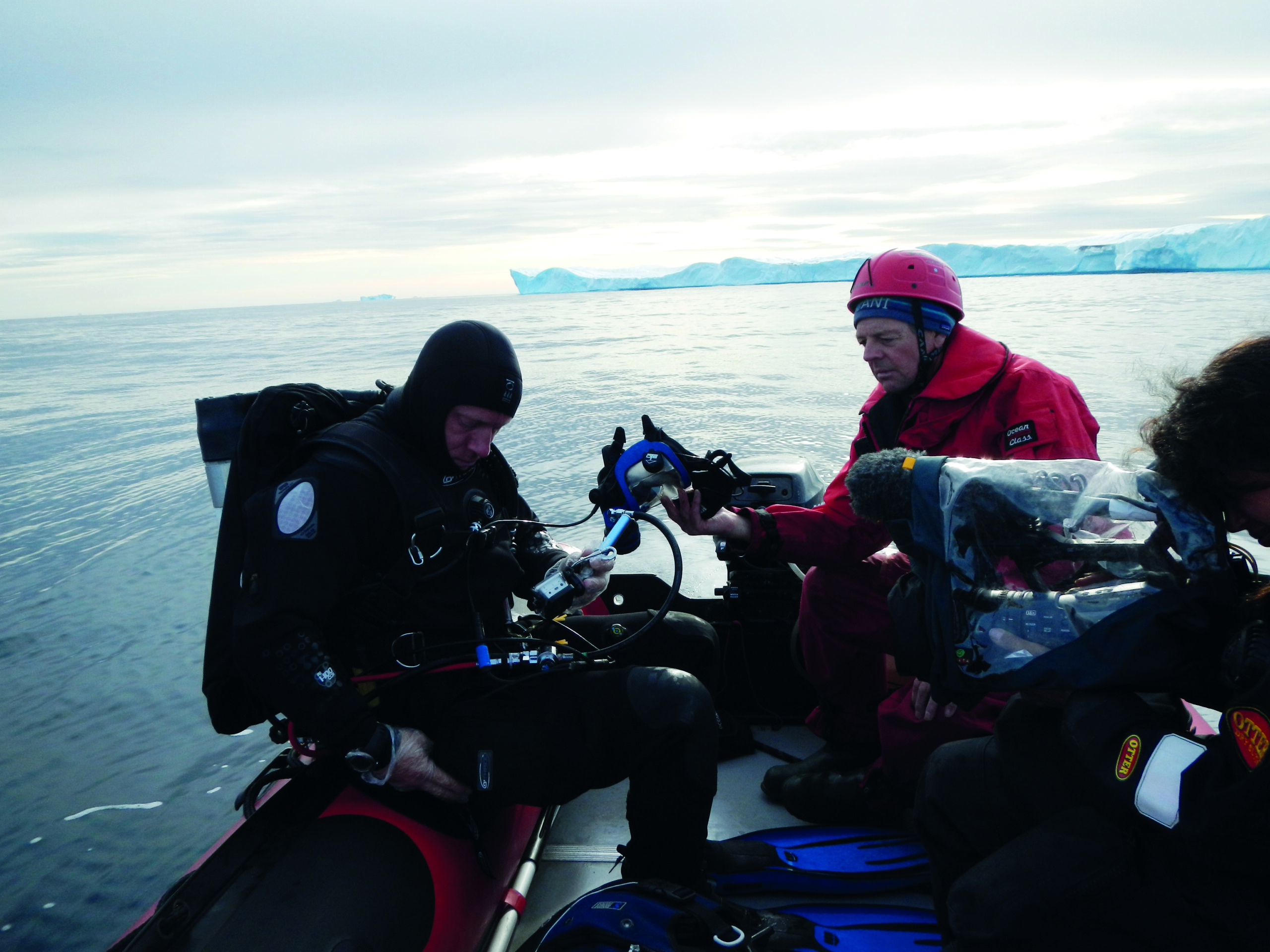
Diving around icebergs in the Arctic Ocean off the coast of Canada might sound cool… mainly because, frankly, it is very cool… but it does bring its own set problems. The first is the cold. This may seem obvious, but I mean really cold. Saltwater freezes below 0 degrees C, and at 30m the waters around the iceberg read -2 degrees C on our gauges.
Because of this we kept our dives short, 45 minutes maximum, and wore appropriate clothing. For ‘appropriate’ read ‘as much as I can fit under my drysuit’. As an example of how cold it was, and what a difference glove selection can make, on our first dive I wore 7mm mitts.
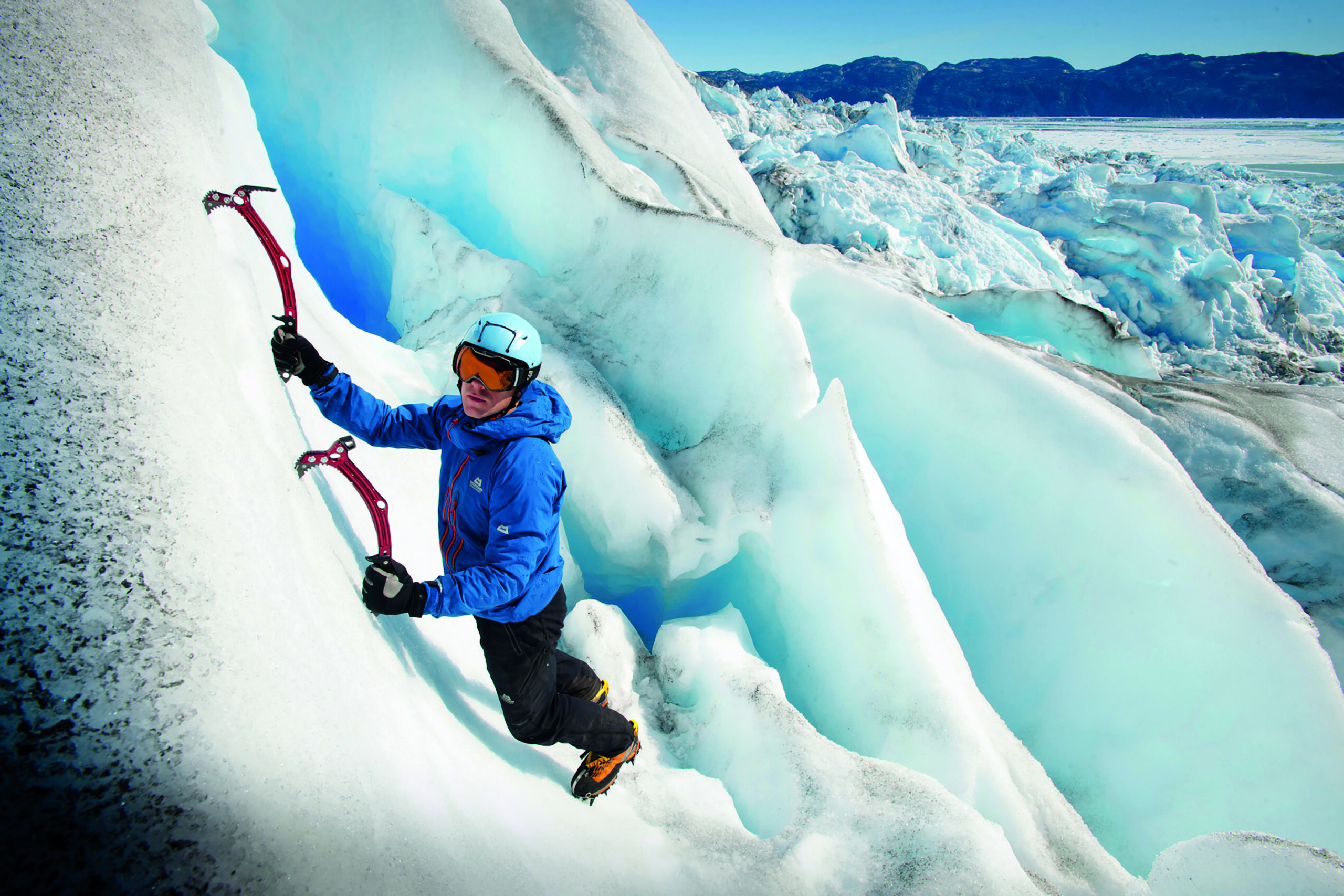
My hands were relatively warm, even at the end of the dive, but working cameras and the sampling bottles I carried was difficult, so I swapped to 5mm gloves thinking I’d sacrifice a little comfort for the increased manual dexterity. I received nerve damage to the third and fourth fingers in both hands that left them numb for about six months. I went back to wearing the 7mm mitts on dive three.
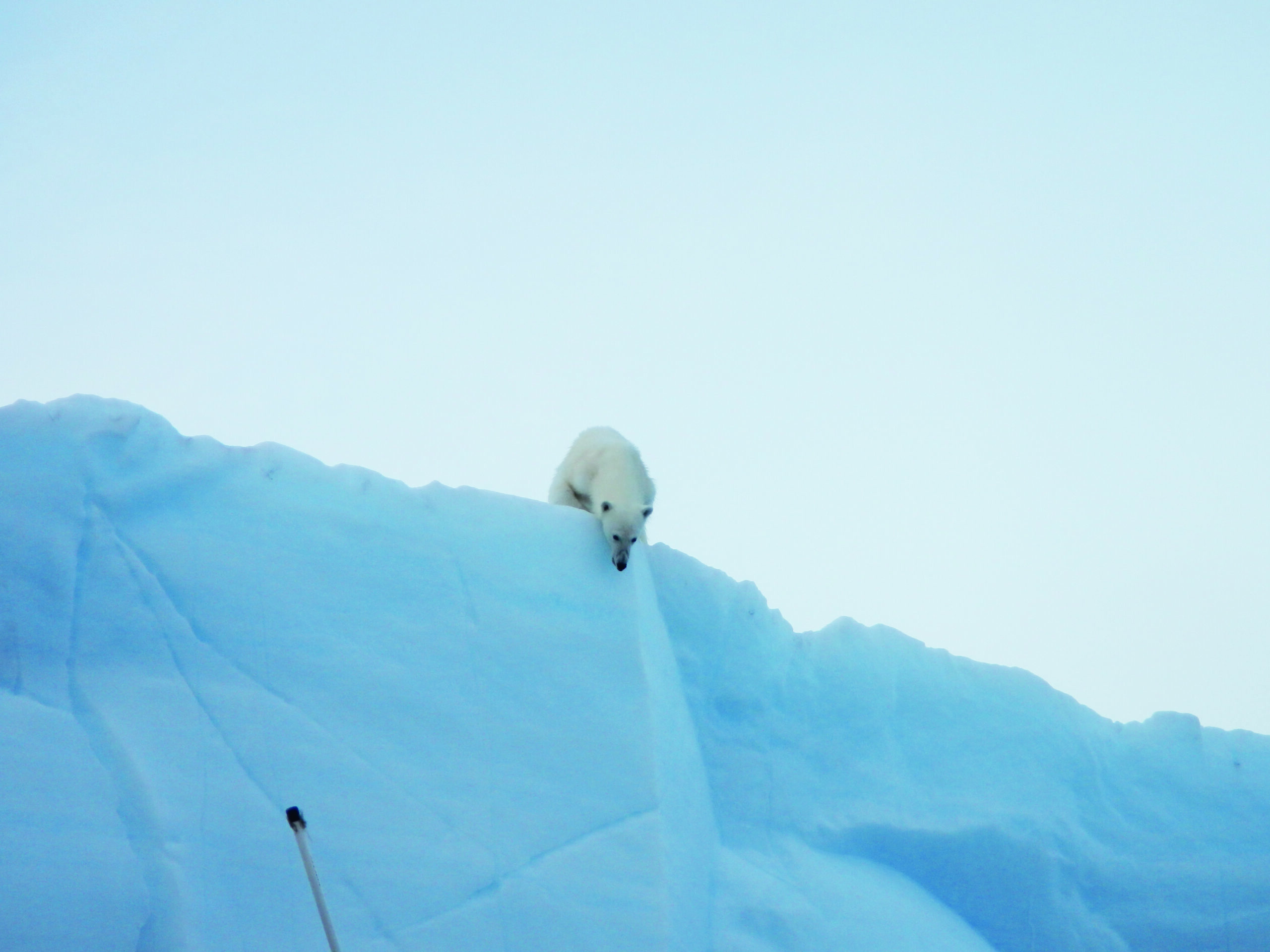
And it wasn’t just the cold that was out to get me. We were diving an ice island, a name given to a really big iceberg. Ours was approximately 25 sq km, so it counted. Upon this island lived some polar bears, 24 to be exact (Chris Packham did a quick helicopter survey). Seeing the world’s largest land carnivore up close is a truly humbling and awe-inspiring experience… even when it’s deciding whether or not to jump into your boat.
On the very first dive we’d pulled our little RIB, launched from the Icelandic research ship we were using, up to the wall of the ‘island’. As we floated around kitting up someone pointed up with a whispered ‘Look’.
We cast our gaze upwards to see a bear, paws on the cliff edge, peering down at us. We backed the little boat away and the animal looked at us, then down the cliff at the water beneath, then back at us, continuing this cycle a few times and clearly judging if the drop to the water was do-able.
We kept backing away and the bear turned, with what in my mind looked like a shake of its head, and headed back inland. I was lucky enough to see, and be stalked by, three more bears on land excursions onto the ice island later in the trip.
Ice-free
The more-extreme side of underwater filming isn’t the exclusive concern of diving. Freediving can bring its own logistical problems… especially if you’re attempting it during an Alaskan winter.
The main environmental concerns are light and cold. Even early in the winter season there is limited daylight in Alaska. We were filming late in November and had a window of about three and a half useable hours between 1100 and 1430. This put us under time pressure and limited any preparation time I’d have before the dive. Then there was the cold.
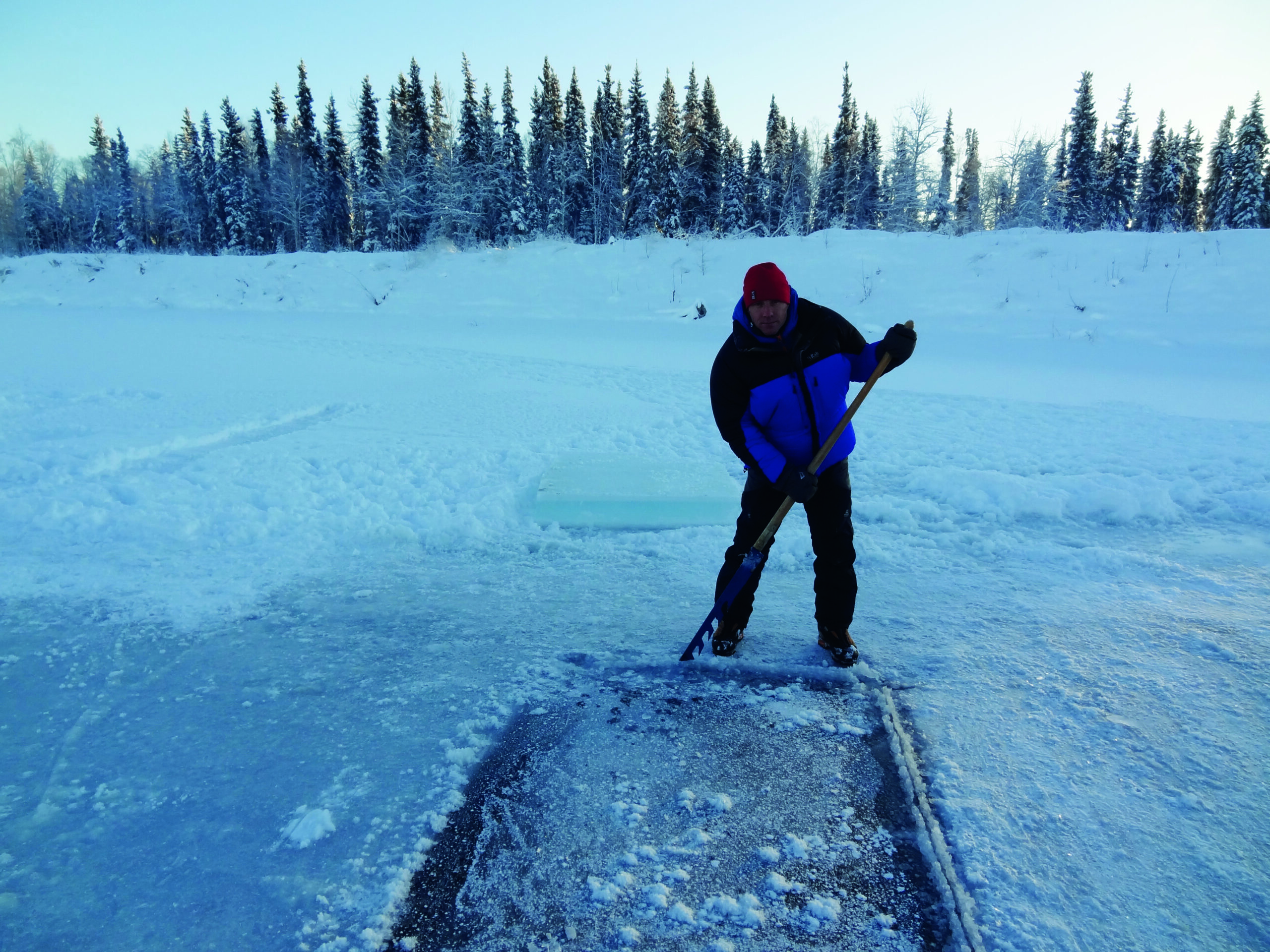
During the day it got down to minus, that’s MINUS, 28 degrees C. There were a lot of Brass Monkeys walking around looking deeply uncomfortable. Fortunately, the water in the lake I’d be diving in was a balmy 1 degree C. Unfortunately, I’d be in a 5mm wetsuit.
We were filming for my Children’s BBC series, Beyond Bionic, where we looked at how a human could use technology and science to mimic extraordinary animals. In this episode it was the turn of the ringed seal and the final challenge was a swim under half a metre of solid ice between two holes cut in the ice 40 metres apart.
And so although I was only in a 5mm suit, I was wearing a thin fleece undersuit with electrically heated pads on my thighs and lower back. This helped keep me functional in the 25 minutes I spent in the water to attempt the task and all the other filming.
Normally before freediving you warm up in the water. Doing progressively deeper or longer dives to encourage your body’s dive reflex to kick in. This is where your breathing rate and metabolism slows down, blood pools around your vital organs and the spleen contracts to pump more oxygen-carrying red blood cells into your system.
However, I had no intention of a prolonged ‘warm up’ in the conditions I was faced with. So I sat in a heated tent on the ice fully kitted up doing breath-hold exercises to try and induce the dive reflex. Apparently this method isn’t as effective as doing it in water, but these sorts of events are often compromises between the many challenges and constraints we are faced with.
After about 20 minutes of exercises, I signalled I was ready and I walked down to the entry hole. In the minute I was standing by the entrance, talking to camera, my neoprene-socked feet had frozen to the ice. Peeling myself off, I sat by the hole, donned my freediving fins, mask and snorkel and slipped into the black water.
I was expecting the cold shock as the water percolated the suit and my body worked to heat that water up so the wetsuit could hold a layer of warm water around me as a barrier to the cold. I pushed myself underwater to let the exposed skin of my face acclimatise and then repeated this to eye-ball the guideline.
I’d asked for a guideline to be installed by driving two steel rods into the ice at the entry and exit holes so they protruded underwater to a depth of 2m. A line was then run between them so I could navigate my way. We’d then planned on marking every ten metres with a glowstick but they simply wouldn’t work in the extreme cold.
The visibility was expected to be ten metres. But when I ducked underwater and cast my eyes down, I could see it was less than two. I couldn’t see the line from the entry hole.
However, it was getting late in the day and we were losing light. This was our last day and I either went soon or not at all. The cold, the dark, the poor visibility, the lack of visible line from the surface and the pressure of filming all played upon my mind.
Freediving is very much a psychological as well as physiological sport. The more relaxed you are the better you will perform and I knew my anxieties were not helping my underwater capabilities… which only added to the anxiety.
I made two more short dives, finding the line beneath me and swimming along it and back ten metres then 20. After surfacing the second time I decided that more ‘warming up’ wouldn’t help. I signalled the camera crew that I’d be going but in my own time then just began to actively clear my mind. I pictured the line and myself smoothly moving along it.
I reassured myself I had swam much further underwater, albeit in much warmer, clearer waters, I ignored the cameras and the 14 people all watching me. I was alone in the world. And I dived.
The lack of distance markers on the line was also a concern, I like to know where I am. But in this case it served to make things easier. I made an effort not to rush, to relax into the swim and to not aim to the end but to simply move in the moment.
I stared down at the line rather than up and along it towards the exit. Craning your neck back tightens the neck muscles, which is not ideal in freediving, and why you see ascending freedivers looking at the line rather than the surface.
I guessed to myself that I must be around the halfway mark and casually glanced up… just in time to stop myself head-butting the rod at the exit hole.
I felt good. Even more so now I knew that my next breath was above me and the job done. So I spent a little time hovering under the ice by the entrance, casting my gaze around and rolling on my back to look up at and through the thick ice.
It was only now, at the end, I had the mind space to appreciate the beauty of my surrounding and the uniqueness of my situation. As the final shafts of winter sun shone through I felt privileged, there are few who get the opportunity to swim under Alaskan ice and a setting sun.
Photographs courtesy of Andy Torbet
FAQ
Q: What makes underwater filming in Greenland so challenging?
A: Divers face near-freezing waters (0°C), issues with regulators freezing, and full-face mask malfunctions. Visibility can be crystal clear, but the extreme cold creates constant risks, including loss of air supply and mask failures.
Q: What was unique about diving the Blue Lakes in Greenland?
A: The Blue Lakes form on glaciers where meltwater gathers, creating pools that range in colour from bright azure to deep indigo. Access is only possible by helicopter, and the underwater terrain includes ice caves, surreal mushroom-like ice formations, and crevasses.
Q: What dangers did Andy Torbet face when diving around Arctic icebergs?
A: Apart from -2°C water, Torbet had to contend with the presence of 24 polar bears on the ice island. At one point, a bear considered jumping into his boat. The extreme cold also caused nerve damage to his hands when he swapped from 7mm mitts to 5mm gloves for dexterity.
Q: How cold was it during Andy’s Alaskan freediving sequence?
A: Air temperatures dropped to -28°C, while the lake water was 1°C. Despite the icy conditions, Torbet freedived under half a metre of solid ice wearing only a 5mm wetsuit, aided by heated pads under his suit.
Q: How was safety managed during the Alaskan freedive?
A: A guideline was installed between two ice holes 40m apart. Despite poor visibility (less than 2m), Torbet relied on psychological preparation, breath-hold training in a heated tent, and strict safety protocols with a support team of 14 people.
Q: What filming project was Torbet working on during the Alaskan freedive?
A: The dive was part of Beyond Bionic, a Children’s BBC series exploring how humans can mimic extraordinary animal abilities. In this episode, he tested how humans could replicate the cold-water endurance of ringed seals.
Q: What was the most memorable encounter of these expeditions?
A: While the ice caves and surreal ice formations were highlights, being stalked by polar bears on the Arctic ice island was a standout experience, both humbling and dangerous.
Q: How does freediving differ from scuba in extreme cold?
A: Freediving under ice is as much psychological as physical. Unlike scuba, freedivers cannot rely on tanks, so relaxation and efficiency are critical. In extreme cold, traditional warm-up dives are avoided, and alternative methods like breath-hold exercises in heated tents are used.
Q: What equipment adaptations were necessary for such extreme dives?
A: Torbet used heated undersuits, 7mm mitts for warmth, and full-face masks designed for polar conditions. For freediving, he relied on a guideline, glowsticks (which failed in the cold), and electrically heated pads.
Q: Will there be a continuation of this extreme diving series?
A: Yes. This is the first in a two-part series. The next instalment will focus on the theme of light in extreme underwater filming.
This article was originally published in Scuba Diver Magazine
Subscribe today with promo code DIVE1 — enjoy 12 months for just £1!