
The Maldives have long been one of the world’s classic dive destinations, with the celebrated central atolls thrilling divers with reefs packed with tropical fish and plentiful big animals. The equatorial location means that they are great year-round, but by happy coincidence, when many feel that time is right for a spring escape, the Maldives are regularly at their peak with their optimum conditions of glass calm seas and blue skies.
Photographs by Alex Mustard

Why the Maldives Both Thrills and Frustrates Underwater Photographers
Plenty of folks get their initial taste of tropical scuba diving here and create indelible memories of seeing their first turtles, sharks, eagle rays and more. It is where I gained my first scuba qualification before I’d collected any GCSEs, and the popularity of the season saw me overlapping this year with the Editor, Mark, and Go Diving Show crowd-thriller Steve Backshall, among others.
The scattered castaway islands attract the tourists, but for divers the draw is the richness of the marine life. Curiously, we underwater photographers have a more-complex relationship with the Maldives. While most experienced underwater photographers will have visited, most return far less regularly than they do, say, to the Red Sea or Indonesia. For us snappers the reason is that shooting in the Maldives is often less reliable than other places. The main reason for the richness of these reefs are the strong currents that pump water (and plankton) in and out of the atolls. This means that while often conditions are perfect for pictures, they can quickly switch to uncooperative. Still photographers need time with subjects to conjure the special shots. I’ve never heard a UPY winner’s acceptance speech start with ‘we were hooked in…’ or ‘we were drifting along and I snapped this as we flew past’. Moreover, outgoing tides often suck surprisingly murky water onto a dive site, or when you least expect it the current shuts off, the soft corals droop, the neat schools disperse and the photographic potential drains away.
Every dive briefing in the Maldives concludes with the guides saying that they won’t know the conditions until they make a current check. Like other places, they will know the state of the tide, but the current in any one spot is far too unpredictable, because of the way the main tidal flow interacts with the highly complex reef topography with farus, kandus, giris, thilas, haas, badhis and gaas (all Maldivian words for different reef structures). For the underwater photographer this makes planning and preparation tough and even simple things like lens choice become a lottery.
How Modern Wide-Angle Lenses Changed Maldives Photography
But recent years have seen change, not in Maldivian diving, but in underwater photography gear. Over the last decade underwater photography has been revolutionised with the proliferation of specialist, water-corrected underwater lenses, that feel bespoke for this destination. So suitable are lenses like Nauticam’s WWL, WACP and FCP to the Maldives, that I really think it is time for photographers to reassess how productive this destination can be. The Maldives is no longer a place where we can sometimes get great images, advances in gear now make my trips there as productive as anywhere, dive on dive.
For those not yet familiar with jumble of acronyms I spewed in the previous paragraph, what you need to know is that they represent a family of revolutionary underwater lenses introduced over the last decade. Each is designed to work with a standard zoom lens on your camera, converting it to a wide-angle zoom, that can zoom both wider and tighter than any existing wide-angle lens, and because the underwater lenses are specifically designed to work in water, they achieve better image quality across the whole of the frame. It is win-win-win for photographers. We can cover more subjects, create more types of images and maintain excellent image quality with a more open aperture – ideal for those more distant passes.
Making the Most of Fish Schools Underwater
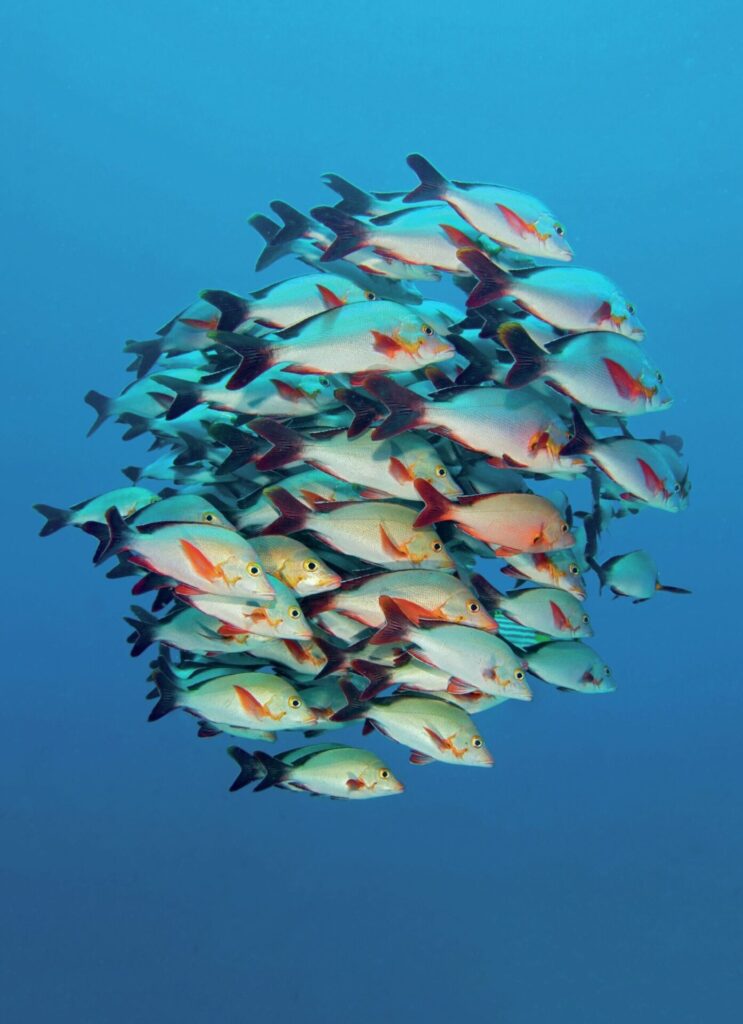
If you had to distil Maldivian diving into one adjective it would be fishy. And these wide-angle zooms are perfect whether it is a small cluster of butterflyfish, or a giant ball of blueline snapper. I always start by making the schools themselves my subject of choice, and there is a wide selection in the Maldives, including oriental sweetlips, several species of snapper, jacks, bannerfish, and hordes of fusiliers. Throughout the dives we should always be looking out for pleasing formations, with the fish all lined up in the same direction, for the strongest images. Some species are more cooperative than others, and even certain species like blueline snapper vary greatly in their photographic potential, from site to site and dive to dive. When it comes together you have to work it!
I also look to use this fishiness in the backgrounds of wide-angle photos, to give my images more visual depth and a greater feeling of a reef thriving with life. Schools of redtooth triggerfish and fusiliers are often helpfully positioned up in the Maldivian water column for the perfect fishy backdrop!
Photographing Sharks and Turtles with Wide-Angle Zooms
The Maldives is equally famed for big animals, which are also perfect for the wide-angle zoom, because a fisheye alone is usually too wide. Hawksbill and green turtles are pretty ubiquitous and many reefs have healthy reef shark populations. At quite a lot of spots sharks will come in close enough for a portrait with a zoom – open your aperture a few clicks and speed up your shutter speed similarly to help get more strobe onto them, to stop them looking too blue.
Manta Ray Photography: Timing, Patience and Positioning
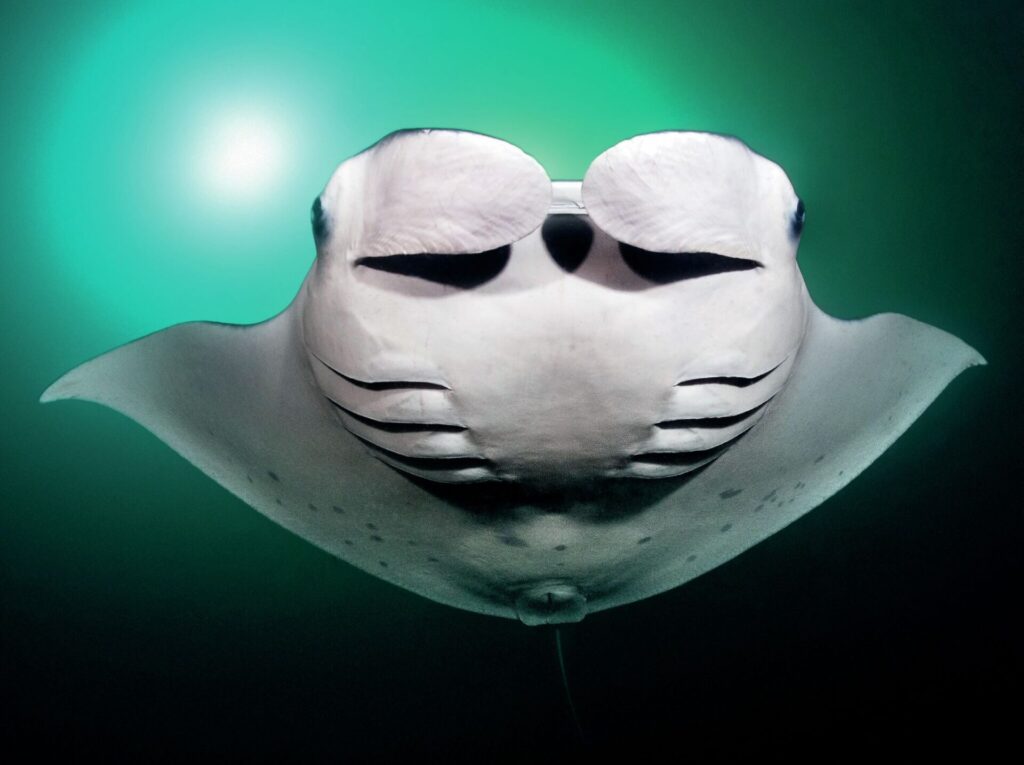
But I can’t say Maldives without thinking of mantas and there are many manta dives across the atolls, most are at cleaning stations, where the giant rays come in for their spa treatment.
Great photos here owe far more to how you dive, than any photographic secret. The best encounters give the best images, so resist the temptation to push too close, let the rays get settled into cleaning and the rewards will come. Personally, I find the best shots aren’t those when the mantas are really close. When they are right overhead, it feels like you are getting the shot of a lifetime, but often these images are unflatteringly distorted, and these preceding shots often look stronger. Again, this is where the zoom comes to the fore.
It is an interesting time in underwater photography, advances in camera high ISO capability have transformed the photographic potential of deep diving and darker cold water destinations and now lens tech is making exciting destinations that used to frustrate photographers some of the most productive.
Frequently Asked Questions
Why is underwater photography challenging in the Maldives?
Strong, unpredictable currents and fast-changing conditions can limit subject time, making planning, positioning and lens choice more difficult than in calmer destinations.
What underwater lenses work best in the Maldives?
Water-corrected wide-angle lenses like Nauticam’s WWL, WACP and FCP are ideal, offering flexibility, superior edge sharpness and zoom capability underwater.
Is the Maldives good for wide-angle underwater photography?
Yes. With schools of fish, mantas, sharks and turtles, the Maldives excels for wide-angle shooting, especially when paired with modern wide-angle zoom optics.
How do photographers improve manta ray images in the Maldives?
By diving patiently, maintaining distance, and letting mantas settle at cleaning stations rather than approaching too aggressively for close-ups.
What makes Maldives diving visually unique for photographers?
Dense fish life, strong currents shaping reef behaviour, and dramatic reef structures create dynamic, layered compositions unlike many other tropical destinations.
This article was originally published in Scuba Diver Magazine
Subscribe today with promo code DIVE1 — enjoy 12 months for just £1!
