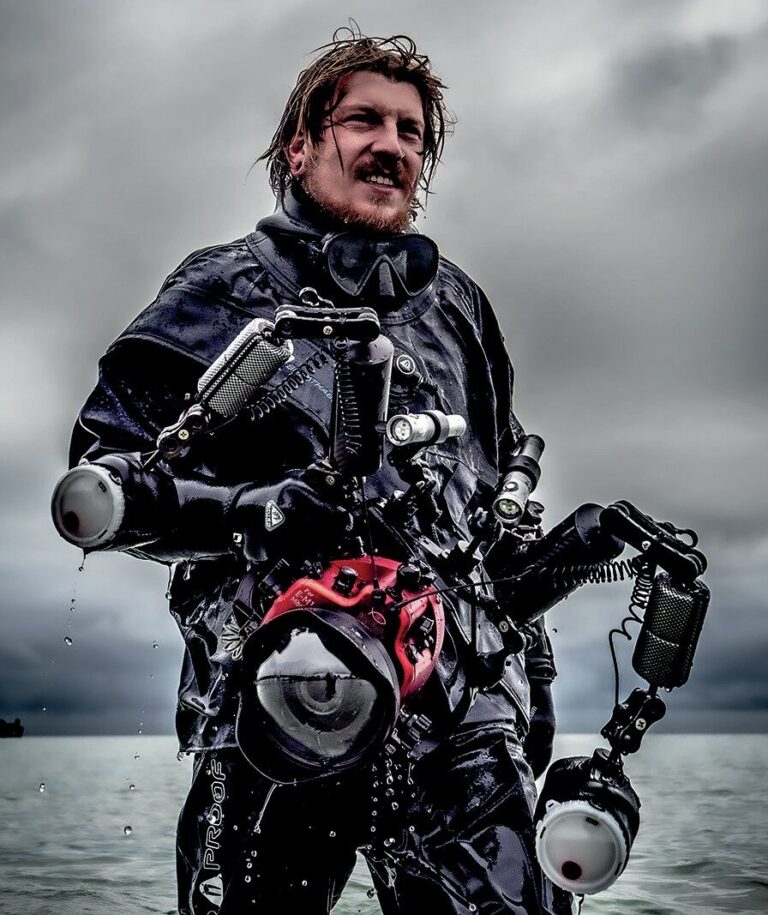
PT Hirschfield chats with the underwater photographer with a soft-spot for octopus, especially those with blue rings

Photography by Sam Glenn-Smith or as credited
How Sam Glenn-Smith Fell in Love with Underwater Photography
While underwater photographer, dive guide, instructor and dive shop manager Sam Glenn-Smith has spent his entire life on Victoria’s Mornington Peninsula, he learned to dive as a Year 10 student in Fiji in 2010.
After his teacher Alan ‘Wiggsy’ Wiggs encouraged him to join a trip to Beqa Lagoon, Sam says: ‘My parents set me a challenge of achieving specific school grades by the end of the year as criteria for being allowed to go on the trip. I got the grades, so my Dad – who was already a diver – took me on the trip where I learned to dive.’ After encountering a four-metre tiger shark on his second dive out of Open Water, Sam joined another four ‘Diving With Wiggsy’ trips, including a trip to Atmosphere Resort in the Philippines.
There he met Daniel Geary, aka ‘Dr Frogfish’: ‘He handed me his camera, and when I took my first photo of a harlequin shrimp, something clicked. Within two days of getting home, I’d bought my first underwater camera.’


Nowadays, Sam dives for work locally through The Scuba Doctor Shop, as well as diving interstate and overseas in places like Indonesia, Fiji and the Philippines.
” As a result, images of this species demonstrating their super-power of ‘glowing blue’ are rarely if ever awarded in underwater photography competitions”
The Magic of the Mornington Peninsula: A Local’s Perspective
Averaging 200-300 dives a year, with around five to ten dives per week in his shallow local waters, Sam’s convinced: ‘Australia’s Mornington Peninsula has got some of the best diving in the world.’
‘That’s due to the access and ease of the diving, and the diversity of the critters. There’s not many parts of the world where you can gear up, walk less than 50 metres from the carpark and see all the marine life we see.’
Sam’s a super-passionate ‘local expert’ who regularly serves as a guide for the international tourist market. He’s also in-demand as a dive guide for interstate and internationally renowned underwater photographers and film crews.
The pinnacle of Sam’s dive life so far was serving as a guide for the crew of director James Cameron’s latest release on Disney+, titled ‘The Secrets of the Octopus’.


In 2023, he was booked to help locate and tell the story of blue-ringed octopuses, and to help reveal the popular shore-diving pier at Rye as an ‘octopus kingdom’.
Reflecting on the accessibility of another iconic Victorian species, the weedy seadragon, Sam shares: ‘It’s nice in my role as an instructor and guide to be able to show visiting divers more dragons that I can count.’
‘I’ll be giving a dive briefing and they’ll ask ‘What’s the maximum depth?’ and I tell them ‘4m.’ And they’re thinking ‘What am I doing here? 4m isn’t even a dive; I could snorkel this.’ Their reaction when they see the dragons up close is priceless.’
‘And the fact that it’s 4m means I’m not too worried about their skill level because almost anyone can do it. These dives are pretty much doable 365 days of the year.’
The Truth About Blue-Ringed Octopus Behaviour
Being drawn to anything with a reputation for ‘being dangerous’, Sam rates the blue-ringed octopus as his favourite animal. He’s taken many stunning portraits of them, one of which was featured on a PADI certification card.
The dive shop he manages also offers guided dives for anyone specifically wanting to encounter blue rings when they’re in abundance.
‘Everyone thinks ‘What are you doing, diving with blue rings? Be careful!’ But they’re totally fine. I like being able to photograph them in a beautiful way, to make people excited about seeing them.’

Sam notes: ‘There are four different species of blue rings and they’re all unique. The greater blue-ringed octopus found in tropical waters are often quite plain. But the species on the Mornington Peninsula will more often than not have their blue rings flashing. Even if you just make eye contact with them, they might stand up, start flashing blue and start swimming.’
While arguably all marine life might become slightly stressed when humans are in close proximity, the blue-ringed octopus is one of the very few creatures that literally wears its rather timid ‘heart on its sleeve’.
As a result, images of this species demonstrating their super-power of ‘glowing blue’ are rarely, if ever, awarded in underwater photography competitions. Those who take photos of them are sometimes demonised, vilified, or even excommunicated from certain groups, as though they’ve crossed ethical boundaries by capturing images of glowing rings.
Ethics, Imagery and the Future of Marine Conservation
A popular image Sam had taken of a glowing, swimming blue ring was once discussed in a video review by English underwater photography guru Dr Alex Mustard. Sam recounts how Alex indicated he’d swum with blue rings in Melbourne; that they were charismatic creatures. He attested that the glowing and swimming behaviour was totally natural for them, not unduly provoked as critics might suggest.


Sam says he’s glad it’s a conversation people are willing to have: ‘I welcome the conversation, but not the accusation. There are so many photographers and dive guides who manipulate all manner of marine animals to get better shots. Especially in places like Bali where it’s common practice. In general, it’s best not to touch. Just photograph what you see.’
Sam was thrilled to recently cross mating blue-ringed octopus from his Bucket List. He’s also looking forward to taking part in the invitation-only Atlantis Image Makers trip in September 2024, in his quest to continue making images that showcase the natural beauty of marine life.
Reflecting on the current state of the ocean, Sam says, ‘I like to still think there’s a window of optimism. But we’ve got a long way to go and I’m very worried overall. I think a lot of things have gone past the tipping point. The only thing I can do is keep trying to promote the beauty of the ocean, and that everyone should love and protect it. If every diver, underwater photographer and videographer did that, we’d be able to change a lot of opinions.’
You can see more of Sam’s stunning underwater photography on Facebook and Instagram.
Frequently Asked Questions
Why is Sam Glenn-Smith known for photographing blue-ringed octopus?
Sam has a long-standing fascination with blue rings and regularly encounters them on Victoria’s Mornington Peninsula. Their natural tendency to “flash blue” makes them a signature subject in his portfolio.
Are blue-ringed octopus dangerous to divers?
They’re venomous, yes, but attacks on divers are virtually unheard of. Sam notes that they’re generally timid, and when approached with respect, they’re safe to observe and photograph.
What makes the Mornington Peninsula such a strong dive destination?
Sam highlights easy shore access, shallow depths and an exceptional range of local species, including weedy seadragons and multiple blue-ringed octopus species.
How did Sam begin his career in underwater photography?
His first underwater photo — a harlequin shrimp — sparked an instant obsession. Within 48 hours of returning from his trip, he’d bought his first camera and never looked back.
Why are images of “glowing” blue-ringed octopus controversial?
Some believe the glowing behaviour indicates stress. Sam, along with other experts, notes the behaviour is natural and occurs readily without provocation.
This article was originally published in Scuba Diver Magazine
Subscribe today with promo code DIVE1 — enjoy 12 months for just £1!
