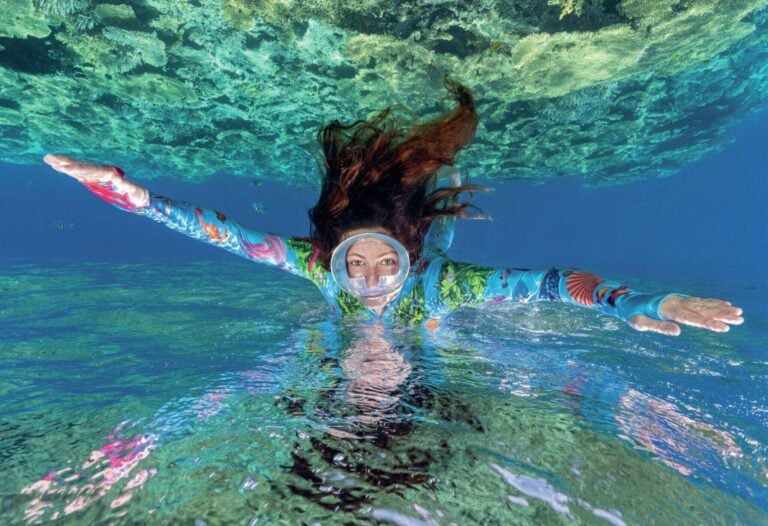
Alex Mustard discusses some ideas for underwater-photography-related New Year resolutions
Photographs by Alex Mustard

A New Year, A New Underwater Photographer
It’s the start of 2026, and it is time to consider the leaves we should be turning over to improve ourselves as photographers. The fun place to start is exercising our credit card. Fortunately, there are always exciting new products in the world of underwater photography that can transform the types of images we take. Underwater shooting is a technically challenging branch of image-making -and that means that the best gear innovations really do expand our horizons.
Mirrorless Cameras: Evolution, Not Obligation
First up it’s cameras. The big photographic news of the last few years has been mirrorless cameras coming of age. That doesn’t mean you have to get one, because older cameras didn’t suddenly stop working (despite what Nikon, Canon and Sony would have you believe). But it is also realistic to conclude that if you are not currently shooting mirrorless that your next camera will be mirrorless, and things like lens purchases should be planned accordingly.
Mirrorless cameras bring some significant technical advances over SLRs, but not all of these translate underwater. So do your research – a good place to start is this column from exactly a year ago, where we made a deep dive into the topic.
Where Image Quality Is Really Won or Lost
The big advances in underwater photographic equipment in the last ten years have not been cameras, but in underwater optics and underwater strobes. And for us, these both have a much bigger potential for transforming the quality of images we can produce. If you are looking for rewarding resolution for 2026, investing in these areas is a smart move.

The bottleneck for underwater image quality has always been the air/water boundary. Our cameras need to be in air (inside our housing) while the subject is in the water. So at some point the light must pass between these two mediums and this boundary causes all the problems. Of course, it is easy for a camera to see underwater, just as it is easy for us to see through a facemask, but as soon as it tries to see away from straight ahead the image quality drops significantly. Next time you are on a dive, try purposely looking at details in the reef through the corner of your mask and you will appreciate the problem.
These optical problems have always been known, but the solution required the combination of the highly complex mathematics and specialist optical products, and with so few people interested in underwater imaging, cost stopped anyone solving the problem. That was until a little over ten years ago when Nauticam led the way, pointing powerful optical design software at the issue, which could now be run on home computer. Numbers were crunched and specialist underwater optics were constructed that squashed the optical gremlins. These days we’ve never had it so good and there is an entire range of lenses that can create pictures with edge-to-edge quality that previous generations never dreamed of, and specialist optics that make previously impossible images completely mainstream.
The Quiet Revolution in Underwater Lighting
More recently, we’ve seen a revolution in underwater lighting. LED torches are now easily powerful enough to be photographically useful and small ones are regularly exploited for creative macro photography, while large ones can be used as off-camera light sources in wide angle photography, particularly in darker environments. More importantly, the last couple of years has seen a proliferation in underwater flashes or strobes. Five years ago almost everyone was using just a couple of well-established brands. Now there are lots of new names on the market who revolutionised what we can light with high-performance products. Not only that, but some strobe manufacturers, like Retra, have realised that even more important than the spec sheet is the quality of light and prioritised this in their designs. It is like having golden hour in your pocket, as finally strobe manufactures have realised that photographers don’t want to just shoot in the brightest midday tropical sun, but the most-attractive images come in beautiful light.

All that said, while retail therapy might be the easiest photographic resolution, almost every underwater shooter will transform their results far more by working on their game, not their gear.
Why Better Diving Makes Better Photos
Humble diving skills are too frequently ignored by snappers as a route to better photos, which is a big mistake. Most photographers, once they have done several hundred dives, conclude they know what they need to. The best resolution I can recommend is to avoid thinking you’ve ‘learned diving’ and to adopt the attitude that we all, always, can keep learning.
New Year Resolutions: Escaping the Creative Rut
Probably the biggest frustration I hear from photographers is that feeling of being stuck in a rut creatively. Your pictures continually improve, but you find yourself always shooting the same subjects in the same way. Breaking this cycle is tough and I believe it takes a deep-seated resolution that goes to heart of our relationship with photography.

None of us gets to dive and shoot as much as we’d like, and it is natural to repeatedly return to the same tried-and-tested techniques if you want to get as many good shots as possible. But I challenge you to question if this is the best route. Nobody wants to see 3,000 photos from your last Red Sea week, perhaps your time would be better placed working on a few special shots. What an audience love is seeing a just handful of seriously stunning pictures. The best start is to make your goal the enjoyment of taking photos underwater, rather than the enjoyment of getting good shots (or even winning a contest). This gives you permission to play, to experiment and frees you from your hobby being results-driven. Any dive where you enjoy the creative process of working with a camera is what really matters. And over time this will see you creating fresh imagery and most importantly truly memorable pictures.
Measure Success by Enjoyment, Not Output
There are lots of ways to revolutionise your underwater photography in 2026: new gear, new destinations, new subjects… But above all, I’d encourage you to ditch fear of failure, and not to measure success through how many good shots you can get on a dive, but on whether you enjoyed the process. Experiment and play with ideas and more likely than not you will produce types of images you never have before. And having just finished judging UPY 2026, I can assure you that the winners circle is dominated by such creative thinking, not photographers taking very good versions of the shots they have before.
Frequently Asked Questions
What are good New Year resolutions for underwater photographers?
Focus on improving diving skills, experimenting creatively, and investing in optics or lighting rather than constantly upgrading cameras.
Is mirrorless worth switching to for underwater photography?
Mirrorless is the future, but older cameras still perform well underwater. Lens and housing choices matter more than camera bodies.
What gear upgrades make the biggest difference underwater?
Underwater optics and strobes have had the greatest impact on image quality over the last decade, more than cameras themselves.
How can photographers avoid creative burnout underwater?
By prioritising enjoyment, experimentation, and play over results-driven shooting or chasing volume and competition wins.
What matters more in underwater photography: gear or skill?
Skill, buoyancy, and creative thinking will improve images far more than new equipment alone.
This article was originally published in Scuba Diver Magazine
Subscribe today with promo code DIVE1 — enjoy 12 months for just £1!
