Alex Mustard turns his attention to that true crowd-pleaser – shark photography
Photographs by Alex Mustard
I love my rugby, so I’ve been glued to the telly for most of the autumn watching the egg-chasers’ World Cup. Once again, when rugby reaches high stakes knockout matches, it is the goal kicker that so often decides the match.
And for the second World Cup in a row, Handré Pollard of South Africa (and Leicester, who he was busy playing for when the tournament started) made the difference when it counted, as the Springboks won three matches in a row by a single point to clinch the title.
op sportspeople really show their mettle when the pressure is at its greatest, training and preparation allowing them to perform at those critical moments.
In many disciplines of underwater photography, like the popular pursuits of reef wide angle and macro, we have time to think and consider our shots. But when the action hots up, such as when we jump in with sharks, the nature of the challenge changes.
We need both sharp reactions and that spare capacity to make good photographic decisions under pressure, to make sure we go beyond a record shot and truly make the most of these opportunities.
Creating images that people want to look at is an aim that unites all photographers, and there is no argument that this should be easier when diving with exciting subjects. But the excitement of these encounters – and the pressure of wanting to get a shot – often stifles our creativity.

This month’s column is about making the most of the precious opportunities that come when photographing sharks, a subject that is guaranteed to get our heart pounding and our shutter finger pumping.
Photographing them typically involves some waiting around, interspersed with high-octane moments. The challenge is to keep a cool head, when the opportunity presents itself and your adrenaline is flowing.
Like an elite sportsperson, the key to such success is preparation, knowing your techniques and knowing how encounters will pan out.
A successful shark photographer studies the species, plans for the likely shots, rehearses and optimizes settings. Then in the moment we have to stick to our plan and take the best possible version of the image we have prepared for, rather than snapping away randomly.
Sharks are reasonably easy to shoot. They are usually better photographed with a wide-angle zoom, than a fisheye.
Nauticam’s WWL and WACP lenses are my preferred options because they offer a very wide zoom range, have an ideal angle of coverage at the widest end (130˚) and don’t make sharks look skinny and weedy like rectilinear wide angle lens do.
We generally use strobes to light them, balanced with the ambient light, but some of the larger species are photographed in ambient light only.
Beyond that, the main rule with shark photography is that there is definitely not one size that fits all. The photographic approach differs greatly species to species, location to location and also with how the encounters are run by the operators.
Starting with the biggest species, basking and whalesharks, the main challenge is often finding them and getting good encounters.
The majority of shots are taken snorkelling without flash, although in a few places where whalesharks are attracted to boats, such as in the Maldives or Indonesia, there can be the chance to dive and use flash.
When shooting with available light it is important to use it well, swim slightly towards the sun as the shark approaches, so it passes you with the sun on it. With whalesharks, if you have the skills it is also possible to freedive beneath them and shoot silhouettes.
Sharks that rest on the seabed are favourites with photographers because they don’t swim away, allowing us time to compose them in their environment, or get close ups of faces and other details.
Nurse sharks are a widespread example, but I also love the angel sharks of the Canaries, the wobbegongs of Raja Ampat and the resting whitetips of Socorro.
Other sharks, like scalloped hammerheads, offer ephemeral encounters, the reward for venturing into their realm and waiting quietly and patiently for them to approach. With such limited opportunities, being ready with your lighting and settings is essential.
Reef sharks are more reliable, but often wary and can stay beyond ideal photography range. In some locations we may use bait or chum to attract them in. Some of you may not agree with attracting sharks with the scent of a meal and I am not here to change your mind.
I think we should all only take the types of underwater photos we are happy with, but I will share why I am happy to use bait, because I see so many places around the world where the sharks have been fished out.
And baited sharks definitely help protect shark populations by turning them into a living commodity for the local community. Baited dives give repeatable and predictable encounters and are the easiest way to shoot sharks. Challenge yourself to go beyond the obvious shots and to try more advanced techniques, like long exposures.
Many of the biggest sharks require bait. Over the last 20 years quite a lot of tiger shark dives have been developed around the world. Tiger sharks are intelligent and quickly adapt to these dives, but they remain incredibly powerful predators.
Do your research thoroughly and choose your operator and location carefully to have a safe and respectful experience. Just because others have done a dive, doesn’t mean it is well run.,
Safety is a big part of these dives, following the local operators instructions and avoid getting stuck in your viewfinder, oblivious to what is going on around you. Practice shooting from the hip, aiming at the pectoral fin on the shark, not its head, so you avoid chopping off its tail in photos.
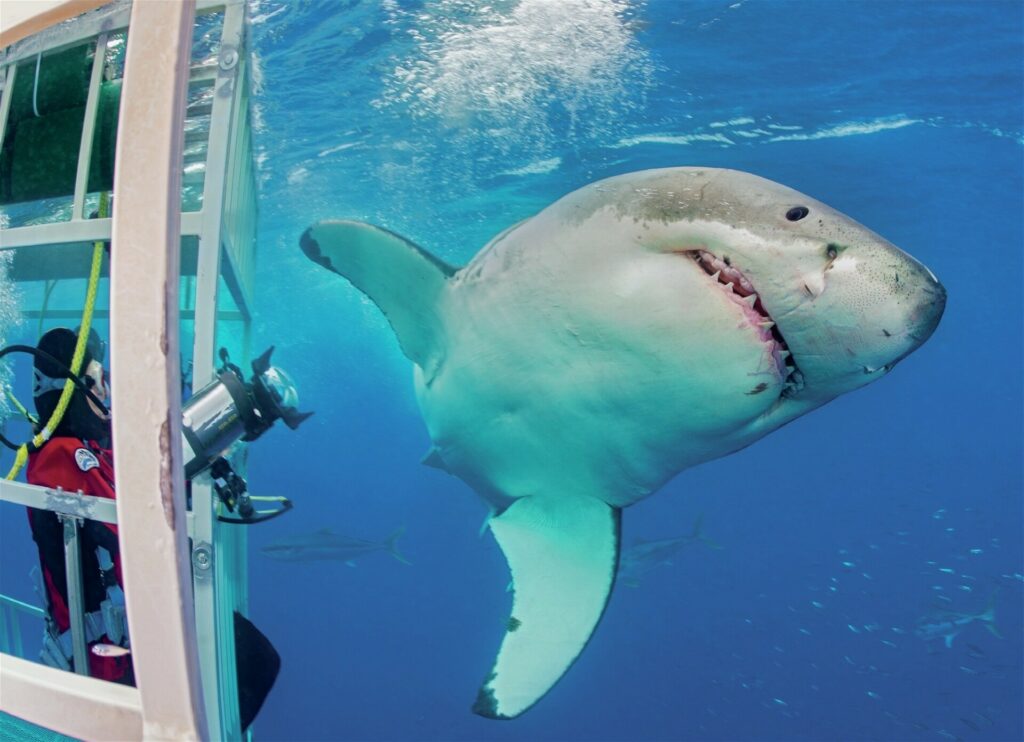
The great white is top of the shark tree and all the reliable encounters with them are baited. All operators also use cages, which limit our movement and photography options, but do mean we are freer to focus on our camera than on other big shark dives.
White sharks are stealthy and you need you senses on red alert so you don’t miss a pass.
This diversity of experiences is part of what makes shark photography such a fulfilling branch of underwater photography.
It is a genre that rewards those that can perform in the critical moment of a close pass. It is no wonder some underwater photographers get totally addict to this type of photography. In future columns, we will dive deeper into the specifics of different shark dives.

This article was originally published in Scuba Diver Magazine
Subscribe today with promo code DIVE1 — enjoy 12 months for just £1!