Breathtaking karst caves peppered between charming French villages and stunning river valleys welcomed Kerrie Burow, who was embarking on a cave photography course
Photographs by Kerrie Burow, Ingrid Olberg & Max Masu
The Lot district in the central area of southern France is one of the most-famous cave diving areas in the world. The three rivers in this area -Dordogne, Lot and Cele – feed dozens of caves including some of the deepest siphons in Europe, many of which are diveable.
In early October 2022, I had the opportunity to attend a multi-day cave photography workshop in the Lot. The workshop was being run by Global Underwater Explorers (GUE) cave diving instructors and photographers JP Bresser and Kirill Egorov.
It was open to any diver with at least a cave-level rating. Having heard so much about cave diving in the Lot, long being an admirer of the cave photography of JP and Kirill, and itching to start spending regular time in Europe again after a few years of closed Australian borders due to Covid, I jumped at the opportunity.
Traversing continents
My journey to the Lot from Sydney consisted of three flights -Sydney to Hong Kong, Hong Kong to Paris, and then a domestic flight from Paris to Toulouse in southern France.
At Toulouse airport, I had arranged to pick up a small hire car to drive the approximately two hours north to The Cave to Be dive shop, where the photography workshop was being held, and for daily travel between my accommodation, the dive shop and the caves sprinkled around the Lot district.
The Cave to Be – the mothership
Gramat is a small town in central, southern France surrounded by farmland and with a population of about 3,500. The town has a very large supermarket and every facility you may need during your stay.
Lying on the outskirts of Gramat is The Cave to Be – the most well-known dive facility in the area. It’s an excellent TDI / IANTD / GUE training centre run year-round by well-known cave diving instructor Olivier ‘Oli’ Bertieaux.
As well as offering cave diving courses from beginner to advanced to CCR, it’s fully stocked with cave diving gear for sale (Halcyon, XDeep, Shearwater, Santi, Tecline, Aqualung) as well as equipment rentals (tanks, scooters, etc), guided dive services and an excellent filling station offering trimix, nitrox and oxygen.
Accommodation
The Cave to Be can also arrange accommodation in a multilevel farmhouse just a two-minute walk from the dive shop.
This is where I stayed, along with the other photography workshop participants. The large, charming farmhouse is split into small apartments with all the basics (and more) you may need, including excellent showers and Wi-Fi. There’s a very large BBQ area with a wonderfully long outdoor table, parking, a basic dryroom for drysuits and plenty of clothes-line space.
In the realm of gastronomy, the Lot district emerged as a foodie paradise. The farm-fresh food and exquisite wines surpassed expectations, elevating the overall experience of the trip. We varied our meals with restaurant visits, home cooking in the farmhouse’s kitchens and a communal barbeque on the last day.
The cave photography workshop
The cave photography workshop with JP and Kirill ran for three days at the Cave to Be. It was a truly international mix of participants with four Europeans (each from a different country), a cave diver based in Dubai and myself coming from Australia.
The divers were also a mix of cave to advanced-cave level, and a mix of configurations with sidemount, backmount twins and CCR all represented among the participants and the instructors.
Eager to get cracking and learning, we quickly settled into a structured routine. We spent half of each day in the classroom learning cave photography theory and techniques from JP and Kirill. Then, at the end of each daily classroom session, we would be given an assignment to focus on during the next cave dive.
We chose our buddies for the day, decided on a cave to dive from the many available, and then went off to cave dive to try to nail the photography assignment underwater. As usual, I found the technical lessons on lighting the most interesting as well as the most challenging.
The drives to and from the caves added a wonderful scenic dimension to the trip. These typically being 20- to 30-minute car journeys winding through pretty little French villages, each exuding historical charm and nestled into the valleys formed by the meandering rivers.
One particularly memorable drive took me past the stunning Rocamadour, an historic town ingeniously built into the side of a limestone cliff.
On the following day after a cave dive, we would critique the previous cave dive photography results together as a class and discuss what worked, what didn’t and what we could and would change on the next shoot.
It was a wonderful opportunity for us all to get targeted instruction on areas of our cave photography we wanted to improve as well as a challenge to master new techniques introduced by JP and Kirill.
The cave diving
I was able to dive in three different caves while in the Lot -Source du Marchepied, Emergence du Ressel, and Gouffre de Cabouy.
Source du Marchepied is, like many of the caves in the Lot, about a 25-minute drive from The Cave to Be. The cave is accessed via a small entrance on the edge of a river. There’s a 30-metre restriction at the entrance which has only just become possible to do in backmount, though it’s still more comfortable in sidemount tanks.
After the restriction, the cave opens up into a beautiful passageway with water so clear, it’s like diving in gin. This was my first cave dive there, and I must admit I was so enthralled by how beautiful it was that I didn’t take many photos!
The next cave I dived was Emergence du Ressel (often just referred to as ‘Ressel’) – a very large cave and probably the most well-known cave in the Lot as it’s also considered the training cave. Ressel is very close to the village of Marcilhac, and the cave begins in the Cele riverbed.
The size of the car park is a testament to how popular this cave is – both times I was there, on weekdays, the parking lot was almost full of customised ‘cave vans’, the vehicle of choice for European cave divers.
Entry to Ressel is easy – walk your gear about 100 metres from the carpark to the edge of the river, climb down a few steps into the river, then do a short surface swim until you’re over the entrance of the cave.
You then drop down to about 8m and follow a slope into the cave. The entrance, and the passageways, are quite wide, making the cave popular for scootering.
It’s the go-to cave for cave divers of all levels due to its multiple long passages, so dives here can be at the beginner level (with an accompanying instructor and only at the start of the cave) to the very technical for deeper and longer penetrations using scooters and CCR machines.
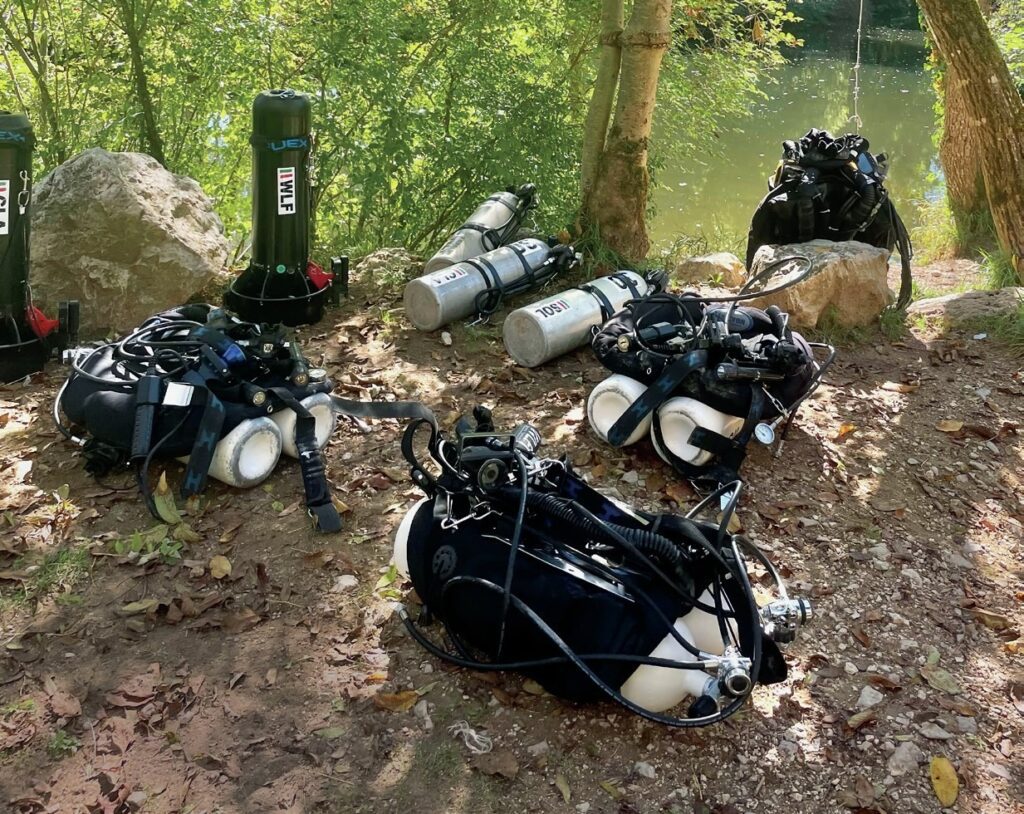
The variety of divers and dives here means it can get quite busy, especially just inside the entrance where we saw a few cave classes happening (the blindfolded divers being a giveaway).
Being focused on doing the photography workshop assignments on my dives here and not penetrating too far, I really look forward to diving this cave again as I only experienced a small part of the adventures it offers.
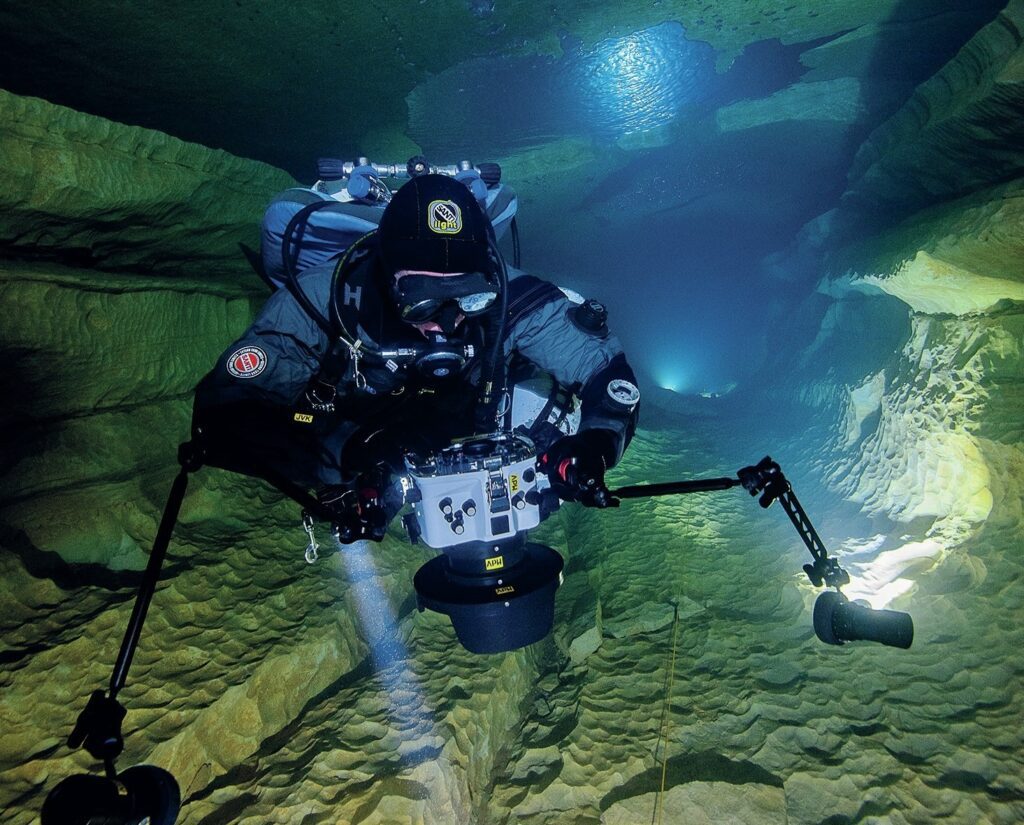
Finally, Gouffre de Cabouy. This was my last cave on this trip to the Lot, and the one which left the biggest impression (and an itch to return). The entry to the cave is via a short surface swim to the opposite riverbank, where there is a buoy indicating the cave below.
Dropping down, we followed a rope in zero visibility to the cave entrance, after which the visibility started to clear significantly. The cave then drops to about 30m where it becomes shallower, opening up into a huge passageway that seems endless.
I remember thinking how it seemed like a semi-trailer truck could be driven through it. I was told Cabouy is an example of a ‘Power Cave’ and it’s easy to see why! ‘Epic’ is another word to describe it.
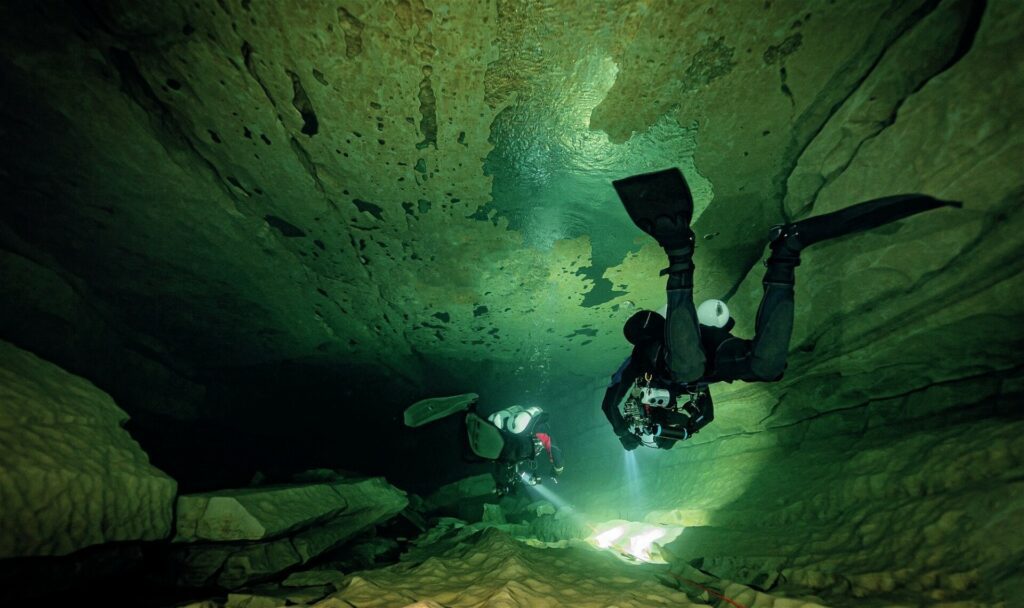
Overall, the caves themselves were nothing short of breathtaking. Featuring mostly wide and long passageways, the caves boasted very good to excellent visibility. Surprisingly, the temperatures both in and out of the water were warmer than anticipated.
With an average of 14 degrees Celsius, the caves in the Lot were no colder than the caves in Mount Gambier, Australia. Above the surface, early October graced the region with perfect weather – warm, dry, and sunny days.
Most of the time, I was dressed in a T-shirt, just needing to don a light jumper for the cooler evenings, a subtle nuance of the seasonal transition.

Conclusion
Overall, the cave photography workshop in the Lot, France, with JP Bresser and Kirill Egorov proved to be an outstanding learning experience. I successfully addressed several technical challenges that had been a source of struggle in my cave photography.
The wealth of knowledge imparted during the workshop also equipped me with new techniques, which I’ve implemented in my subsequent cave dives in Australia and Mexico.
I’ve now had a taste now of cave diving in France, and I can’t wait for a repeat visit in the near future.
Note: JP Bresser and Kirill Egorov have run an annual cave photography workshop in the Lot, France, for most of the last few years. Keep an eye out on their social media accounts for more information.


We design, manufacture and retail scuba and rebreather equipment. We have fully equipped test and certification labs, and can pressure test large items in our vacuum chambers, as well as run fully automated leak test and dive simulations down to 400m. Our EMC and EMF lab is filled with state-ofthe-art equipment for testing electromagnetic compatibility and electromagnetic fields. We also have a large in-house laser for cutting and engraving on plastics and metals. www.narkedat90.com
This article was originally published in Scuba Diver UK #83
Subscribe today with promo code DIVE1 — enjoy 12 months for just £1!