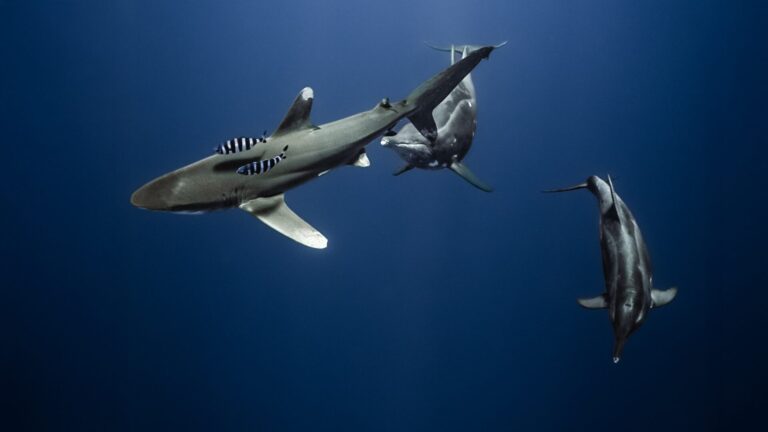
Much-touted international trade measures designed to protect endangered sharks are being routinely violated, according to a new study.
CITES (Convention on International Trade in Endangered Species of Wild Fauna and Flora) is a treaty between 185 national governments intended to regulate international trade in wildlife products. In theory, species listed on CITES Appendix I cannot be traded commercially, and those on Appendix II can be traded only if the trade is proven to be sustainable and legal.
However, researchers have concluded that Critically Endangered species such as hammerhead and oceanic whitetip sharks, first listed under Appendix II more than a decade ago, continue to appear in “alarming numbers” in the markets of the world’s biggest shark-fin trade hub, Hong Kong.
The study was led by Mote Marine Laboratory and also involved Florida International University, the Wildlife Conservation Society (WCS) and others,
“Oceanic whitetip fins are 70 times more common in the trade than documented by CITES, and hammerheads are 10 times more common,” says study co-author Demian Chapman. “It has been this way since 2014 and unless countries take stronger actions these species may be doomed.”

Using DNA analysis of more than 16,000 fins collected between 2015 and 2021, the researchers found that those from CITES-listed species appeared in 6.5% of all sampling events – significantly higher than the level governments report to CITES.
In one case, 70 times more oceanic whitetip shark fins appeared in Hong Kong markets than are shown in official CITES reports – meaning that more than 95% of trade in the species is illegal.
Turtle example
“CITES is the strongest global tool we have to ensure that wildlife trade isn’t driving species toward extinction,” says another co-author, WCS director of shark & ray conservation Luke Warwick. “When it’s implemented well, it works – but more is clearly needed to ensure it works for sharks.
“Forty years ago, green turtles were Critically Endangered and listed on Appendix I. The global trade stopped and their populations have rebounded all over the world, and they are no longer endangered.
“That’s the power of CITES. For some shark species, like the oceanic whitetip, that same level of protection is being considered at CITES CoP20 this month. This study shows just how badly it is needed, if we are to save the world’s most threatened sharks from trade-driven extinction.”
Genetic evidence
Many exporting countries report zero trade in Critically Endangered shark species even though genetic evidence confirms the presence in Hong Kong of sharks caught in their waters and neing sold on the international market.
“This study reveals a systemic failure to uphold existing protections,” says lead author Dr Diego Cardeñosa. “The science is clear: CITES can stop trade-driven extinctions – but only if countries enforce it. We urgently need stronger accountability and better traceability tools to ensure these species aren’t pushed beyond the point of recovery.”
The study, supported by the Shark Conservation Fund, is published in Science Advances.
Help PADI AWARE shark appeal to enter Red Sea trip draw

The PADI AWARE Foundation is seeking US $100,000 (£763,000) to help it fulfil its commitment to protecting sharks and rays, and says it will enter all donors to its 2025 appeal, whatever their level of contribution, into a draw to win a seven-night Emperor Divers liveaboard trip in the Egyptian Red Sea, including airfare.
The conservation body says that reaching its target will allow it to launch and sustain its global Shark & Ray Census ; provide timely, reliable data for decision-makers ; measure and advocate for shark protections worldwide; equip trained volunteer divers with survey tools and guidance; and track progress at priority sites and highlight where action is needed.
Donors of £200 or more will receive a limited-edition whale shark hoodie designed by artist and conservationist Kent Yoshimura. Donations can be made here.