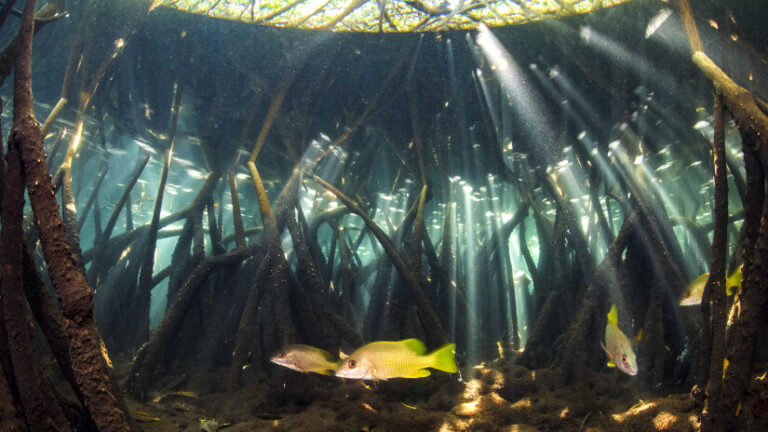
After decades of heavy losses, the destruction of coastal mangrove forests has slowed as their importance is recognised. But according to a new study a shock awaits in the future, because the oceans are warming too fast for that mangrove recovery process to keep up.
Increasing sea temperatures are set to erase those mangrove-restoration gains that had been expected to result from conservation and economic development, according to researchers from University of California (UC) San Diego’s Scripps Institution of Oceanography, a major centre for global earth science research and education.
Divers in tropical and subtropical regions are often drawn to mangrove sites, where salt-tolerant trees with their exposed roots grow in intertidal zones and support a distinct set of marine life.
The economic value of these wetlands has come to be recognised in recent years, because mangroves protect coastal human communities from storm surges and tsunamis, create habitats for fish and other wildlife, store carbon and improve water quality. This has led to greater effort being put into protecting them.
However, the Scripps scientists’ three-year study concludes that by 2100 the world will have lost some 150,000 hectares of mangroves and the economic value of their associated “ecosystem services”, estimated at around US $28 billion per year.
Mangrove tolerance
Rising ocean temperatures will exceed the limits of mangrove tolerance ni some regions more than others. Nearly two-thirds of the projected annual losses will occur in Asia, estimated at $18.6 billion, followed by the Middle East and Africa ($5.4 billion) and Latin America and the Caribbean ($3.6 billion).
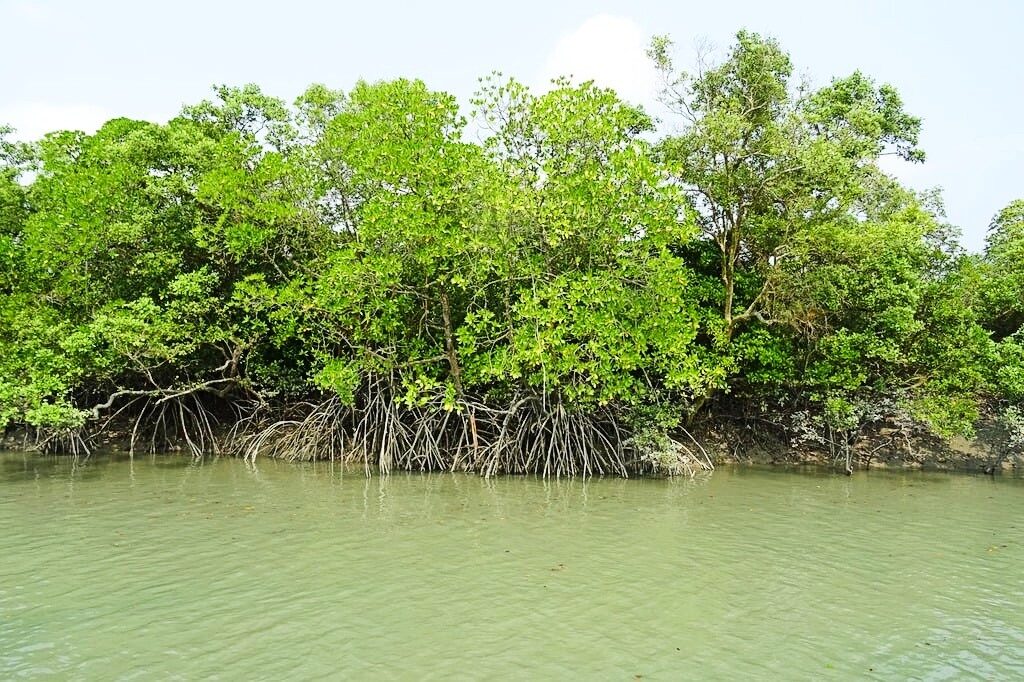
“As a country gets richer you tend to see an initial increase in environmental destruction, but once a place achieves a certain level of economic development the environment degradation starts to diminish,” says study co-author Katharine Ricke, a Scripps climate scientist.
The researchers analysed high-resolution satellite data on mangrove-forest coverage from 1996 to 2020, combining this with local economic indicators and ocean surface temperature records for 1,533 locations worldwide.
By isolating the effects of changes in sea-surface temperature and gross domestic product in these places from other factors such as local governance and conservation policies, future mangrove coverage under various climate and economic scenarios could be projected over the next 75 years.
The models show economic growth and associated increases in conservation restoring substantial mangrove coverage over time, only for the warming oceans to wipe out these gains almost entirely.
“Socio-economic and policy forces are currently strong enough to cancel out climate damage to mangroves, resulting in stability rather than decline,” says Ricke. “But our projections show we need to accelerate both conservation efforts and emissions reductions to keep making progress for mangroves.”
The team wants to see those working in mangrove conservation and restoration now integrating climate projections into their targets. Their study is published in Environmental Research: Climate.