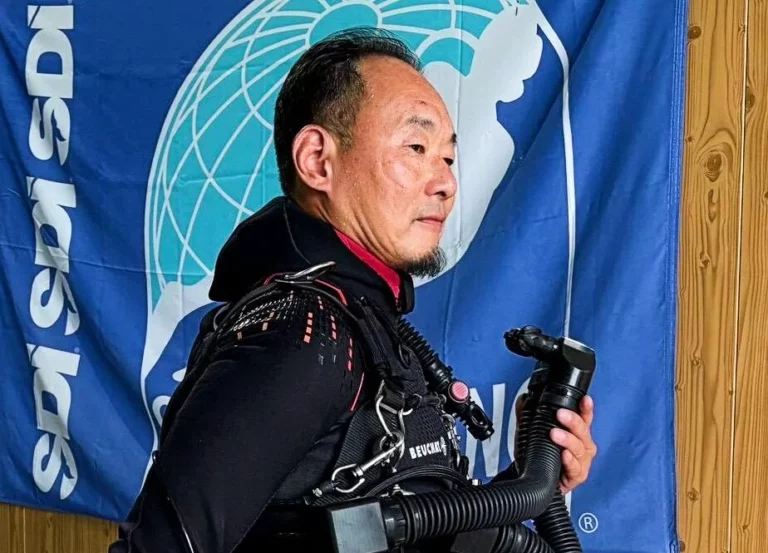
A 57-year-old Taiwanese rebreather diver died earlier today (7 February) while searching for human remains in a World War Two-era Japanese undersea coal-mine.
The man, named as Victor Hsuwei or Wei Hsu, had been part of an international group of divers investigating the Chousei mine off the coast of Ube City in Yamaguchi prefecture.
Hsuwei was a technical diving instructor-trainer and a member of the Japan Karst & Underwater Exploration Project (JKUEP), which has been heavily involved in exploration of the mine. A rebreather specialist, he was a cave-diving instructor with extensive experience, particularly in Mexico, and a member of the Japanese Speleological Society.
Hsuwei had been diving with two others from about 11.30am but at around noon was reported to have suddenly experienced convulsions before falling unconscious. One of the other divers had gone back to raise the alarm.
Hsuwei was taken to a decompression / medical-support point inside a ventilation-shaft, where CPR was administered. He was taken to hospital by ambulance under the care of paramedics but failed to regain consciousness and was later confirmed to have died.
The mining disaster
By February 1942, Japan was actively engaged in military operations across South-east Asia and the Pacific, with its mining operations heavily mobilised to support the war effort.
The miners at Chousei included Korean labourers, who were often conscripted to work in Japanese mines under wartime conditions. Of the 183 workers who died when the undersea tunnel collapsed and flooded with seawater, 136 were from the Korean peninsula.
Abandoned and sealed with the bodies inside, the mine had remained largely forgotten until recent decades. It has been surveyed intermittently by technical divers directed by a Japanese civic group, the Association To Record The Chousei Coal Mine Flooding, with the aim of recovering victims’ remains. Some human bones have already been found on earlier dives.
Entry is made via ventilation-shafts that protrude from the sea and last August divers had reported finding remains at a depth of about 43m. Visibility inside the mine is typically poor because of mud and silt.
The recent diving operation had begun on 3 February, on the 84th anniversary of the mining disaster. Scheduled to continue for eight days, it has now been suspended.
Sebastian Dobrowolski, CEO of Polish training agency the International Diving Federation, described Hsuwei as “an enthusiastic, calm and forward-thinking leader who quickly became the driving force behind our growth in Asia and the first official IDF representative outside Europe.
“The impact you made on the history of cave-exploration will not fade – it will continue to inspire future cave-divers, explorers and adventurers,” he said.