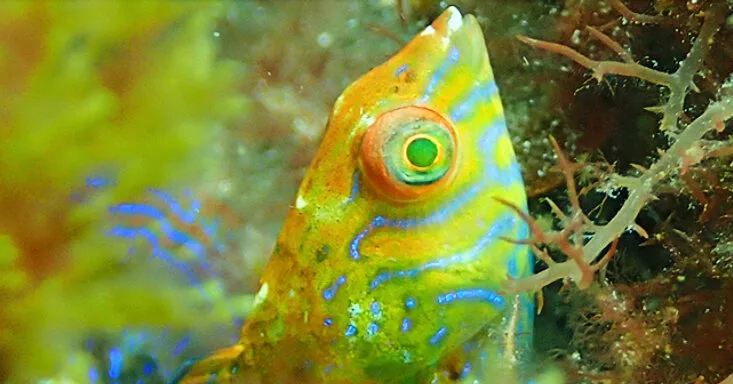
Marine ecologist Océane Attlan was on her last dive of a four-day expedition to study changes caused by marine heatwaves in the Great Southern Reef (GSR) kelp forests off Western Australia.
“I was conducting a fish survey and wasn’t specifically looking for the Braun’s wrasse,” she said. “When it appeared, it took me a few seconds to register what I was seeing, because the species is so rarely encountered. Within moments I realised it was something special.
“I got very excited but, out of nine dives, that happened to be the only one where I didn’t have a camera on me – so I needed to find a buddy to quickly try to get some shots.”
The PhD candidate was diving with four other researchers from the University of Western Australia (UWA) Oceans Institute, and the tiny fish she had spotted near Albany is so rare that it had been officially recorded only once since its discovery in 1996.
The vividly coloured Pictilabrus brauni or Braun’s wrasse has been seen in only a handful of locations along Western Australia’s south-west coast since it was first described near Albany, a port some 400km south of Perth. The wrasse has one of the smallest geographic ranges of any temperate fish in Australia.
Despite years of targeted surveys in the region the shy species, which grows to no more than 7.5cm long, had not been seen since a scientific survey 17 years ago.
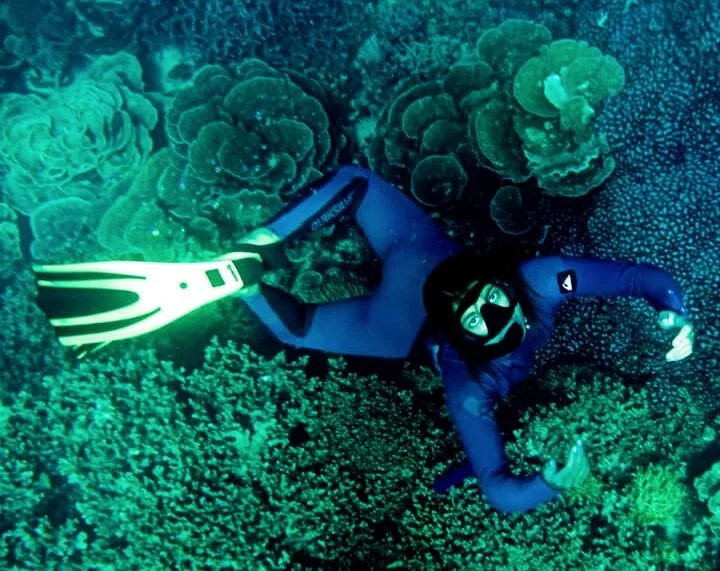
Diver with camera
Another of the divers, Dr Albert Pessarrodona, did have a camera and just had time to take two photographs before the wrasse disappeared back into the kelp forest.
The shots were posted to a fish-ID site, and two curators from the Western Australian Museum joined a Tasmanian-based researcher who had last spotted the species near Albany in 2009 to confirm its identity.
“The marine heatwaves that have struck south-west Australia in recent years had raised concerns that the species had gone extinct, making this confirmed sighting particularly important,” says Attlan. Effective camouflage could explain the scarcity of sightings, although “with relatively few active marine ecologists covering extensive and remote reef systems, many species may remain overlooked”.

Global hotspot
The biologically rich GSR stretches 8,000km along Australia’s southern coastline as far east as New South Wales. “Despite its extent and productivity, the GSR remains far less well known than Australia’s tropical reefs,” says Attlan..
“It is home to one of the highest levels of endemic marine flora and fauna in the world, hosting seaweed and fish species found nowhere else – making it a global hotspot for biodiversity conservation and particularly vulnerable to climate change.”
Other discoveries on the recent expedition included a sea snail 500km further south than its current known limit, and another rarely observed fish. “Documenting rare and endemic species is a crucial step toward understanding, protecting and managing these unique underwater environments,” says Attlan.
Also on Divernet: World’s Biggest Plant Revealed in Shark Bay