When fishing-boat crew reported a large whale entangled in fishing rope south of Cape Recife in South Africa on the morning of 2 September, the National Sea Rescue Institute (NSRI) was quick to respond.
Two of its rescue craft were dispatched from Gqeberha carrying South African Whale Disentanglement Network (SAWDN)-trained crew equipped with specialist cutting and other equipment. The fishing-boat remained on-site to guide them to the scene.
“We found a large humpback whale entangled in fishing rope trailing a flotation buoy and appearing to be anchored to the seabed by one of the ropes,” said NSRI Gqeberha cox’n Kevin Warren. “A seal was also found to be on the scene, swimming around – and what appeared to be the casualty whale’s mate, another large humpback whale, was close by.”
The tethered whale, which appeared healthy and strong, was swimming in wide circles, and when rescuers got close they found line wrapped around its fluke and the base of its caudal fin, along with a bird’s nest of rope on one of its flanks.
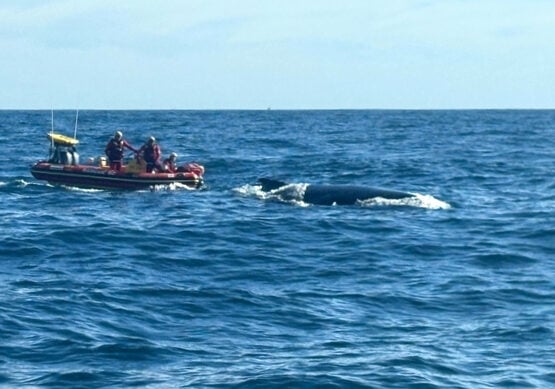
Two more humpbacks then joined the victim’s mate and kept impeding the NSRI craft as the rescuers worked to attach grappling hooks to a trailing line in a bid to slow the whale down – though it continued swimming in circles. With many rope cuts required, two cutting poles and a specialist knife were lost as the crew struggled to free the humpback.
“While cutting on the fishing rope at least five orcas then arrived on the scene – we assume they had come to take a look at what was going on,” said Warren. “By that stage the seal had left and the three humpback whales that had remained on the scene appeared to chase the orcas away.”
It took another four hours of “extremely challenging conditions” to release the whale and collect the line and buoy for disposal.
“When we finally cut away the last fishing line that was anchored to the seabed the affected whale and the remaining whales dived under water and swam off, not to be seen again,” said Warren. “We’re confident of the success of this SAWDN disentanglement operation.”
Whales in Wales & Devon
Meanwhile in the UK several unusual whale strandings have occurred, according to Marine Environmental Monitoring (MEM), which says that the change in weather at summer’s end has coincided with an increase in calls to its stranding line.
On the same day as the humpback rescue in South Africa the MEM was on Cefn Sidan sands in Carmarthenshire, Wales to examine the reported decomposing remains of a fin whale, the second largest whale after the blue whale.


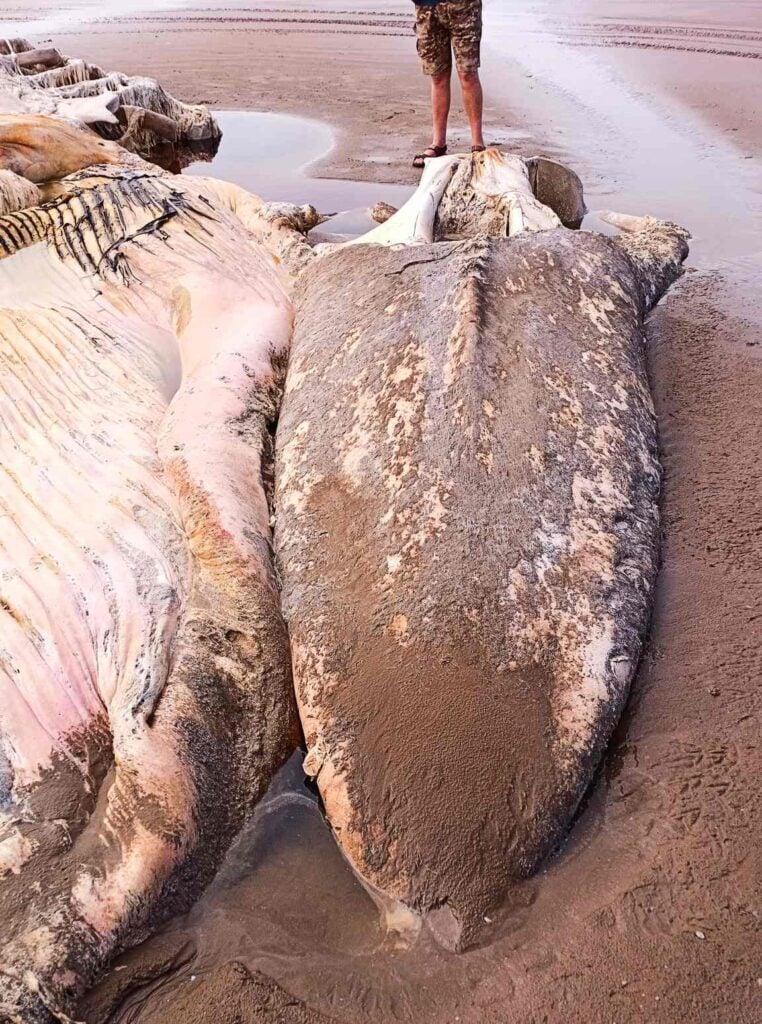
Thought to be a female, it was more than 21m long – its head alone measuring more than 5m and nearly 2.5m wide. It is only the fifth fin whale reported in Wales in the past 24 years.
The previous day, I September, a 2.7m juvenile female long-finned pilot whale had live-stranded on Rhossili Bay beach, also in south Wales on the Gower peninsula. I
t was found by passers-by who raised the alarm but at 2.7m long the animal was too big for them to move, and died before the Coastguard and British Divers Marine Life Rescue (BDMLR) could reach the scene.
MEM suspected that it had become separated from its family unit, and a post mortem examination was being carried out.
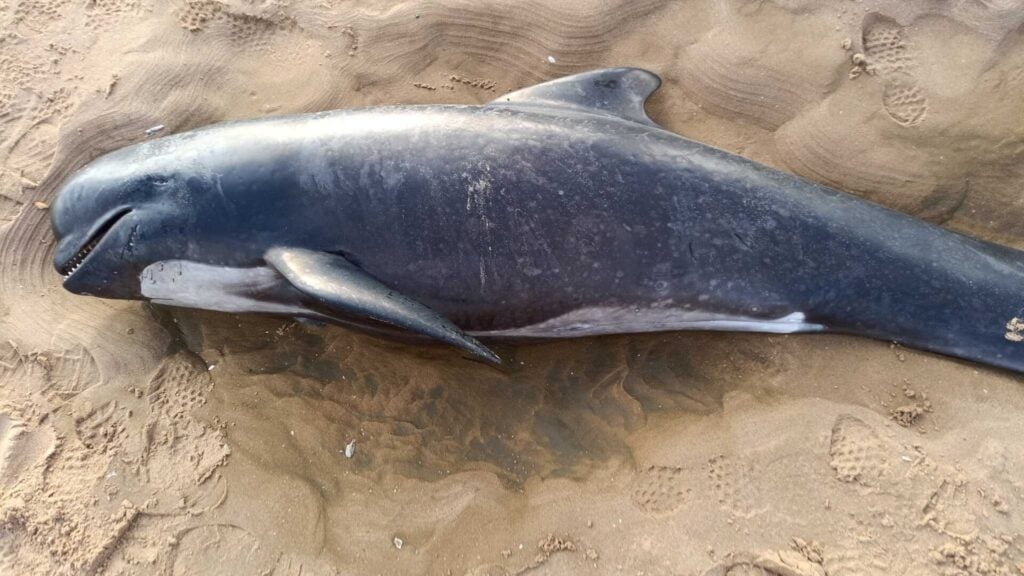
In England on the same day a 4m pygmy sperm whale, considered exceptionally rare in British waters, was found dead on Bigbury Beach in South Devon. Its carcass was removed using a local farmer’s tractor.
Devon Wildlife Trust described the event as “a very rare stranding indeed” and praised the co-ordinated efforts of BDMLR and trust volunteers and local residents: “Although incredibly sad to see such a magnificent and rare mammal, this incident highlights the huge value of local people in supporting marine citizen-science and conservation.”
The UK Cetacean Strandings Investigation Programme (CSIP), based at the Zoological Society of London, is conducting a post mortem to establish cause of death.
The pygmy sperm whale was described as a species only in 1966 and little is known about this deep ocean-dweller – though in August a calf washed ashore in Honduras with a plastic bag in its stomach.
Divernet also reported last month on soaring rates of cetacean strandings in Scotland.