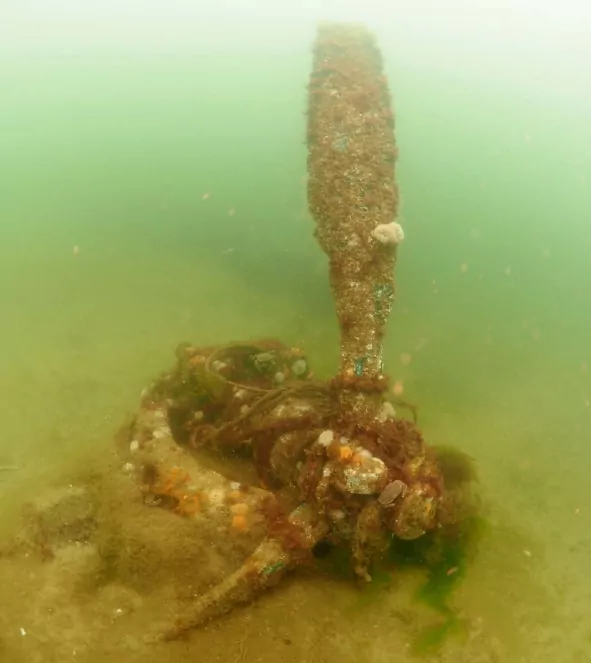
An East Anglian scuba diver came across the remains of a WW2 bomber wreck by chance in 2022 – and recently had the opportunity to share the experience with BBC news radio listeners.
Diver Rob Spray from Suffolk had come across the wreckage of what proved to be a Handley-Page Hampden twin-engined aircraft in 7m-deep waters off Salthouse beach in north Norfolk. The stand-out remnant was a Bristol Pegasus engine with one of its three propeller blades still intact.
Also read: 80 years sunk: Another Beaufort bomber traced

“I was looking for interesting bits of seabed and this loomed out of the slight murk,” Spray, chair of the Marine Conservation for Norfolk Action Group and a Seasearch diver, told BBC Radio Norfolk’s Look East programme, which can still be heard on BBC Sounds. “The clincher was: that’s an aircraft engine with a propeller on.
“It was quite a big piece of wreckage and it’s got to have been there since the war, so these are 80-year-old artefacts hanging around on the seabed.“
The aircraft wreckage was richly colonised by sessile life and provided a hang-out for lobsters, crabs, prawns and wrasse.


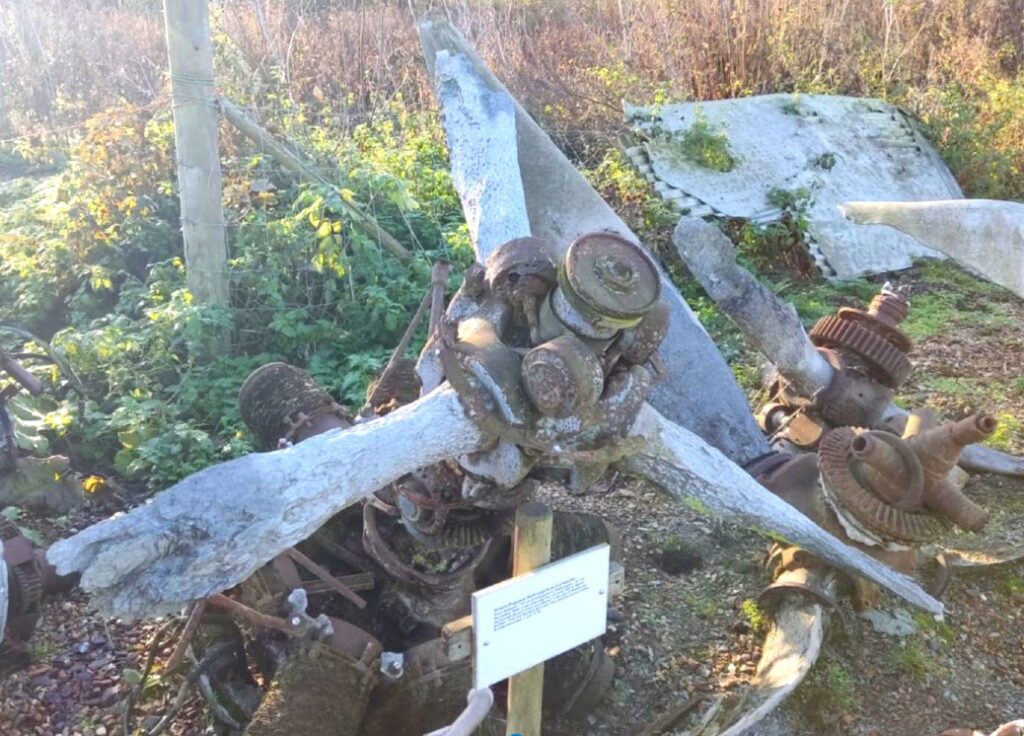
Paul Hennessey of Norfolk Wreck Research helped Spray to identify the aircraft. “There was only one engine at the site so this was throwing quite a large spanner in the works for us,” he said, but research indicated that the other engine had been recovered in 1975 by local diver John Wise as a favour to fishermen who had been snagging their crab-pots on it.
That unit had been left lying in the grounds of the Norfolk & Suffolk Aviation Museum at Flixton, near Bungay, Suffolk, where it can still be seen – though divers will be in no doubt as to which of the two matching artefacts holds the most interest.
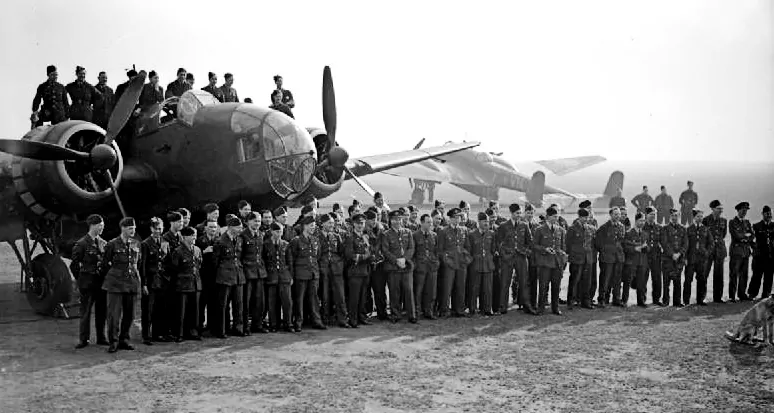
The bomber, identified as P-2123 from RAF Waddington, had pancaked in the North Sea on 1 September, 1940 about a quarter of a mile off the coast, after running out of fuel on its way back from a raid on Berlin.
It had submerged on impact but then popped back up for long enough to allow the crew to get clear and take to their inflatable dinghy.
The aircrew who survived the ditching – and landmines on the beach – were Sgt Jimmy Mandale, Sgt Harry Logan, Canadian pilot David Romans and fellow Canadian, navigator Donald Stewart.
Geoff Mandale, whose father Sgt Jimmy Mandale had been rear gunner, still had the plane’s flight logbook and spoke to the BBC. Shown the wreck footage, he commented: “He’s done a really good job, that diver – I have to thank him.”
He said that his father had been lucky, having flown 47 missions without seeing an enemy aircraft at which to fire. He had survived the war and died at the age of 63.
Aviation historian Bob Collis from the museum described the Hampden as a “largely forgotten aeroplane – over 1,000 were built and only three examples are left”.
Also on Divernet: GREEK DIVERS FIND LUFTWAFFE AIRCRAFT WRECK AT 60M, THREE TRUK AIRCRAFT WRECKS LOCATED, WW2 AIRCRAFT WRECK LATEST IN STRING OF ESTONIA FINDS, NAXOS BEAUFIGHTER STILL FLYING HIGH FOR DIVERS
.
.
.