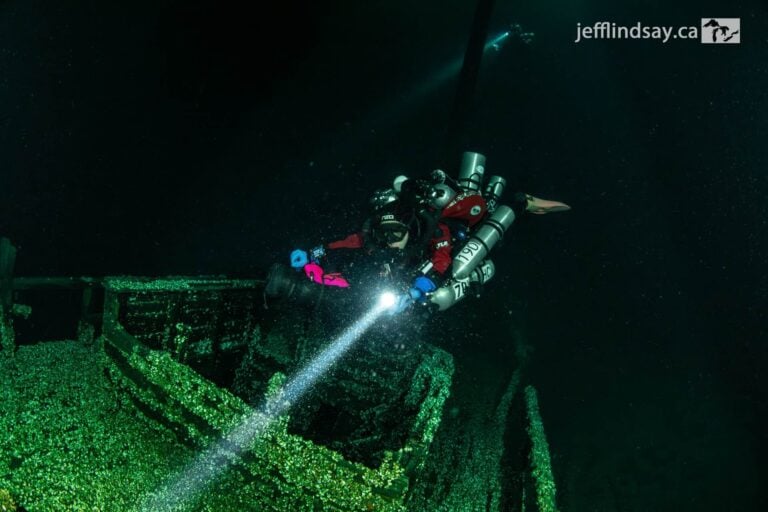
Many well-preserved shipwrecks have been discovered in the Great Lakes, but it is unusual to find one with its masts still standing and thought to date from the early 1800s, as an experienced team of Canadian technical divers believe they have done in Lake Ontario.
The team, led by Ontario Underwater Council (OUC) president Heison Chak, had been prepared to find the two-masted Rapid City schooner, built in 1884 and lost in 1917, but the wreck they encountered at a depth of around 100m appears to be considerably older.


Using closed-circuit rebreathers, Chak carried out two dives at the site out from Toronto with underwater photographer Jeff Lindsay, joined by colleagues Greg Hilliard on the first dive and Terry Irvine on the second.
They found the shipwreck in an exceptionally intact state, and were especially surprised to find that both the mainmast and foremast remained standing. If not damaged during a sinking, it is usual for the masts of sailing ships to collapse over time.

Even more unusually, the divers observed a preserved feature that Chak says he had never before seen on wrecks he has dived in Ontario or the St Lawrence River – an intact topmast.
“It took us a few moments to calm ourselves down, because it’s overwhelming finding a pristine wreck that is all in one piece,” said Chak after the dive. “It’s got its shape. It hasn’t broken down… both masts were standing, which is pretty rare.
“This is deep enough that I don’t think anyone’s been on it. I think we’re the first group, and that joy was just overwhelming.”

Based on visible structural features, the team believe the vessel is likely to be British and to date to the early 1800s. Its rigging is made of rope rather than the metal cable that became common only after the 1850s.
The absence of both a centreboard, introduced later to increase stability, and a wheel on the aft deck were also consistent with early 19th-century boat-building.

Timber samples
British vessels on the lake in the early 19th century typically supported coastal forts, patrolled and defended Ontario (then Upper Canada) and transported troops, munitions and supplies.
The wreck site was first detected as a large anomaly during a fibre-optic cable survey in 2017, and it was Trent University archaeologist James Conolly who drew the dive group’s attention to it, in the belief that at that depth it would allow study of a previously undisturbed wreck in an excellent state of preservation.
Conolly was present on the expedition and was able to map the wreck from the divers’ observations and photographs.

Chak says the team plan to return to the wreck next summer to measure it and obtain timber samples for dating purposes.
The Aurora-based OUC was founded in 1958 to represent recreational scuba divers and support safe diving. It also works to protect underwater cultural heritage such as shipwrecks in co-operation with archaeological organisations.
On the US side Lake Ontario is home to a national marine sanctuary, managed by the National Oceanic & Administrative Administration (NOAA) with regulations to protect shipwrecks.
In June this year a University of Rhode Island / NOAA-led expedition used an ROV to survey the sanctuary and mapped 17 sites, including “previously uncharted wrecks”. NOAA’s maritime archaeologists reported being “stunned” by the number and condition of wrecks in Lake Ontario.
Read the two-part Ghost Ships Of The Great Lakes on Divernet.