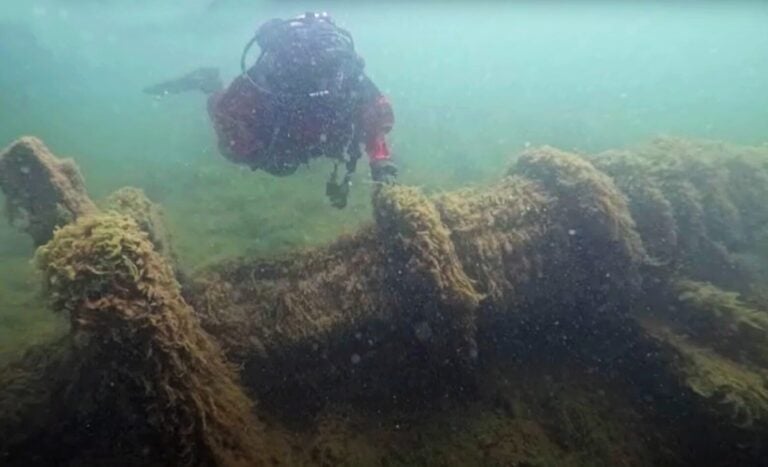
Two historic Great Lakes bulk-carriers have been discovered and now dived by well-known wreck-hunting teams.
In 1913 the James Carruthers had only recently been completed as Canada’s largest bulk-carrier, and until its discovery the 165m-long ship had remained the largest undiscovered wreck in the Great Lakes.
The steel-hulled vessel disappeared along with many others in one of the worst North American inland maritime disasters, the four-day Great Lakes storm known as the “White Hurricane” – and is one of the last of its victims to be found.
It was spotted as an anomaly at a depth of 56m by 84-year-old David Trotter, skipper of the Lake Huron dive-boat Obsession Too. Responsible for finding two previous White Hurricane casualties, the John A McGean in 1985 and the Hydrus in 2015, he and his team reckon to have found as many as 100 wrecks in the lake altogether.
Trotter is the subject of a book by Gerald Volgenau, Shipwreck Hunter: Deep, Dark & Deadly in the Great Lakes.
10m waves
The James Carruthers, built for the St Lawrence & Chicago Navigation Co of Toronto and new enough that the paint was hardly dry, was laden with some 10,000 tonnes of wheat grain. The ship had left Fort William for Midland, both ports in Ontario, with a crew described as numbering between 22 and 28 on 6 November, 1913.

After heading down Lake Superior she was last seen entering northern Lake Huron early on 9 November.
With winds gusting at 90mph and waves up to 10m, the storm claimed at least 250 lives, including the entire Carruthers crew. Wreckage from the ship and some bodies, including that of the captain, started washing ashore on the Canadian side of the lake on 12 November.
One body bore a ‘JT’ tattoo and what seemed to be a familiar burn scar on one leg, so the parents of sailor John Thompson had resigned themselves to burying their son – until the man himself arrived safely home, having decided to join another ship.
Trotter, who had been searching for the Carruthers for five years, noted the mark on 26 May and found that its dimensions matched those of the long-lost ship.
He returned to the site on 27 July, when eight divers used rebreathers to give them time to explore the inverted wreck, accompanied by an ROV to livestream video to the boats above.
The wreck was surrounded by unusual clouds, thought to be caused by fermenting grain from the holds, and the divers were unable to find any way of getting inside.
The Frank D Barker

Meanwhile, considerably smaller and shallower, another grain/coal-carrier has just been found in Lake Michigan. The long-sought Frank D Barker had gone missing after stranding in 1887, and was rediscovered by serial wreck-finder Matt Olson, owner of Door County Adventure Rafting.
Last year Olson had found another wreck in the lake, the Grey Eagle, which sank in 1869, and in 2023 had discovered a scow schooner, the Sunshine.
He had been scouting for rafting sites when he caught sight of timbers at a depth of around 7m, and reported his find to the State Historic Preservation Office.

Subsequent dives by Tamara Thomsen and her team of maritime archaeologists from the Wisconsin Historical Society enabled them to identify the Frank D Barker, which had been 20 years old when it sank after hitting rocks in foggy conditions.
Written off and forgotten
The 41m carrier had been bound from Manistee to Escanaba, both in Michigan, to collect a load of iron ore. Following six failed attempts to recover the stranded vessel, it had been written off and forgotten.
Olson spotted the wreck within a body of water named Barker Shoal. Although long thought to have been named after the vessel, it had also been assumed that it would have come to rest closer to the site of its stranding at Spider Island.

The Frank D Barker had been built in 1867 by Simon G Johnson of Clayton, New York with a design described as unique to the Great Lakes.
Carrying grain from Milwaukee and Chicago to Lake Ontario and usually coal from Lake Erie ports on return trips, its overhanging features had been designed to pivot upwards to enable the vessel to fit through narrow, shallow locks.
The Wisconsin Historical Society predates both the Frank D Barker and James Carruthers, having been founded in 1846. Its dive-team hope to carry out an archaeological survey of the Frank D Barker next year with a view to having it listed on the National Register of Historic Places. In the meantime the wreck is legally protected under state and federal laws.
Read the two-part Ghost Ships Of The Great Lakes on Divernet.