Exploring the mysterious Mikea caves in southern Madagascar became almost an annual ritual for PIERRE CONSTANT over more than a decade, and he learnt much about subterranean diving in the process. He also came across the remains of strange creatures forgotten by time
My relationship with the Indian Ocean island of Madagascar has been a steady affair for more than 30 years. In 2012, curiosity brought me there to explore the sinkholes of the Great South, south of Tulear on the Mahafaly Plateau.
From previous cave-diving experience in South Australia I understood that sinkholes, often connected to underground rivers, could be a source of unexpected finds, such as fossils of prehistoric animals. Madagascar would certainly yield such a bounty of hidden treasures, as was the case with Brazil or Mexico.
Following the break-up of Gondwana, Madagascar separated from Africa 130 million years ago, in Jurassic times. A vast sedimentary basin formed between the two, leading to significant deposits of limestone on the west coast of Madagascar, stretching from the Tsingy of Ankarana in the north to Bemaraha near Morondava, and in the Great South.

Like a gold-digger on a lucky streak, I kept coming back. The lure of the Great South and its enchanting spiny forest, together with the discovery of sinkholes – here known as aven or dolines – had hooked my interest.
Back in 2011, I explored Itampolo on the Mahafaly Plateau. The following year the sinkholes of Tsimanampetsotse National Park fascinated me. I discovered skulls and the skeleton of an extinct dwarf horned crocodile (Voay robustus) that had appeared on the south-west coast 11,700 years ago during the Holocene period.

Diving to a depth of 25m at Binabe Cave near Sarudrano, north of the Onilahy River, I found the femur of a dwarf hippopotamus (H lemerlei) in the sediment. Researchers at the Museum of Natural History in Paris carbon-dated the bone and found it to be 1,400 years old.
A few months later, at a remote inland sinkhole, I came on the lower jaw of a dwarf hippo with teeth intact. This species became extinct due to man’s predation as early as the 7th century AD. That find was incredibly exciting.
Sadly, the fossil site of Tsimanampetsotse was closed by the Malagasy authorities following looting for profit by an unscrupulous individual.
Finding Ali Baba
In September 2015, I ventured onto the Belomotra plateau, north of Tulear. This is a karstic Eocene limestone environment hidden in the Mikea forest, made up of endemic species such as octopus trees, giant Pachypodium and baobabs. The rough, sandy tracks were accessible only by using a 4×4.

This remote region is home to an indigenous tribe, the Mikea. They have long been familiar with its caves and waterholes from their searches for bats and drinking water, and without their help I would have been unable to proceed.
Karan businessmen once prospected here and for several years would load their trucks with bat guano from the dry caves. I checked these caves first but was frustrated to find no signs of diveable water after tough treks under the scorching sun.

Then, in 2015, a lucky strike led me to a wonder cave that I named Ali Baba. Carrying dive equipment, it was a fair walk into the Mikea forest along the reddish sandy trail. An inconspicuous lentil-shaped opening in the limestone was my portal into the underground world.
I had to duck beneath a low ceiling to enter the narrow passage. In pitch darkness, a slippery slope with loose rocks led to a fascinating chamber with stalactites, stalagmites and Dantesque pillars.
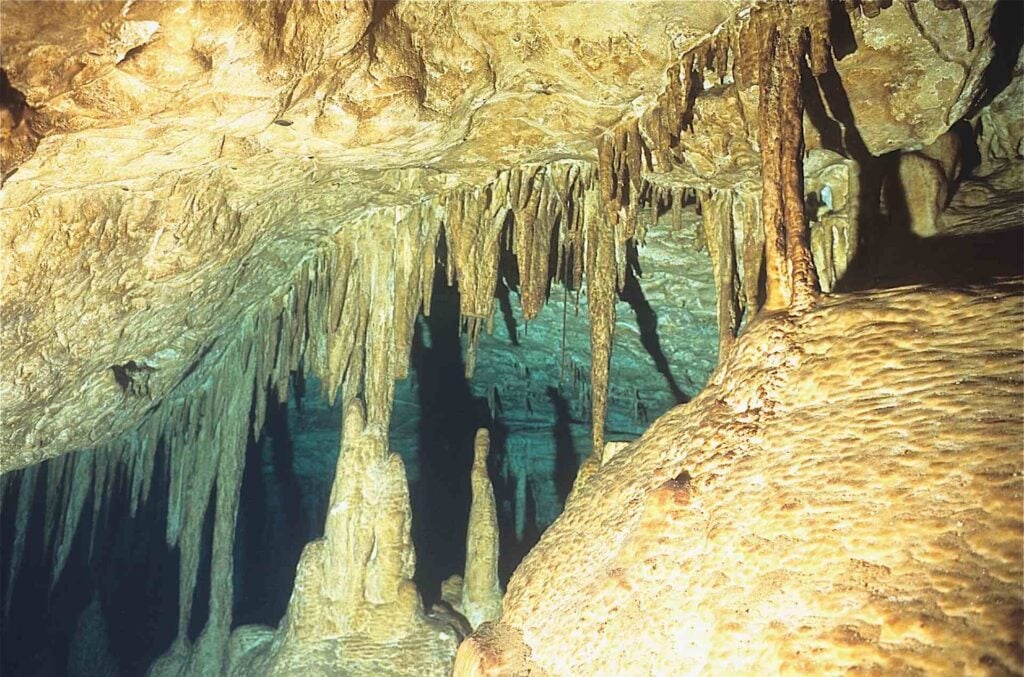
Fifteen to 20m below ground, a subterranean lake with more pillars appeared. The air was stale, hot and humid – I sweated profusely and breathing was difficult. Bats fluttered about in the darkness and cockroaches crept over the damp guano floor.
Double-checking my dive-equipment carefully, I handed my headlamp to the Mikea guide. “Turn on the light on my return,” I said as I slipped into the balmy 28°C water. I could see white and blind endemic cave fish (Typhleotris pauliani) that would have thrived on the bat guano.

At the lake’s end, the bottom dropped steeply into twisting passages among golden and brownish stalactites and pillars. The deeper I sank, the whiter the limestone became.
At a depth of 20m I managed to squeeze through a restriction without getting stuck and then the cave opened up magnificently. Pushing ahead into a snaky tunnel I was amazed by the surrounding beauty but as a solo diver on a single tank I had to be realistic on this occasion.
Venturing into a succession of chambers in Ali Baba cave in 2016, I marvelled at a replica of the Phallus impudicus mushroom in front of a cascade of stalactites. It was an awesome sight and a morbid thought crossed my mind: I wouldn’t mind dying in a tomb like this one.

On to Gargantua
Fresh revelations from my local host provided a new direction for my quest. A courtesy visit to the local headman or fokontany was compulsory. Offerings to the cave spirits had to be made by a sorcerer with hazy eyes. Sitting in front of his hut, absent-minded, the old man watched the flies go by. The ritual required a little bottle of rum and a few packets of tobacco.
My Mikea guide knew the forest like the palm of his hand. We trekked into the spiny bush beyond a set of baobabs to a collapsed sinkhole partially covered by vegetation.


Ten metres down, I gazed at a gaping stony arch with overhanging roots. I named the site Gargantua Cave. An underground lake lay still in the dim light and I submerged into a long, winding, oval-shaped tunnel.

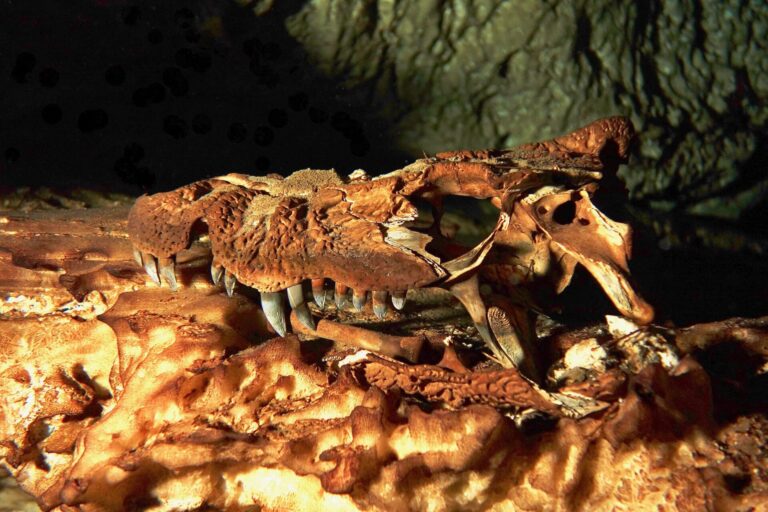
At a depth of 10m, on a bed of fine grey silt, the skull of a dwarf-horned crocodile (Voay robustus) with red teeth grinned at me. The striking coloration was caused by iron oxides in the water. I found the reptile’s spinal cord and vertebrae nearby and, below a ledge, the skull of a full-horned version of the species barely visible in the silt.
Gargantua had been a crocodile lair in Holocene times, 11,700 years ago. The Nile crocodile had yet to reach Madagascar.

The climate had been different then: wet, lush and tropical, not arid as it is now. Voay robustus was a freshwater crocodile living away from the coast, and scientists have found that its functional lingual salt glands secreted excess salt.
Its ancestors had originated in Africa in the Miocene period (23-5.3 million years ago) and had crossed the 400km-wide Mozambique Channel to Madagascar on their own. What caused the extinction of Voay robustus remains anyone’s guess.

I met a restriction at a depth of 14m under a low ceiling with a silty bottom. Fearing a silt-out, I chose to turn around. On the way back to the 4×4, some Mikea men told me of another spot and led me off the track into the bush.
A moment later I was gazing at a star-shaped hole in white and pink limestone, plummeting into a black void. Could this vertical-solution pit open into a chamber below?

“How do you expect me to get down there?” I asked, with an uneasy smile. My guide shrugged, amused like a naughty kid.
Ali Baba revisited
In May 2017, after the wet season, I reckoned I had to go with twin tanks from now on. I brought two of my 11-litre aluminium tanks in a suitcase. Backmount-diving was not an option if I wanted to negotiate restrictions so I had signed up for a full cave and sidemount course in Yucatan.
The 4×4 packed, we headed off. A dirt track meandered along the seashore over rolling dunes. On fringing turquoise lagoons colourful Vezo sail-canoes drifted in the breeze. The big smile of the Mikea guide was welcome.

I chose to avoid the village headman and the mad sorcerer this time. Plan one was to dive Gargantua cave.
I passed the restriction and the tunnel widened, with a conspicuous bend to the left. I reached a T-junction. The depth was now 17m.
I followed the right tunnel for 20m. A stubby stalagmite rose from the cave floor before another bend to the left. The tunnel continued, large enough for a train to pass through, but I called it off for now. The dive had lasted 54 minutes.
In the early hours of the morning, a Malagasy suimanga or sunbird was collecting the pollen of a hibiscus flower. The sun promised to be hot. I had resolved to go as far as possible into Ali Baba cave on a single tank.
I bowed beneath the lentil-shaped gateway and entered the cave sauna. The porter followed close behind with a steel tank on his back. My headlamp was low on power so I switched to the backup torch on the helmet. Holy smoke! A 1.5m snake was coiling on the slope in front of me.

Reddish-brown and silver, with a diamond-shaped design on its sides and back, Dumeril’s ground boa (Acrantophis dumerili) is a species endemic to southern Madagascar and was waiting to ambush passing bats. It ignored us as we proceeded swiftly downhill.
Squeezing through the restriction, I passed a bulbous-headed Phallus impudicus mushroom with the overhang of stalactites behind it. The main tunnel was a mess of broken rocks.
I pushed beyond the great curtain of organ pipes, hanging above a round window, passed through a couple of restrictions and hit a dead end, a rounded chamber displaying ripple-marks in the sediment. The turnaround point, 19 minutes after I started, was at a depth of 24m.
On the way back, I froze in awe before an amazing double pillar below a fountain of helictites, bizarre cave formations that twist and curve in gravity-defying directions.
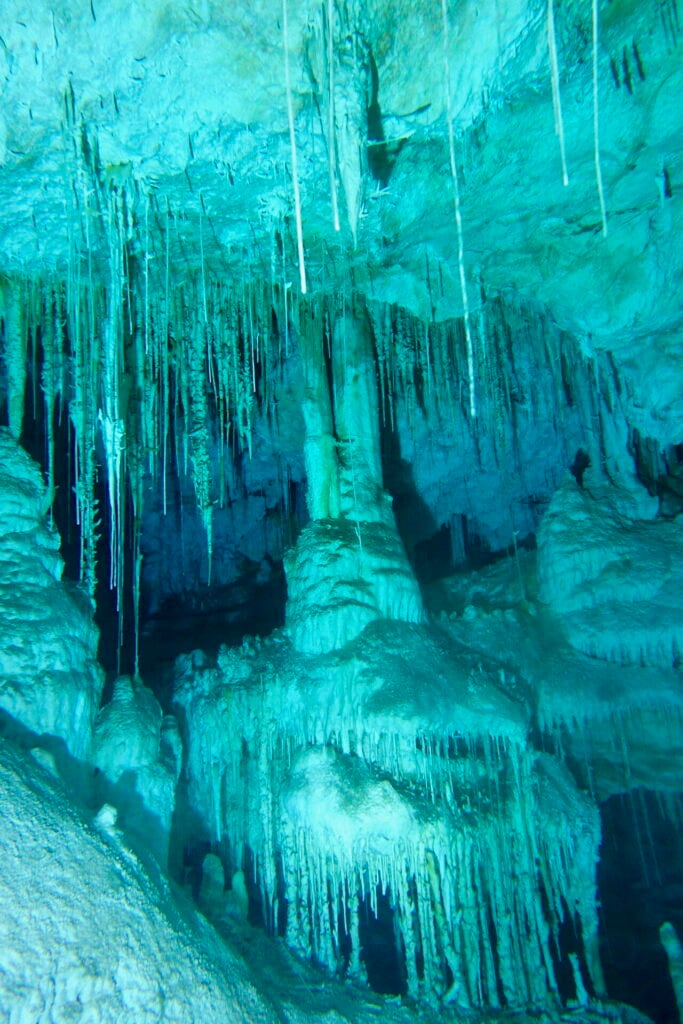
Back in the lake chamber, I was filled with inner peace. On the deco stop a blindfish approached and seemed to stare at me with its vestigial eyes. The porter turned on the light as I surfaced.
Back at Gargantua cave, my goal was to explore the oval-shaped right tunnel after the T-junction, which I reached in 14 minutes. The tunnel passed a stalagmite with a rhino horn before a gigantic pillar rose to my left.


Perhaps 10m tall, the pillar displayed conspicuous marks of former water levels through two dark bands high up, reflecting long periods when the cave lake had a pocket of air above it.
The hot, humid air had cooked the limestone to a black colour. Beyond a short thumb-like stalagmite with two watermarks, my beam of light shone on an apparent dead end at a cave depth of 18m.

On my return I glimpsed the left side of the line, where an adjacent tunnel I had not noticed earlier branched off. I boldly went forward, thinking I was on the right track and saw a cluster of ornate stalagmites with zebra-like markings before facing a dead end.

With only 90 bar left, I was struck by a moment of fear. Exerting mental control of my breathing, I made a swift beeline for the T-junction, followed by a 13-minute rush back to the croc skull.

On the deco stop the light-beam revealed two huge winged crocodile vertebrae above the silt. My inner voice whispered: “Next time sidemount diving, by all means!”
Sidemount time
In 2018, I used sidemount for the first time. Exploring the left tunnel after T1, I reached T2 and ventured a bit further beyond a “shark fin” stalagmite into a right tunnel.


Back to the shallows for the safety stop, I was unable to deflate the wing and found myself stuck to the ceiling. I had to crawl my way back to the exit lake! Later I realised that I had to deflate from the lower back side of the wing rather than the front purge.
Misfortunes strike
In 2019 I experienced a dramatic event, flooding the camera-housing on my first dive. The curse of the cave spirits?
Madagascar was closed for two years during the Covid pandemic but I resumed my explorations in October 2022 – anxious, considering my previous misfortunes.
Overcoming my fears, I pushed into the left tunnel after T2 at 22m to reach T3 through a canyon that was at least 30m deep.
In May 2023 I explored the right tunnel after T2, beyond an oval window up to a cross window, a progression of 1,080m return.


According to early explorers’ research the cave system must have at least 5km of passages heading in all directions. Although I had done the TDI Stage and DPV courses in Yucatan in 2020, I am not foolish enough as a solo diver to venture beyond my capacity and experience. My purpose is underwater photography, and so I need both hands.

I adhere strictly to the sidemount system now. I might be ‘hardcore’ for some or an ‘idiot’ for others, but I’m not a daredevil. However, as part of the Mikea National Park since 2023, the caves have been officially closed by the authorities.

Pierre Constant has been organising and leading trips to Madagascar for more than 30 years with his company Calao Life Experience. Find a dozen more of his extended dive-adventure features on Divernet.