The Isles of Scilly is renowned for its seal encounters, but as Roisin Maddison discovered, there is much more to this destination than playful marine mammals.
Scillies
Eyes closed and my head resting against my makeshift pillow, I thought back on the already-hectic morning starting with a 5am alarm, and thensomehow still managing to be late in leaving resulting in a race from Falmouth to Penzance, in order to get there in time to throw all our dive kit in the container! But finally,I got to sit and relax on the Scillonian III, better known as the ‘great white stomach pump’. But it was all worth it because at the end of the three-hour journey,we would be arriving in the Isles of Scilly for a week’s worth of diving on some of the most-amazing dive sites in England.
Northern Underwater Photography Group
I had been to the Scillies before. Last year, John Adams and I joined in with a week organised by the NUPG (Northern Underwater Photography Group) and fell in love. So we put together a group of ten made up of Seaways staff, regular customers and close friends and booked our own week with Dave Mcbride.


There are only three dive charters operating in the Isles of Scilly and due to weather there is a very short dive season,so we were incredibly lucky to get our own week. We had to book it almost a year in advance, so finally 12months of waiting and excitement had past and we were finally on our way. A three-hour nap later, we arrived.
I had managed to sleep the entire way,which probably had something to do with the early start -and the fact that Iam in no way a morning person –this was definitely going to be a problem for the rest of the week!Our first pit stop was the Mermaid for a spot of lunch and a chance to finally gather our group in one place.
Dive Brief
The way Dave runs his charter is six days of diving Sunday to Friday, meeting early in the morning, starting thefirst dive before or around 8.30am and being back on the island after two dives around 2-3pm -just in timefor a portion of chips and a pint (or two) in the Atlantic for the mandatory post-dive debrief.
So bright and early Sunday morning,there we were, cameras in hand, half asleep and ready for our first day of diving.

The first dive of the day was the Lady Charlotte and it was a perfect first dive to kick off the week. Even though the sky was a rather miserable shade of grey, the sun was attempting to shine through, the sea was flat calm and the water a toasty 14 degreesC.
The Lady Charlotte
The Lady Charlotte is an old cargosteamer formally known as the Aphrodite. She was about 3,593 tons and was built in 1905 by the Tyne Iron Steamboat Company. Sadly, on 11May 1917,shebecome lost in dense fog whiletravelling from Cardiff to France before managing to run aground on St Mary’s Island. Thankfully, the entire crew managed to escape safety but the ship was lost to the bottom of the ocean.
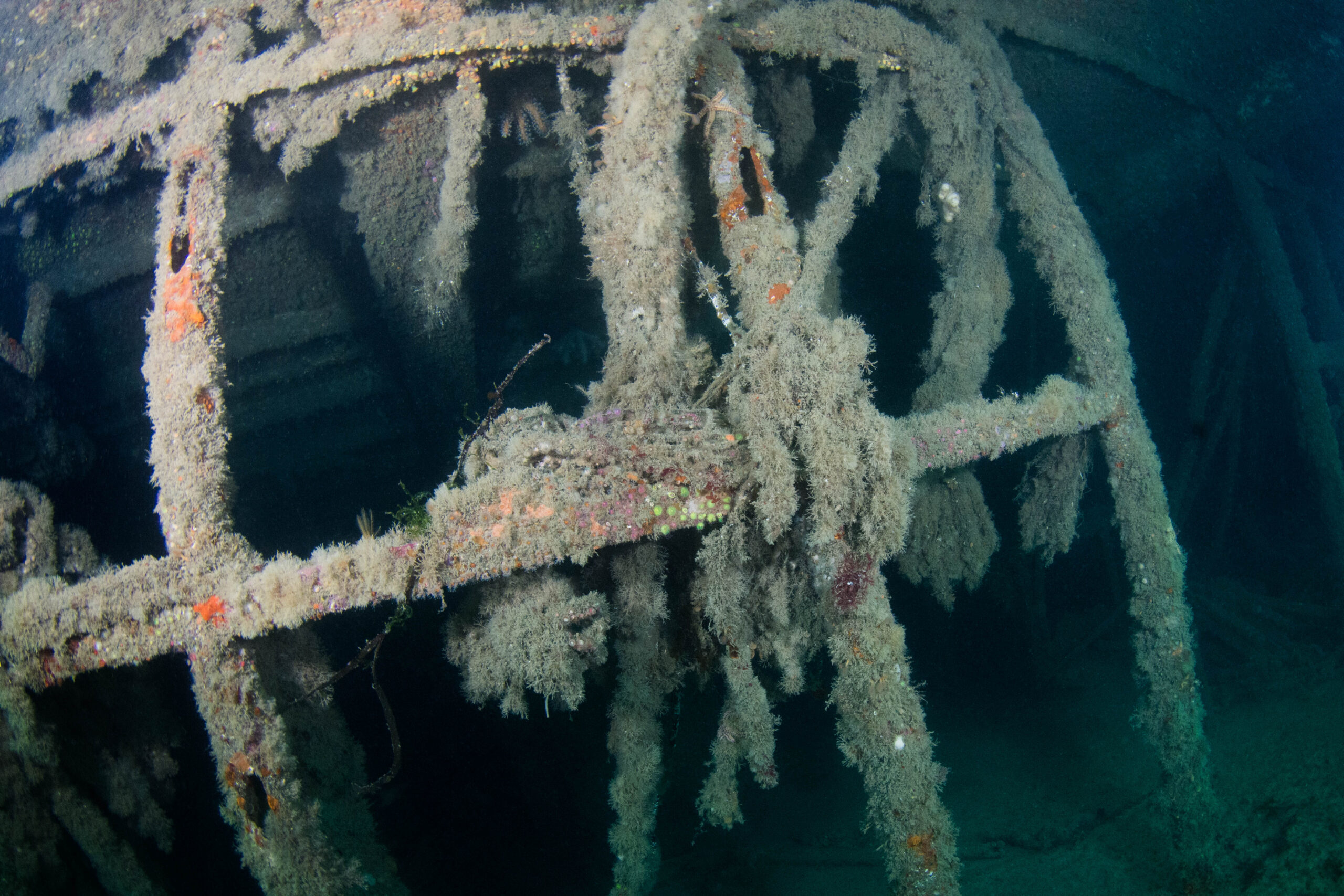
A hundred and one years later and there is still a lot of this wreck left to discover. Although it has been heavily scavenged and broken up, there are still recognisable traits to the ship that she used to be, the most iconic of which are her grand boilers that tower above the seabed and are covered in life.
The wreck lies between 10m-35m,so she is a good dive for all levels of divers, although the really interesting bits of wreckage startat the boilers that lie at about 15m. From here if you gradually head down the slope getting slightly deeper as you go you’ll come across piles and piles of steel plates and other pieces of wreckage.
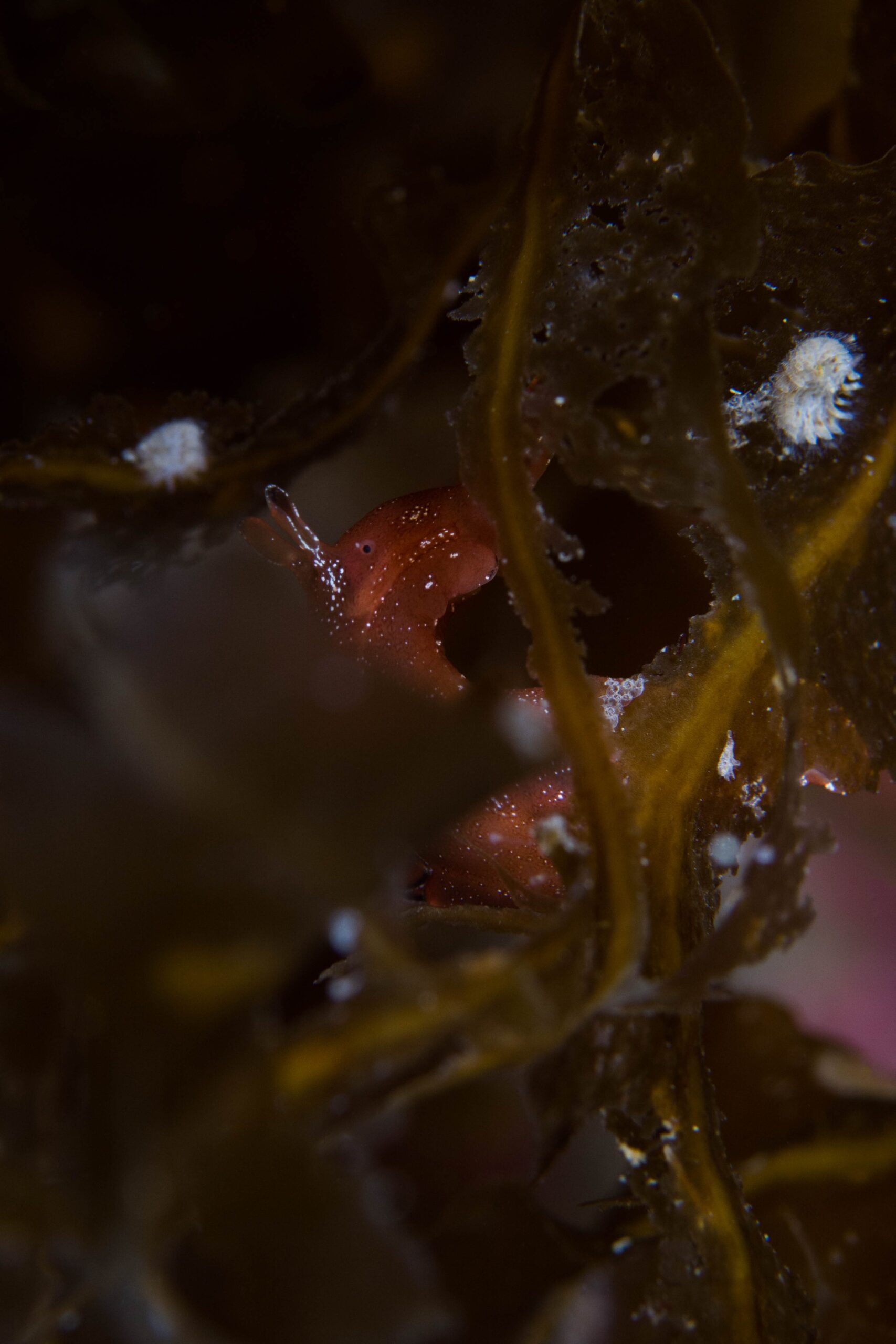
Dueto the grey skies I decided to stick my macro lens on for this dive and I was so glad that I did. Dave had dropped the shot line on the boilers and before I had even reached thebottom I was greeted by a free-swimming nudibranch. Granted it had probably been kicked up and disturbed by the divers that had got in before us, but it was still a lovely welcome. The Lady Charlotte has been totally claimed by the sea and is covered in life, anemones and dead man’s fingers cover nearly every surface and starfish, nudibranchs and crabs can be found hiding amongthem. Myself and my buddy Annie (both avid photographers and lovers of macro and anything small and ‘squishy’) barely moved through our entire 40-minute dive, there was just so much to see.
Second Dive
The second dive that day was the one we were all looking forward to most, the shallowest and probably easiest dive we would do this week but one of the best by far. We headed over to the Eastern Isles, more specifically to the east of Menawethern Rocks, where the seals like to play. Dave dropped the anchor and we all jumped into the water pretty much bang on high tide,when the seals were at their most playful. Annie and I immediately found our pot of gold and positioned ourselveson a little rocky platformin about 5mof water. It took a while for the seals to get comfortable with us.
At first, they just kept diving down, giving us a little eye up and down and then carrying on with their own business, but the little ones just couldn’t resist playing and within tenminutes, they were all over us. They especially loved my bright blue fins and their reflection in the dome port. It was an amazing dive, every time we turned around there was another one nibbling our fins or asking for its belly to be stroked. Seals really are the puppies of the ocean and we were sad to have to tear ourselves away when our 60-minute dive time was up.

t felt right that we would dive the Italia only the day after diving the Lady Charlotte, as both ships were wrecked on the same day.The Italia fell victim to the sea only a few hours later whileall the islanders where helping the crew of the Lady Charlotte. The Italia was also a cargo steamer carrying coal from Cardiff to Taranto when she got lost in the same dense fog and managed towreck herself on Wingletang Rocks to the south of St Agnes.
With all the excitement of the Lady Charlotte,none of the islanders noticed the Italia and, therefore, there was nobody to help its 66crew members. After that night,the Italia was lost until 1964 when it was discovered by Richard Larn,who managed to identify her using the ship’s patent log.
Like the Lady Charlotte,101 years has not been too kind to the Italia and while it lies between 15m-40m, it is well broken up and all of the interesting wreckage likes around 30m-35m; so not a great dive for new or nervous divers. If you are comfortable to go so deep however you will be rewarded with some magnificent wreckage and photographic opportunities as the frame work stands proudly off the bottom ofthe seabed.
Dave dropped the shot in at around 15m and myself and John quickly descended down to about 35m to explore as much as the ship as possible, before heading back up the slope and spending our deco exploring the shallower bits of wreckage. I have been told that if you can find it and if you are prepared to get that deep,the ship’s propeller is still there complete with shaft and is a rather amazing site to see.
Jane Morgan and myself had been begging Dave to let us investigate his crack ever since we got on the boat the day before,andfinally the weather and wind were just right. Now get your minds out of the gutter! Dave Mcbride discovered this reef during one of his many,many exploration dives around the islands and it was rightly named after him. It is also less crudely known as the ‘sweet shop’due to its amazing array of jewel anemones.

The entire site is a deep crevice between two walls, only a couple of metres wide reaching down to about 30m with boulders and swim-throughs to explore and the entire thing is covered in colourful clumps of jewel anemones. We hadn’t gota chance to dive this site the year before so I was super excited to dive it this time and it did not disappoint.
What makes diving in the Scilly Isles so iconic for me is its deep sheer walls covered in life and this was a perfect example. Annie and I were the first in the water and one of the last out. Dave had dropped the shot line on the top of the wall, so we were able to go down the shot line and then descend the rest of the way down the rock face ourselves.
Our navigation was spot on, andwe ended right back at the shot line at the end of the dive and this was entirely due to the fact that other than swimming backwards and forwards under one of the boulders multiple times,we just barely moved anywhere (a theme of the week it would appear). There was just somuch to photograph everywhere we looked and time quickly got away from us.
We reached the halfway point in our week in seemingly no time, so sticking to our general theme we started out with another wreck,the King Cadwollen. As with the Italia and the Lady Charlotte, the King Cadwollen also fell prey to the fog. Built in 1900 she was a 3,275-ton steamer of the Glasgow Kings line.
She left Barry on 21July 1906 on herway to Naples to deliver her cargo of coal, but sadly she would never make her delivery. On 22July shewould strike the eastern rocks. Thankfully the captain and crew managed to get away in the lifeboats, but the King Cadwallon would sink to her final resting place. She now lies on a slope reaching from15m-33m, so a perfect dive for divers wanting to extend their depth experiences.
Dave dropped our anchor on the boilers that lie at about 28m, from there we explored the boilers and surrounding rocks which are covered in primrose and jewel anemones and then headed shallower to find the rest of the wreckage. It is an exciting dive with a lot of intact wreckage still available to explore and penetrate, my favourite of which are the ribs of the hull, upside down they create a cradle that you can swim through and create nice frames for some wide-angle photography.
The Cita is by far my favourite wreck on the Scillies, partially because it is so new and intact that you really do feel like you are exploring theinsides of a ship and partially because of its fantastic story. I don’t have enough words to go into the entire story now but if you are in the Scillies, I highly recommend going to one of Dave Mcbride’s talks on a Thursday night in the Methodist church hall.
Not only is it a fantastic talk with amazing pictures and insights into life on the Scillies,but there is also focus on the sinking of the Cita, from a man who was there when it happened and helped with the clean-up. It really will make the experience of diving it so much more intriguing.
Top 5 Dive Sites in the Isles of Scilly
1. Lady Charlotte
Historic cargo steamer wreck (10–35m), covered in anemones and nudibranchs, with iconic boilers still standing.
2. Italia
Cargo steamer wrecked in 1917; lies 15–40m. Best for advanced divers seeking deeper wreckage and dramatic structures.
3. King Cadwollen
Coal steamer wreck (15–33m). Features intact ribs of the hull, boilers at 28m, and jewel anemones adding colour.
4. Cita
Modern cargo ship (1997) split in two. Bow (8–27m) is ideal for photographers; stern (15–40m) towers dramatically above the seabed.
5. Dave’s Crack (“Sweet Shop”)
A jewel anemone-covered reef crevice reaching 30m, with boulders, swim-throughs, and walls bursting with marine life.
St Mary’s Island
In short, the Cita was a cargo ship which struck the rocks off St Mary’s Island on 26March 1997. She was carrying around 200 containers containing a wide range of treasures and let’s just say that to this day,the island still has a hefty collection of car tires.
As she sank,the Cita split in half, the bow and the stern. While they lie fairly close together there is a large pinnacle separating the two wrecks and there is so much to explore that trying to do both sections of the wreck in one dive would be a waste. The bow sits between 8m-27m so again a nice dive for anybody wanting to work on their depth progressions. It is a stunning dive with so much infrastructure still intact, you can swim through under the hull and explore all of the winches and ropes still intact. It is amazing for photography, so make sure your buddy knows their place and is happy to model for you.

Friday was our last day of diving so we decided we had to dive the stern of the Cita and after acouple of tries, including a line going down with no buoy, the shot line finally landed on the bridge. The stern section is deeper than the bow and lies between 15m-40m, so we had a relatively shorter dive and I didn’t get to explore as much of the bridgeas I would have liked. It is a fabulous site though to be met with, as it towers above the seabed with all the railings and doors still intact, so you can stick your head inside the compartments and see all of the inside structures. The rock separating the two wrecks rises to about 8m and is covered in life,so it’s a lovely way to end your dive and finish off any decompression you may have built up.
All in all it was a fantastic week in the Isles of Scilly and we had a fabulous time and some amazing diving. Although the weather may not have been what we had hoped for, we managed to dive everyday and managed to explore a wide variety of sites. We have already booked next year’s week with Dave and I am already counting down the days. Until next year, Scillies!
“The Lady Charlotte has been totally claimed by the sea and is covered in life, anemones and dead man’s fingers cover nearly every surface and starfish, nudibranchs and crabs can be found hiding amongthem”
“What makes diving in the Scilly Isles so iconic for me is its deep sheer walls covered in life and this was a perfect example”
Photographs by Roisin Maddison
FAQ
Q: When is the best time to dive the Isles of Scilly?
A: The diving season is short due to weather, typically running from late spring through summer. Most charters operate between May and September.
Q: What kind of marine life can divers expect in the Scillies?
A: The Isles of Scilly are famous for playful Atlantic grey seals, but divers will also encounter jewel anemones, starfish, nudibranchs, crabs, cuttlefish, and shoals of bream and wrasse.
Q: Are the wrecks in the Scillies suitable for all levels of divers?
A: Yes, some wrecks like the Lady Charlotte and the bow of the Cita start in shallower depths (8–15m) and are suitable for beginners, while others like the Italia or stern of the Cita extend to 35–40m and are best for advanced divers.
Q: How do you get to the Isles of Scilly for diving?
A: Most divers take the Scillonian III ferry from Penzance, a three-hour journey. Diving weeks and charters should be booked well in advance due to limited operators.
Q: What makes diving in the Scillies unique compared to other UK destinations?
A: The Scillies combine spectacular wreck diving, steep walls encrusted in colourful life, and close-up encounters with wild seals. The mix of history, scenery, and marine interaction makes it a standout UK diving hotspot.
This article was originally published in Scuba Diver Magazine
Subscribe today with promo code DIVE1 — enjoy 12 months for just £1!