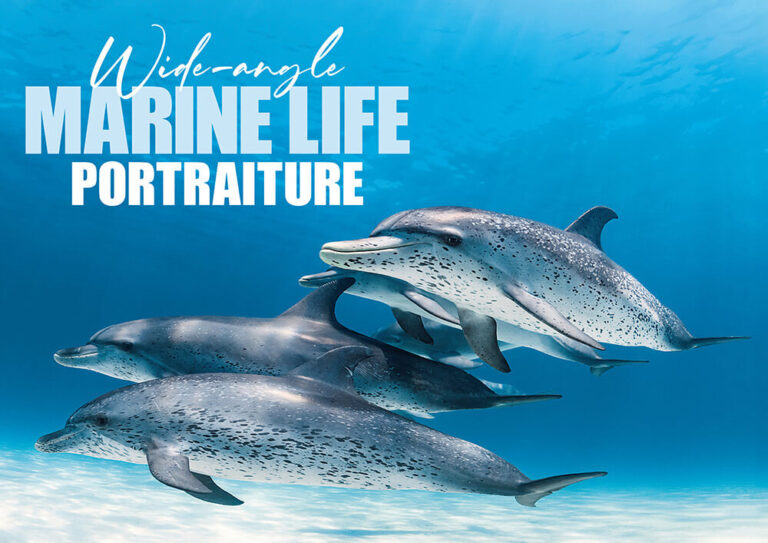
Walt Stearns offers some sage advice on wide-angle underwater photography, explaining how to capture eye-catching wide-angle images of marine life.
An encounter with large marine life is a thrilling and awe-inspiring experience. Words alone can seldom capture the full majesty of the moment. Which is why we take pictures. FOMO – Fear Of Missing Out – can be a real concern for underwater photographers who aren’t prepped and ready to react when something big and wonderful swims by. After all, as the saying goes, ‘If you don’t have pictures, it didn’t happen!’ To ensure that doesn’t happen to you, here are some simple rules to help you capture that image of a lifetime.
Choosing the Right Wide-Angle Lens for Underwater Photography
A wide-angle lens with a dome port is crucial equipment for shooting marine life that is as big as or bigger than you. Many photographers opt for super wide to full-frame fisheye lenses. This set-up will require you to get in close, but the rewards will far outweigh the needed effort. In underwater photography, we are always faced with the element of visibility. No matter how good the underwater clarity might be, you’ll still want to minimise the distance between yourself and the subject.
In addition to limiting the effect of suspended particles that can prevent a clean, crisp image, shooting wide provides a broader field of focus that can keep the details sharp when you are shooting on the fly and working with a subject that is also moving.
Rectilinear Wide-Angle Lenses: Pros, Cons and Dome Port Choices
The most common rectilinear glass option in the super-wide class is a 20mm lens for full-frame cameras or a 17mm lens for crop sensors. This category of lenses is valued for its ability to provide very expansive coverage without the barrel distortion associated with fisheyes.
The biggest downside to rectilinear lenses is retaining corner sharpness when shooting from behind a dome. This becomes apparent when the aperture is opened wider than F/11 and is more notably in the F/8 range. The wider the aperture, the shallower the depth of field, and the more visible the problem becomes.
The countermeasure for this is to use a larger size dome port of no less than seven inches in diameter. Dome ports in the nine-inch diameter size range will render even better results, which is what you want/need when shooting wrecks, reef or a large school of fish.

A lot of underwater photographers/ videographers favour rectilinear wide-angle lenses that have some zooming capabilities for added flexibility. My own preference in this department, since I don’t like lugging around big, heavy glass dome ports, is the Nikon Z 17 – 28mm f/2.8 wide-angle zoom behind a Nauticam 180mm dome port. Wide enough for most things, twice as large as me, while still handling something the size of a dinner plate.
Fisheye Lenses Underwater: When Distortion Works in Your Favour
Fisheye lenses seldom suffer from fall-off in corner sharpness when paired with small dome ports that are designed for such optics. What’s more, fisheye lenses by nature have a more pronounced forced perspective, meaning objects closer to the lens appear larger, while objects farther away appear smaller or more distant. This kind of distortion can certainly create a dramatic sense of depth and scale. Used creatively, this distortion can emphasise a subject or create a more dynamic ‘in your face’ composition.
With the exception of Nikon and Canon 8-15’s fisheye zooms for full frame cameras, and Tokina’s famous 10-17 fisheye zoom for crop sensor (APS-C) cameras, fisheye models are single ratio primes either in the full-blown circular format or classic full frame fisheye that provides a 180° (corner to corner) diagonal field of coverage.
Personally, my take on circular fisheyes is that they are a novelty, whereas the classic full-frame fisheye is more practical for most applications involving super large to even moderately large subject matter. The trick is knowing how to get close enough to pull it off.
“A wide-angle lens with a dome port is crucial equipment for shooting marine life that is as big as or bigger than you. Many photographers opt for super wide to full frame fisheye lenses”
Ethical Approaches to Photographing Large Marine Life
The most common advice for underwater photographers working with wide-angle optics is to ‘Get close, and when you think you’re close enough, get closer!’
However, there are both practical and ethical limits to close approaches. An overly aggressive approach to a shy or easily spooked animal is sure to end the photo session even before it gets started. Chasing after wildlife is a surefire way to learn that they can swim a hell of a lot faster than you.
Aggressive approaches and pursuit may also stress some types of marine life, pushing a sea turtle to alter course and prolong its dive, disrupting a grouper’s hunt or keeping a manta ray from approaching a cleaning station. The more ethical – and generally more successful – alternative is to remain calm and let the animal come to you. While some might say you’re still disturbing the animal’s natural behaviour. I’ve found a sweet spot in the get close/don’t disturb equation by assuming a flanking position while adjusting my distance between myself and my subject based on its own comfort level.
Sometimes, this ‘wait for it’ strategy calls for you to get in the water as quickly as you can and swim like a maniac to reach an intercept point ahead of your subject, or to position yourself to be able to keep up with them for a few frames. A prime example of this was when I went to Magdalena Bay in Mexico to photograph striped marlin. Spooking these speed demons is not an issue. They were so entirely focused on pursuing their prey that they couldn’t care less whether you were there or not.
My sage advice here is to always, always keep in mind that wildlife have the real say as to just how close they are going to allow you to get. Learning to read animal behaviour is a skill that comes over time, but you won’t get there if you don’t start doing some homework first.

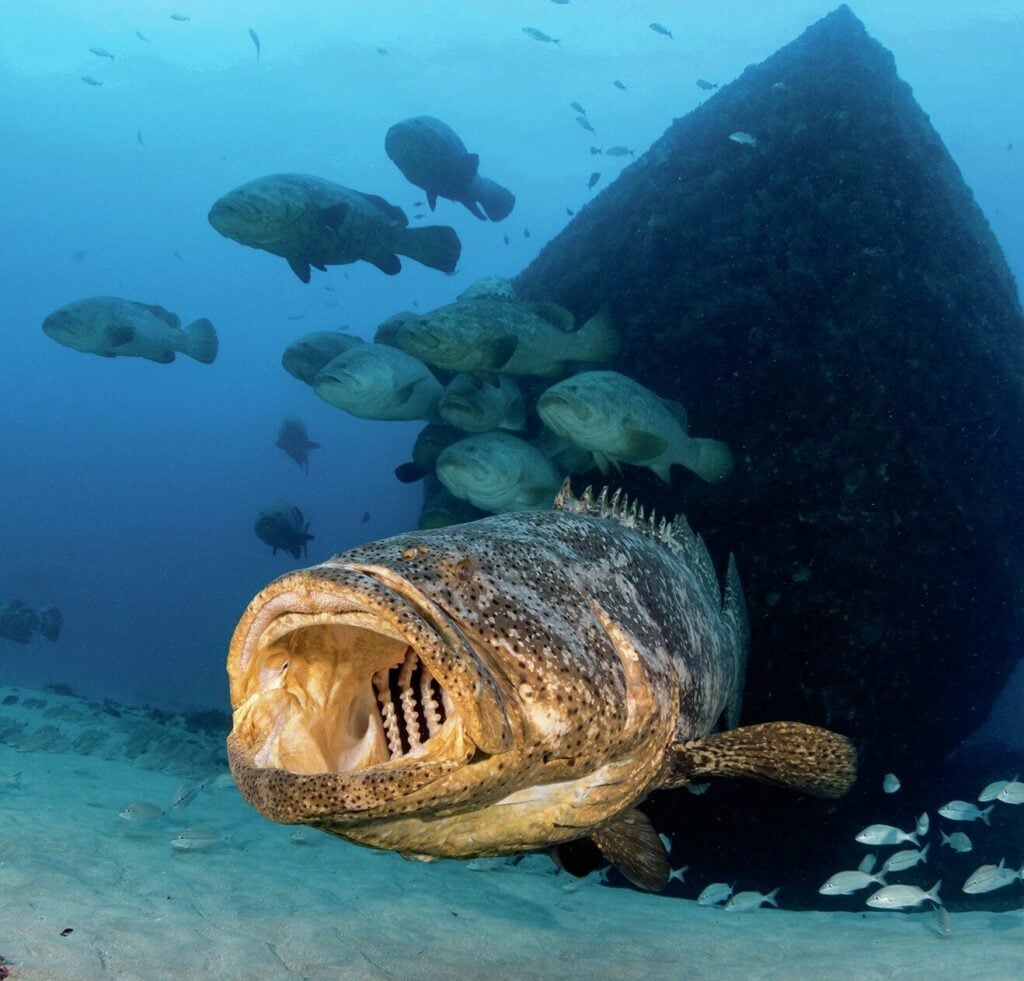
Researching Marine Life Behaviour Before the Dive
Before going after big subjects, take the time to research your subject(s) ahead of time as part of your trip preparation. This may begin with something as rudimentary as learning your target’s seasonality and migratory routes, as well as possible aggregation sites for that species. Learn something about their nature – are they going to be skittish, standoffish, indifferent, curious or even aggressive? Sealions are often curious, while I find whale sharks are indifferent to the point that you’re seldom registered on their radar. One of the best ways to gain insights is to search for advice from those who have some expertise with particular animals.
Environmental conditions can also come into play. Learn what to expect for sea state, underwater visibility and water temperature. If it involves working on the surface with a mask, fins and snorkel, I highly recommend investing in a pair of freediving fins instead of what you normally use for scuba.

“The most common advice for underwater photographers working with wide-angle optics is to ‘Get close, and when you think you’re close enough, get closer!”
Camera Settings for Fast-Moving Marine Animals
To increase your chances of capturing that once-in-a-lifetime, jaw-dropping image, you need to become intimately familiar with your equipment beforehand.
With the exception of something like a sea turtle fast asleep on the bottom, big animals are habitually in a state of motion. Fast-moving subjects will need fast shutter speeds greater than 1/250 sec to effectively freeze their motion.


While it might be nice that your camera has fast, continuous auto-focus with burst rate shooting capabilities, what is more essential for keeping a subject in the frame is getting a handle on that specific animal’s behaviour. This can help you anticipate their movements, which may not be in a straight line or at a constant depth. Remember, their world is 360 degrees in all directions.
The ability to adjust settings quickly to compensate for shooting into the dark realm below to transitioning to the brighter realm above, can make the difference between getting the shot and not getting it.
Lastly, regardless of whether you are using underwater lighting or not, always try to work with the light Mother Nature provides you. When the sunlight is at any level other than directly overhead, try to work from a position where the sun is to your right, left or behind you to more effectively light up your subject. Remember, most strobes and video lights become less effective when the gap between you and the subject is greater than six feet.
Frequently Asked Questions
What lens is best for wide-angle underwater photography?
Fisheye lenses are ideal for large marine life because they allow close focus, dramatic perspective and sharp corners with smaller dome ports.
Should I use a fisheye or rectilinear lens underwater?
Fisheyes excel for big, close subjects, while rectilinear lenses work well for wrecks and reefs but require larger dome ports for sharpness.
How close should you get to marine life when shooting wide-angle?
Get as close as ethically possible without chasing or stressing the animal, letting it approach on its own terms.
What camera settings work best for fast-moving marine animals?
Use fast shutter speeds (1/250s or higher), moderate apertures, and adjust ISO to maintain exposure while freezing motion.
Is chasing marine animals acceptable for photography?
No. Chasing wildlife often ruins encounters and can stress animals. Patience and positioning produce better images and ethical outcomes.
This article was originally published in Scuba Diver Magazine
Subscribe today with promo code DIVE1 — enjoy 12 months for just £1!
