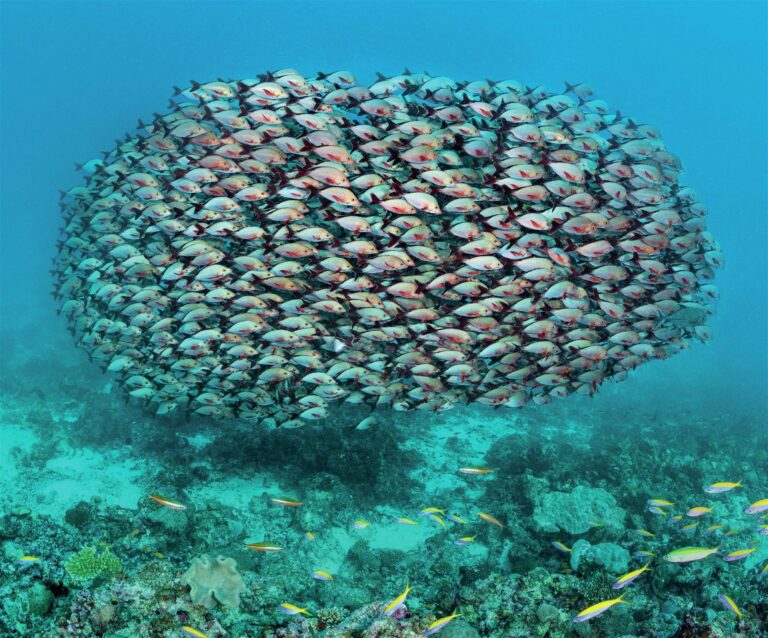
Photographs by Alex Mustard.
The Golden Rule of Underwater Photography
Alex Mustard turns his attentions towards shooting schools of fish, and offers hints and advice to make your photographs stand out from the crowd.
It is said that underwater photography would be easy if it wasn’t for the water! Shoot through too much of the stuff and it robs our shots of the three Cs – colour, contrast and clarity. The result is murky, dull pictures. The solution is to get as close as possible to everything we shoot. If there is a defining rule in our craft it is ‘get close. Get CLOSER! Mastering Underwater Photography Schools of Fish requires understanding this rule and knowing when to bend it
The more we shoot underwater, the more this law is reinforced, and we learn that if we can just creep that bit closer, the picture will be better.
Challenging the Rule for Shooting Schools of Fish
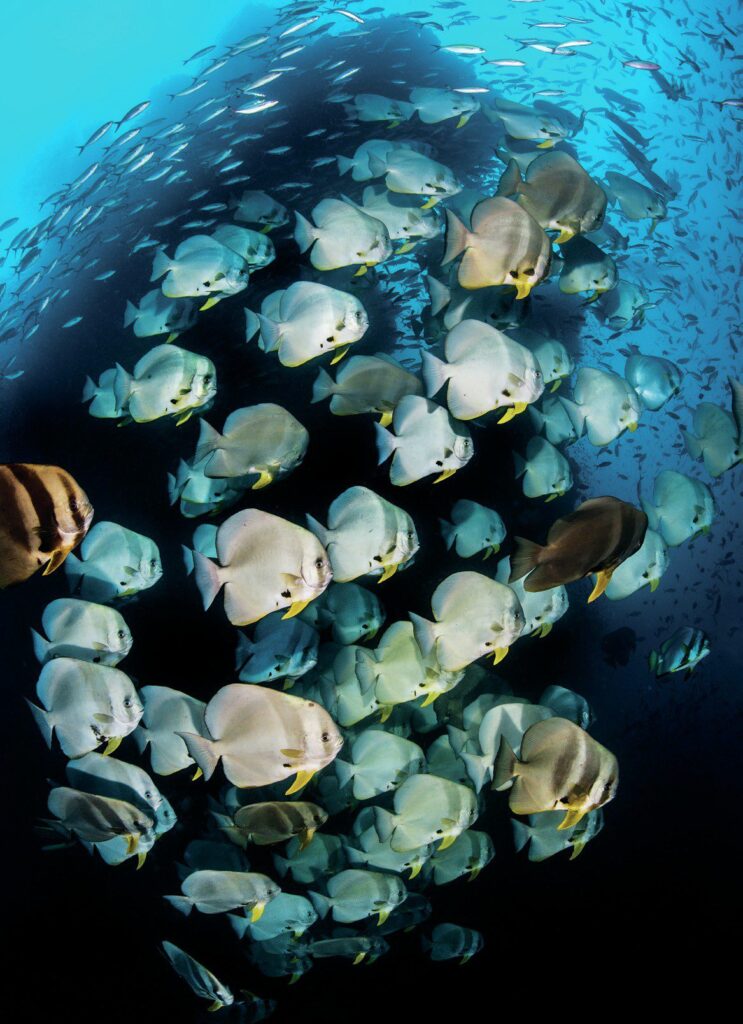
The best pics of schools of fish emphasise the togetherness of the fish in the composition. After all, that is what schooling is about for the fish. We’re after tight formations of neat, repeated shapes to make our pictures pop. When practicing underwater photography schools of fish, keeping a careful distance is essential to preserve these formations.
However, the one thing guaranteed to mess up these pleasing piscine arrangements is a photographer getting too close! Shooting schools requires that we unlearn the golden rule of underwater photography and keep a bit of distance (in underwater photography terms) to maintain those fantastic formations in our photos.
Species Specifics: Adapting Your Approach
Several other factors impact on the togetherness of schools. The type of fish makes a big difference. Some species are very sticky, staying together whatever we do. Silvery fish from silversides or barracuda tend to be highly magnetic, for example. Other species, like batfish, grunts and sweetlips are much more easily disturbed, even when they are perfectly aligned when we spot them. Even when undisturbed, gangs of sweetlips will constantly be swapping positions in the group, and pictures need to be perfectly timed for the neatest, and strongest, compositions. This is one of the challenges of getting good school shots – that we need to adapt our approach depending on the species.
Understanding and Utilising Fish Behaviour

Schools where the fish are all different sizes make less-pleasing pictures than shot where all the fish are more uniform. Swimming schools, like jacks, will usually stay reasonably tidy because they tend to all be travelling in the same direction. Current is usually useful because when it is flowing it is much more likely that fish will all line up and not create a messy frame, all facing different directions. Observing fish behaviour is key to mastering underwater photography schools of fish, as timing and approach determine the best shots. It can also make our approach easier, because it is swimming towards schools that disrupts them, while swimming up current and drifting towards will get us better formations.
A school will always look better coming on to the camera than angling away. One of my favourite tricks is to watch for another photographer who is charging about getting too close to the school. Then I simply swim to the opposite side of the school and stay still. The school will always turn away from the disturbance and end up constantly coming on to my camera. The shape of a school of fish will always be changing, so we should try and time our shots for the moments when the form the strongest graphic shapes, like spheres, towers or rings. The better the shape, the better our shot.
Schooling Reasons and Opportunities
There are lots of reasons why fish school and plenty of opportunities to look out for. The tight schools of silversides and glassfish are often defensive. Numbers means safety, with more eyes looking out for danger, less chance of an individual being targeted and the confusion of bodies defeating predators.
Some fish school only at certain times of the day or year for spawning, resting or migrating. Mackerel are thought to school while feeding, because the rows of mouths lined up together help their filtering efficiency. And a number of species of parrotfish and surgeonfish will school when feeding, where their weight of numbers helps overwhelm the defences of the species that control the best grazing territories on the reef.
Technical Tips: Using Zoom Lenses and Lighting

Technically I favour zoom lenses when shooting schools, because it gives the most flexibility to fill the frame with the strongest formations. Sometimes this means getting the whole school in the picture, while at other times it requires us to zoom in and fill the frame with just the neatest part of the school.
Five neat fish will always look better than one hundred messy ones! The biggest schools are often best photographed without strobes, because the scene is just too big to light. Consider the direction of light and shoot with it for colour and detail on the individual fish, or against it to make the shape of the school stand out. Schools can look great as simple silhouettes.
Strobes, of course, allow us to light up the fish and make the eye and colour patterns pop, but lighting a big school at distance is one of the technically hardest shots in underwater photography, especially in bright, tropical conditions. We should start by positioning strobes on long arms, which helps the light reach the subject without lighting up all the particles in the water.
I stretch my strobes out as wide as they go and point them straight ahead, while still keeping the front of the strobes behind the dome of my housing to avoid particle flare. We will often find we need to use high powers, and I will open the aperture slightly more than usual to capture more strobe light, and then increase our shutterspeed to compensate and quell the ambient light. Even so, we might still struggle to light a really big school shot from below, against the brightness of the surface.
When ambient light levels are lower, schools are ideal subjects for capturing motion blur. But this will only work when we have enough strobe power to freeze the fish, and while correctly exposing the ambient light with a shutter speed below 1/15th sec. Many photographers try and force these shots, but if you can wait for darker conditions, it just makes the whole process much easier.
The Challenge and Reward of Shooting Schools
Shooting schools is one of the most-challenging types of wide-angle photography, because it tests our mastery of both ambient and strobe light, while at the same time rewarding our field craft knowledge of the behaviour of different types of fish. Successfully applying these techniques will make your underwater photography schools of fish images stand out among your portfolio.
But the good thing about a stern challenge is that the results will quickly rank amongst our most satisfying photos.
FAQs
What is the golden rule of underwater photography?
The golden rule is to get as close as possible to your subject to preserve colour, contrast, and clarity.
How do you photograph schools of fish effectively?
Maintain a slight distance, observe fish behaviour, swim upcurrent, and time shots when formations are strongest.
Which fish species are easiest to photograph in schools?
Silversides and barracuda tend to stay tightly grouped, while batfish, sweetlips, and grunts require more patience.
Should I use strobes or ambient light for large schools?
Large schools are often best shot without strobes; use ambient light for shape, or strobes for detail on smaller sections.
How do zoom lenses help in photographing schools of fish?
Zoom lenses allow flexibility to capture either the entire school or focus on the tightest, most visually appealing formations.
Subscribe today with promo code DIVE1 — enjoy 12 months for just £1!
