
Stuart Philpott joins the new-in-2025 Maldives Master liveaboard for his first-ever liveaboard adventure in an archipelago he has visited manytimes, but always land-based
Veteran Cruise Directors Oliver and Carmen said ‘liveaboard diving is an adventure’ and after spending a week onboard brand-new boat, Maldives Master, I wholeheartedly agree. We experienced unpredictable weather, fast-flowing currents, sporadic marine life sightings and low visibility, all mixed in with some onboard dramas to boot. I really couldn’t have asked for more entertainment!
The Maldives Master Liveaboard: New for 2025
I arrived at Velana International Airport, Malé, in late-May. Oliver said, ‘May is the end of the season and not the best time for a visit’. The boat would soon be hauled out for annual maintenance. Oliver had compiled a short list of new-build niggles to fix, including deck drainage, overly complicated shower taps and accident-prone glass sliding doors at the rear of the saloon area. During the week, several people face-planted the doors thinking they were open. For most of us, this provided a great source of amusement but I’m sure it must have really hurt.
Pick-up wasn’t until 12.30pm, and my flight had landed several hours earlier, so I settled down at Burger King with a large Coke and a bag of chicken nuggets trying to spot the other divers booked on my trip. At least I wasn’t waiting alone. I bumped into fellow liveaboarder Callie on my flight over. Callie was an old hand, with more than 20 trips to her name. We spotted a group of eight guys looking highly conspicuous. They turned out to be members of two BSAC clubs, 787 Swale Divers and 278 Southport, based in the UK. A couple sitting at the next table were also booked on our trip and had travelled all the way from Texas. We finished up with a truly international mix of divers travelling from the US, China, UK, Holland, Spain and Russia. Oliver said. ‘These days, the majority come from the US and China’. 70% of clients are repeaters, and the cruises are well booked up in advance. The dive dhoni ferried us over to our floating home for the week.
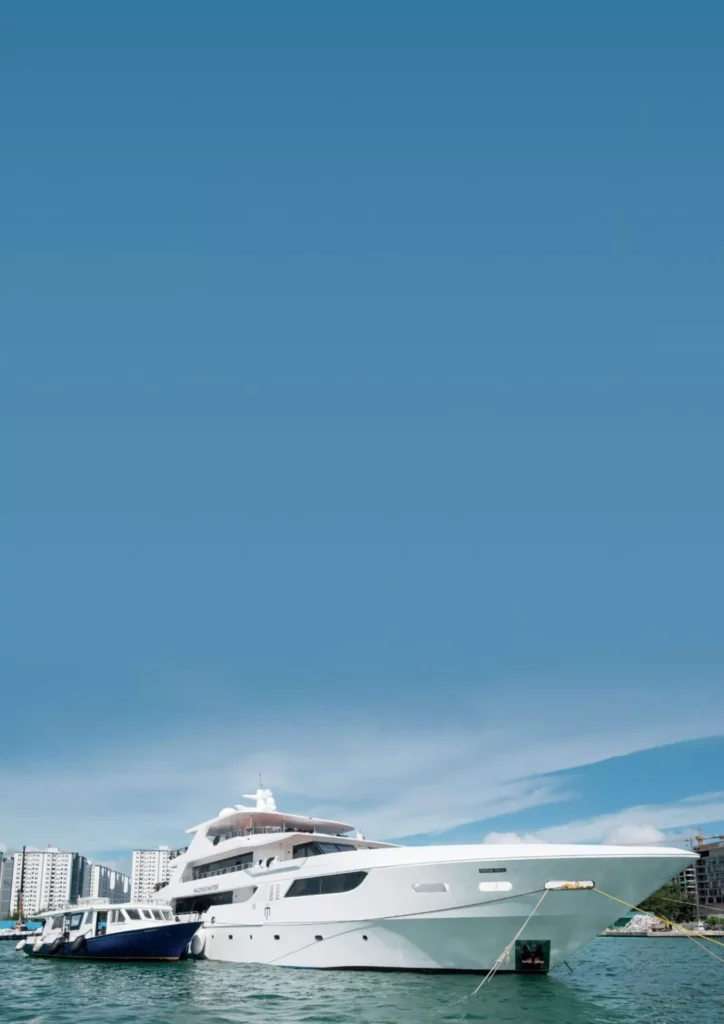
I’m not sure if the liveaboard is called Maldives Master, or Maldives Queen? Even Oliver and Carmen were unsure? But she’s a brand-new boat offered by Master Liveaboards from January 2025. Described as a modern luxury vessel 41 metres long by 11 metres beam and powered by a single engine, she really did look the part when I first laid eyes on her. Built to carry 26 divers in 12 double cabins and two singles, all with modern furnishings, that are located on three levels. I was surprised at the size of the bathrooms, which were bigger than most classy hotel en-suites. Onboard facilities included a bar, lounge/diner and numerous sun decks, plus a jacuzzi. Oliver said ‘it’s not just about the diving anymore, it’s also about comfort and the facilities on offer’. Altogether there are 18 staff servicing the guests, including three working on the dhoni and four dive guides. The boat language is English.
Maldives Liveaboard Itineraries and Seasonal Routes
Maldives Master offers quite a varied schedule throughout the year. I booked a Central Atoll cruise, which visits a total of five atolls in seven days. This included North and South Malé, Ari, Rasdhu and Vaavu Atoll. But we changed route halfway around due to an impending storm front. Oliver said ‘You could all miss your flights home if we don’t head back to North Malé early’.
Did you know?
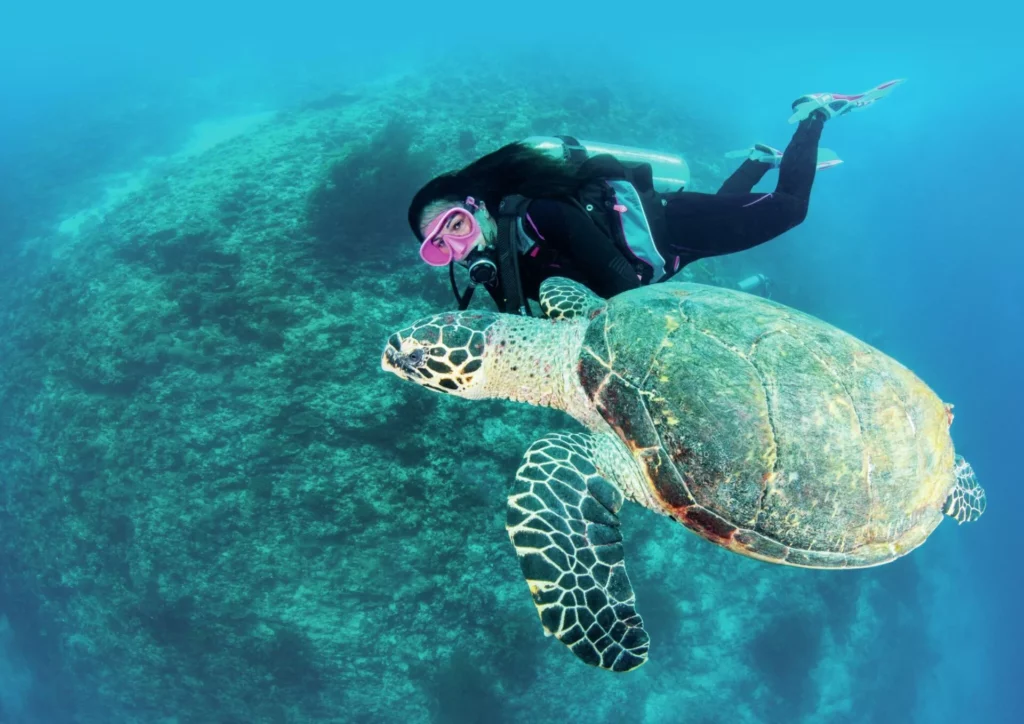
The Maldives is a haven for sea turtles, boasting five of the world’s seven species, including the critically endangered hawksbill and green turtles. These ancient reptiles find suitable nesting grounds on the islands’ beaches and abundant food in the surrounding coral reefs.
Unfortunately, this meant we would miss the Alimatha house reef dive at Vaavu Atoll, where it’s possible to encounter more than 100 nurse sharks.
January through to March, the liveaboard offers trips to the Southern Atolls, including Koodoo and tiger shark central, Fuvahmulah. March to May is Central Atolls. July and August, the route changes to the Central and Baa Atoll, stopping off at UNESCO World Heritage Site Hanifaru Bay for snorkelling with up to 300 manta rays. September to December is Central only. Oliver said ‘we offer a good mix of everything the Maldives has to offer’. The boat is even available for private charter and for one week a year, they offer a family and friends trip which sells out very quickly.
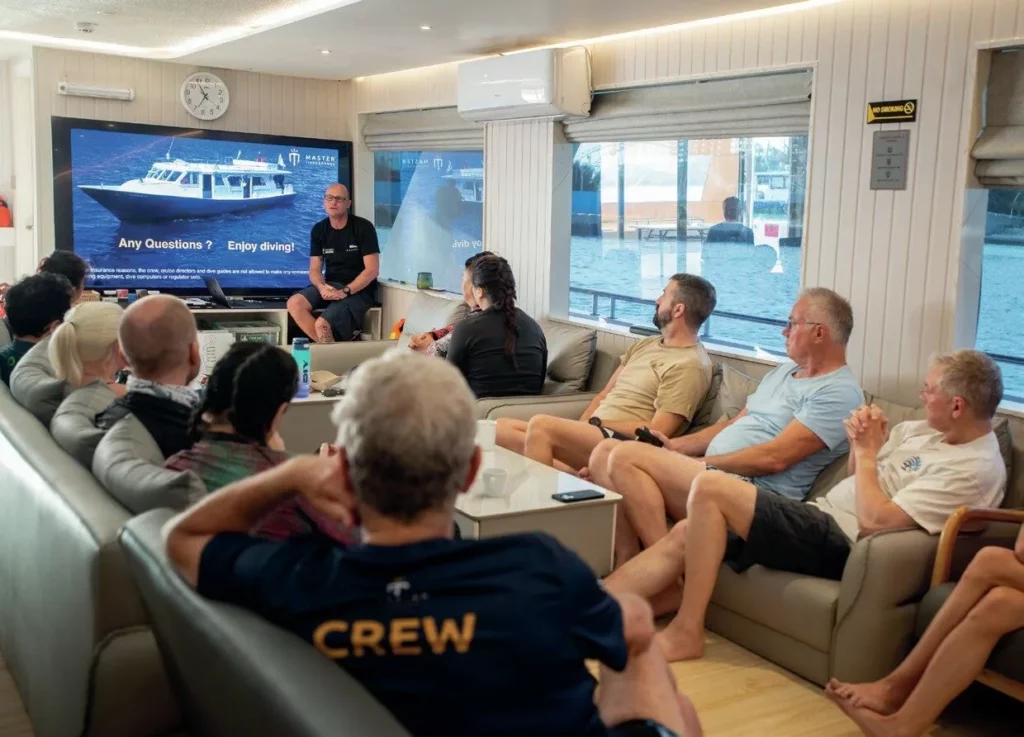
As soon as we set foot onboard, Oliver and Carmen called a briefing to run through all the safety issues, fill out forms, check insurance, certifications and allocate rooms. Liveaboard safety was top priority especially as there had been several high-profile incidents over recent months. Oliver said ‘These high standards are the same throughout our fleet worldwide’.
To book on a Master liveaboard, divers should have a minimum of 30 dives and an Advanced certification. Proof of a Nitrox qualification is also required for those who want to use O2 enriched gas. I won’t mention any names, but there were major problems with a couple from the US. The guy basically lied about his qualifications and only had an Open Water ticket with five dives! After missing the check-out dive due to a stomach bug, he decided to join us on the 50-metrelong Kudimaa wreck, which fortunately for him bottomed out at 30m. Somehow, he did a rapid descent without clearing his mask. The squeeze was so bad his eyes and surrounding tissue turned totally black. It was zombie apocalypse on steroids! I’m surprised he didn’t get transferred off the boat to see a doctor.
Maldives Master doesn’t have a dedicated dive deck/equipment area, instead they have a 19-metre-long support dhoni called the Blue Shadow. This is the centre of all diving activities. Equipment is left set up, wetsuits hung up to dry and cylinders re-filled. I can’t praise the crew enough, they would always be in the background, helping with kitting up and boat entries and exits. Normally everyone uses an 80 cu ft Aluminum cylinder (12 litre) as standard for DIN or A-clamp fitting. 100 cu ft (15 litre) are available, but they need to be booked in advance. Extra cost is around $77 for the week. Full kit hire is around US$255 and Nitrox is another US$105 on top.
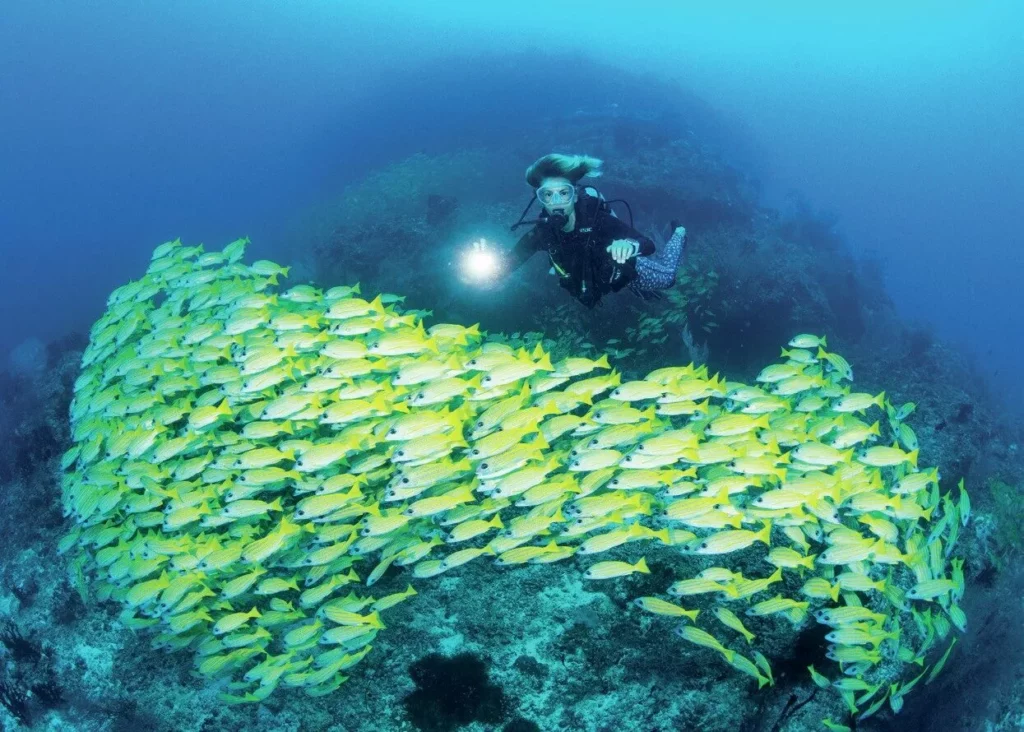
We got split up into four groups, one dive guide per group. My group consisted of five divers, and they were all a good standard. Unfortunately, I didn’t have a dedicated model to help me with my pictures. Carmen was busy with another group, so I had to improvise! All in all, it’s possible to do 18 dives in total. Which equates to three dives a day plus a manta night dive. Ten-day liveaboard trips offer a total of 27 dives.
Diving the Central Atolls: Currents, Sharks and Mantas
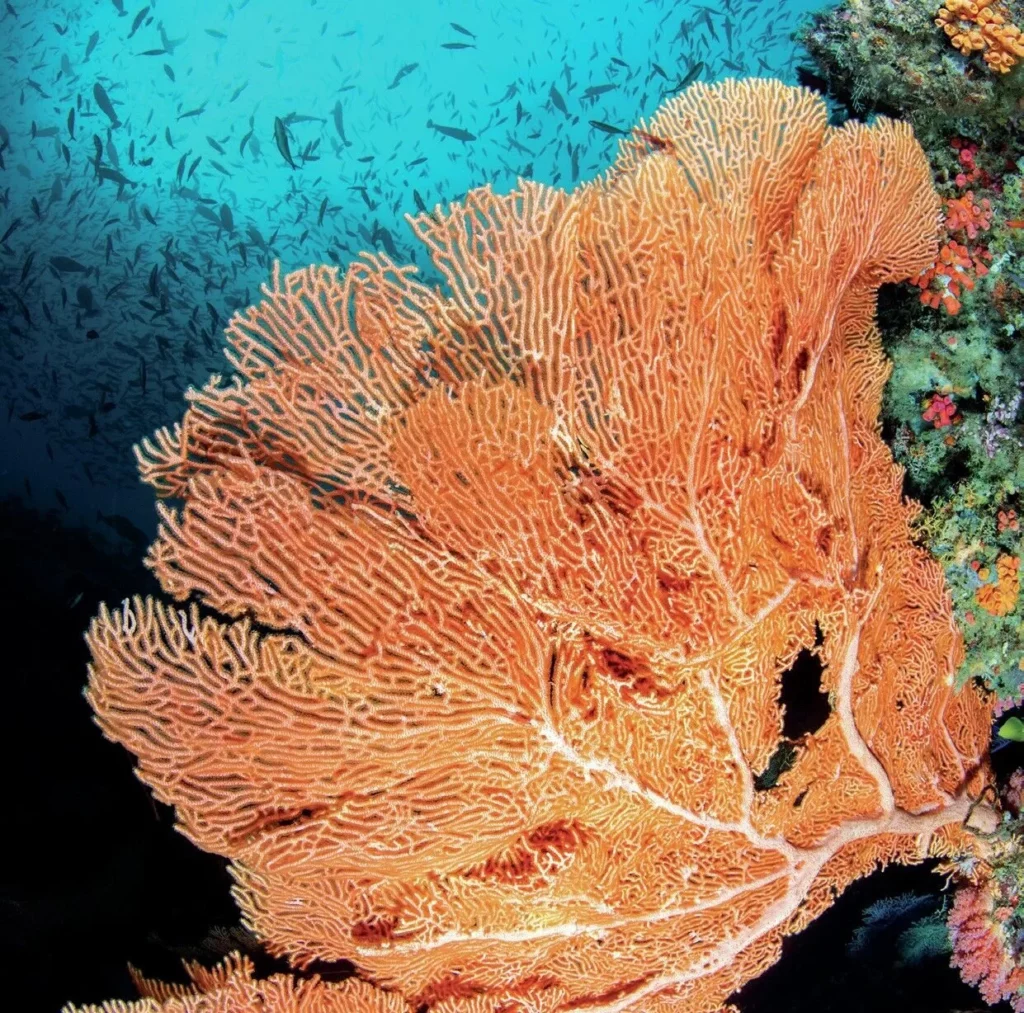
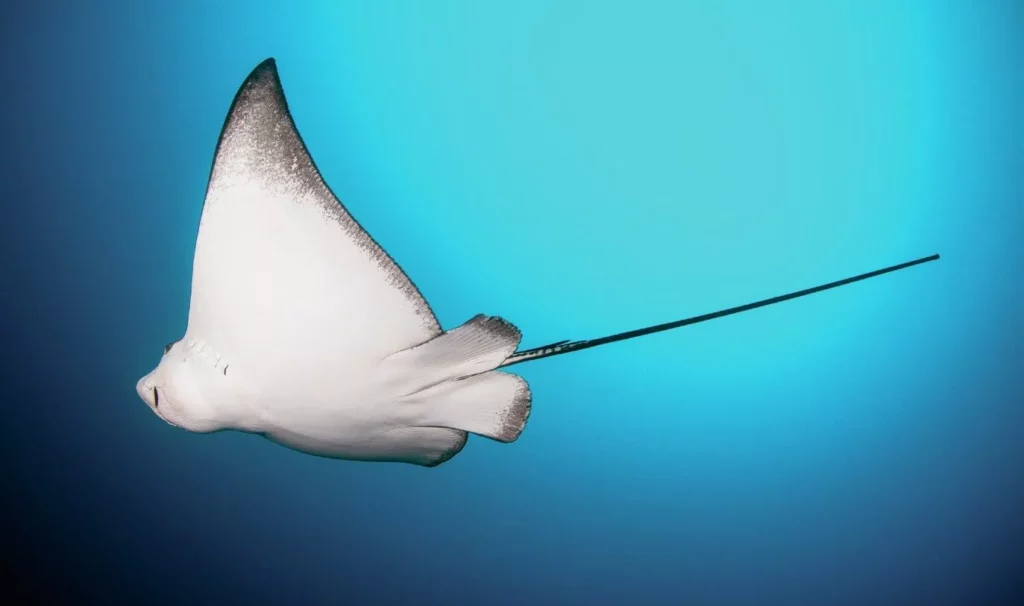
I’m not going to describe every dive site in detail. Carmen and Oliver had written bad or very bad visibility for the majority, so I will focus on the highlights. It’s worth mentioning that bad vis in the Maldives is anything less than ten metres, so it is all relative depending on where you are used to diving! On most dives we saw sharks, (whitetip and reef) and there was always a turtle, eagle ray or Napoleon wrasse somewhere in the background. We encountered a solitary manta at Lily Manta cleaning station, which hung about for ten minutes. No whale shark sightings. But, for most divers, a poor week in the Maldives would still be the best they have ever experienced!
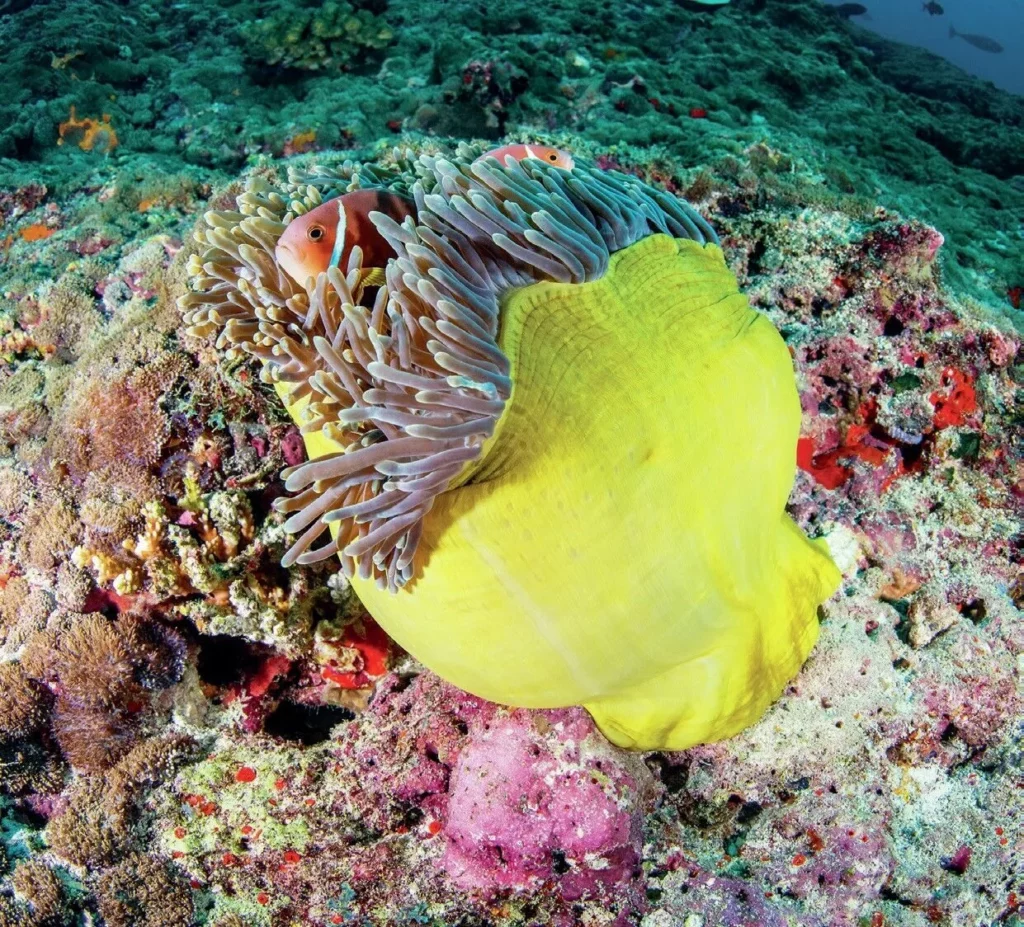
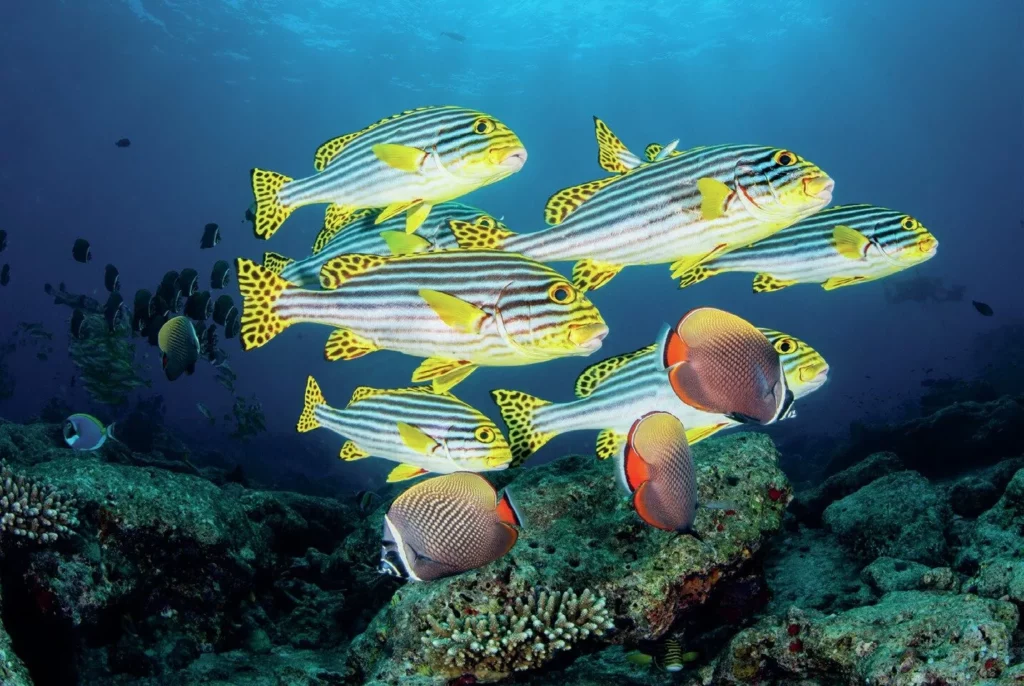
My most-memorable reef dive was probably at Kandomaa Thila, South Malé. We began our dive at the tip of a rocky outcrop where the current was ripping. I stopped to take a few shots of a huge jackfish shoal. Sweetlips and blue-striped snapper were hiding underneath the gulleys and overhangs while eagle rays swooped overhead. A turtle was nibbling away on a coral head, but I was moving far too rapidly to take pictures. An inquisitive eagle ray came up to my camera dome port and then effortlessly powered away. I had no hope of following with my measly fin kicks. We ended up drifting along the reef together as a group. For once, I gave up with my photography and just enjoyed the underwater scenery.
Manta Ray Night Diving in the Maldives
Oliver said ‘only liveaboards offer manta night dives’. We moored up for the night at a site called Fesdhoo. Powerful lamps attached to the ocean deck attracted plankton which in turn drew in the manta rays and some nurse sharks. After 30 minutes there were four or five mantas barrel rolling at the stern. Everybody kitted up, jumped in and made a descent onto the sandy seabed at a depth of around 12m. Just to set the scene, 20 or more torches had been placed on the seabed in two lines which looked very similar to airport runway lights. Everybody was kneeling in a semicircle around the runway while pointing their own torches up towards the surface. I have never seen such an underwater light show, it was impressive. Manta rays were swooping down all around us. I would estimate between eight to ten in all. They couldn’t have got any closer. Visibility wasn’t brilliant but this somehow added to the overall effect. Seeing a giant gaping mouth suddenly appear out of the darkness gulping up plankton was quite a thrill. All 26 divers were in awe, even the Chinese contingent seemed to be happy. For me, this was probably the best dive of the whole trip.

We arrived back at Malé and prepared for our final two dives at Shark Tank. Oliver explained that the dust bin dhoni’s dump the waste bits from the tuna factory just outside of the harbour entrance, usually in the same location. This happens up to two to three times a day depending on the amount they catch, but never on Fridays for some reason. The fish entrails attract a multitude of sharks. Regular sightings include tigers, bulls, spinners, hammerheads, guitars and stingrays. Usually, this dive is offered on the last day, but Oliver said some liveaboards visit the site for their first check-out dive!
We descended onto a flat sandy seabed at around 30m and swam around searching for sharks. We saw a few spinners in the distance and a number of stingrays but there was no sign of anything else. Oliver couldn’t understand what was going on, this was the right location, but there were no sharks. Everybody was totally deflated. Back onboard Oliver made a few calls and discovered the fisherman had changed the dump site location. We were offered a reef dive, but all unanimously agreed to give the Shark Tank a second try. This time around we got to see a good selection of sharks, including tigers, bulls, spinners, lemons and a guitar ray. A huge stocky bull shark covered with remoras patrolled the seabed, while two four-metre-long tigers circled us. One had lost part of its dorsal fin. Unfortunately, by the time we found the sharks, there was only several minutes of bottom time left but everybody seemed happy.
Liveaboard vs Resort Diving: Is a Maldives Liveaboard Worth It?
I regretted broaching the subject of liveaboard vs resort-based diving with Oliver and our conversation soon became quite heated. Over the past 20-odd years I have visited a good selection of islands, but never experienced a Maldives liveaboard. Oliver and Carmen had been working on liveaboards for over 16 years and have clocked up more than 700 trips in all. This was their fifth year with Master Liveaboards. Previously they had worked on liveaboard Blue Horizon operating from Egypt. In their minds liveaboard diving was the only option. Oliver said ‘there are many benefits, for instance everybody is a diver, so everybody has a common interest’. It’s also only possible to dive such a big variety of dive sites on a liveaboard, including many Thilas and Kandus (aka channel crossings). Other positives included arriving at dive sites before the day boats and not having to assemble and wash off kit every day.
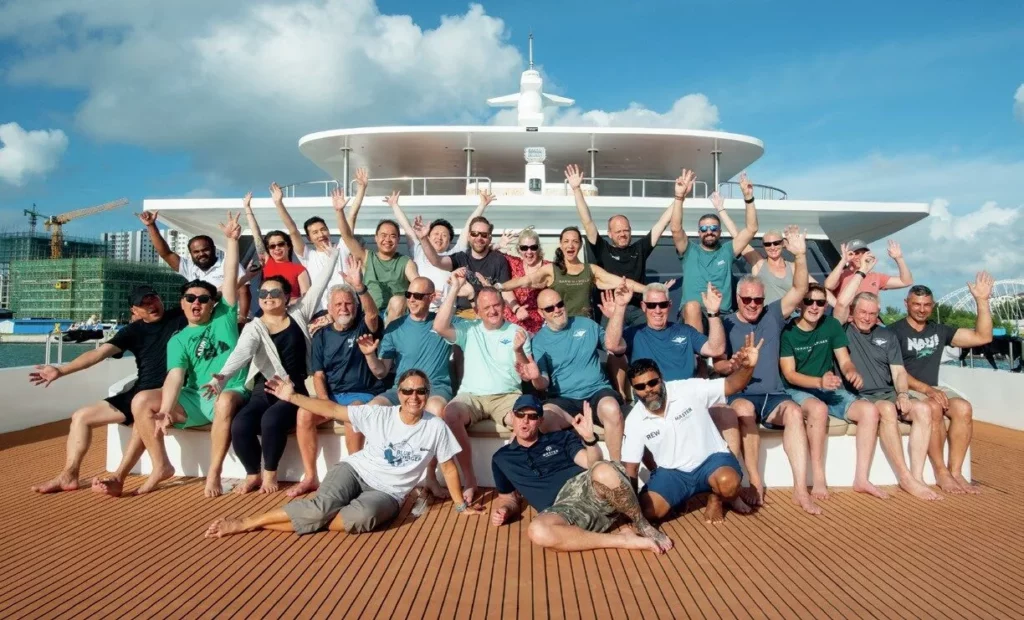

There were basically two large groups on our cruise. The Brits were quite sociable, but the Chinese kept to themselves even though they spoke good English. The rest of the bunch was made up of couples and a few singles. Generally, everybody behaved themselves and the atmosphere on board was chilled. The Russian girl was very quiet to the point of not really talking to anyone and needed supervision underwater. Then there was the sneaky US couple who lied about their certs and were apparently smoking dope onboard. Human nature as it is, Oliver said he had picked up so many incredible stories over the years he was thinking about writing a book!
We had a mixed bag of dives, but I guess this was the end of the season and no one can control the weather. Oliver said that divers expectations are very high, and this is mainly due to social media over-hyping marine life encounters. They expect to see mantas and sharks on every dive and are disappointed if this doesn’t happen.
The new liveaboard performed well with a full contingent of 26 divers. The saloon area and cabins were always kept clean and tidy, and the crew friendly and attentive to our needs. Everybody enjoyed the buffet food and there was always plenty of choices, including cakes after every afternoon dive. Just to round off my first-ever Maldives liveaboard adventure, for reasons unbeknown to me and everyone else, the quiet Russian girl called everybody ‘f**king bast**ds’ and ran off into the airport terminal, never to be seen again. Note: this was Oliver and Carmen’s last liveaboard season for the time being – they are now taking a well-earned break!
Frequently Asked Questions
What is the Maldives Master liveaboard?
Maldives Master is a new luxury liveaboard launched in 2025, operated by Master Liveaboards, offering multi-atoll diving itineraries across the Maldives.
Which atolls does the Maldives Master visit?
Depending on season, itineraries include North and South Malé, Ari, Rasdhoo, Vaavu, Baa Atoll and the Southern Atolls such as Fuvahmulah.
What level of experience is required for Maldives liveaboard diving?
Divers should have a minimum of 30 logged dives, Advanced Open Water certification, and Nitrox certification if using enriched air.
What marine life can you expect on a Maldives liveaboard?
Common sightings include reef and whitetip sharks, manta rays, turtles, eagle rays, Napoleon wrasse, snapper schools and occasional tiger sharks.
Are Maldives liveaboards suitable year-round?
Yes, but conditions vary. Visibility, currents and marine life encounters change seasonally, with stronger currents and variable weather outside peak months.
This article was originally published in Scuba Diver Magazine
Subscribe today with promo code DIVE1 — enjoy 12 months for just £1!
