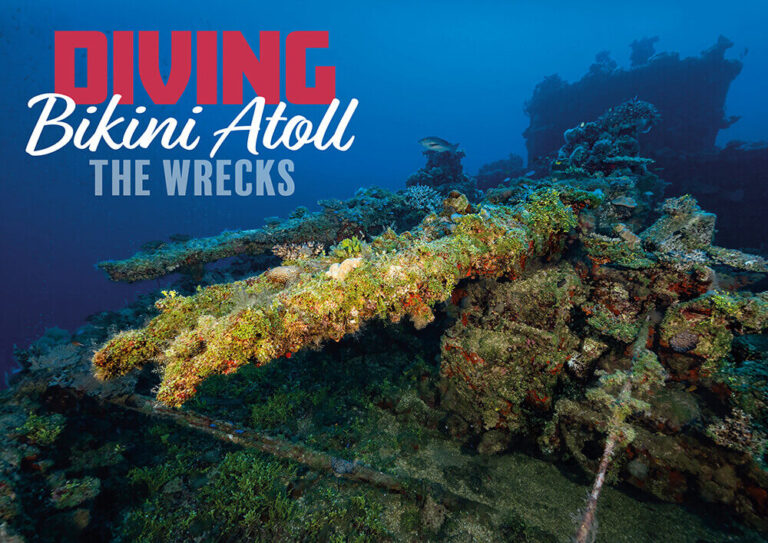
Don Silcock develops a ‘lust for rust’ when he visit the wreck-diving Mecca of Bikini Atoll.
Simply put, Bikini Atoll is the Holy Grail of wreck diving -there’s nowhere else in the world quite like it! I went there as thoroughly prepared as possible for the challenge of diving twice a day to depths of around 180ft in a very remote location. And I will get into the details of that preparation in the third and final article of this series on Bikini. What I was completely unprepared for, however, was the profound impact the remarkable wrecks of Bikini had on me. To paraphrase the renowned Kiwi wreck diver Pete Mesley, I developed a ‘lust for rust’.
Bikini Atoll – The Holy Grail of Wreck Diving
When I travel to a new location, it’s usually because I’ve heard or read stories about what makes it special. I then do enough research to identify the best local operator for the trip. Once there, I dive as much as possible, capture as many good images as I can, and try to absorb everything about the location. So, when I return home, I can put the overall experience into context and (hopefully…) write an engaging, informative article.
With Bikini Atoll, however, the sheer amount of information available makes it challenging to truly grasp what happened – beyond the basic fact that numerous World War Two-era capital ships were destroyed by nuclear explosions.
Finding the right operator wasn’t difficult… there’s only one – Master Liveaboards. Having now been there and understand the logistical challenges of running a tech-diving boat in such a remote location, I’m even more impressed by what Masters does at Bikini and, most importantly, how they do it!
Operation Crossroads – The Nuclear Test Legacy
In total, the United States conducted 23 nuclear tests at Bikini Atoll between 1946 and 1958. The initial tests in 1946 were part of Operation Crossroads, designed to assess the impact of nuclear explosions on a large array of naval ships.
Three nuclear explosions were planned for Crossroads, with a ‘mock’ naval fleet of 95 World War Two-era target ships moored in a specific pattern around the blast centre.
The backstory involves the rivalry between the US Navy, determined to prove that large naval ships could withstand nuclear explosions, and the Air Force, equally determined to demonstrate the ships’ vulnerability.
The first bomb, Able (Alpha), was dropped from a B-29 Superfortress bomber and exploded at an altitude of 500 feet, sinking five ships. The second bomb, Baker (Beta), was detonated underwater at a depth of 88ft and was much more destructive, sinking 12 ships. The third test was cancelled by President Truman due to the severe contamination caused by the Baker test.
Of the 17 wrecks, seven are core wrecks regularly dived on Master Liveaboards’ Bikini Atoll itineraries. I dived six of them, all at depths of 167ft-180ft and here is what I learned…
Diving the Iconic Wrecks of Bikini Atoll
USS Saratoga
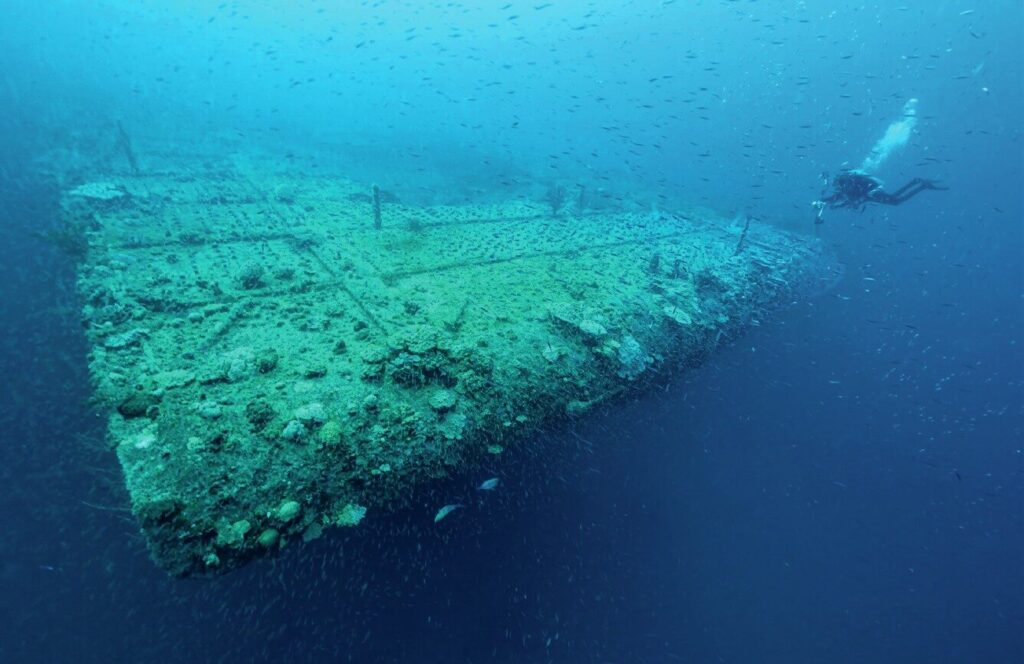
At 885 feet long and a full-load displacement of 43,000 tons, the Saratoga is one of the largest diveable shipwrecks in the world and is without doubt the signature dive of Bikini Lagoon. Commissioned in November 1922, after being converted from a Lexington-class battlecruiser, the USS Saratoga was the first purpose-built aircraft carrier to enter service with the US Navy.
The ship served with distinction throughout World War Two and was awarded four campaign decorations and eight battle stars. But, when the war finally ended, the Saratoga was effectively obsolete and in early 1946, was assigned to Operation Crossroads.
Did you know?
Saratoga was a Lexington-class aircraft carrier built in the 1920s named for the Battles of Saratoga in the American Revolutionary War. Commissioned in 1922, she entered service in 1928 and spent most of her career in the Pacific Fleet. She was torpedoed twice, and severely damaged by kamikaze hits, before being sunk in Bikini Atoll.
For the Able test, the ship was moored some distance from the planned blast zero point, so she could be used later in the Baker test, where she was positioned just 1,200 feet from the epicenter. The force of the Baker underwater explosion lifted the Saratoga completely out of the water, knocking off all the planes and other military equipment that had been secured to the flight deck for the test. But when she did sink, it was bolt upright and the Saratoga now sits in 170ft, with the flight deck at 88ft.
Descending down the mooring line to the Saratoga’s bow for the first time is a truly awe-inspiring experience. The wreck is so big you can only see parts of it at any point in time, but all those vignettes compile in your mind, and you know you are doing something truly quite unique! It takes a few dives to get orientated on the wreck, but as you do that confidence builds to where you are ready to penetrate inside the wreck – but I will save that for the next article!
IJN Nagato
Perhaps the ultimate irony of Bikini Atoll is the wreck of the Imperial Japanese Navy battleship, the Nagato. When first commissioned in 1920, the Nagato was the world’s largest, fastest and most-technologically advanced battleship and the first super-dreadnought ship to mount 16-inch guns.
At 738 feet in length, with a displacement of nearly 47,000 tons and a cruising speed of 27 knots, the Nagato was the flagship of the Japanese Navy. And it was from the ship’s distinctive pagoda superstructure that Admiral Isoroku Yamamoto issued the code phrase ‘Niitakayama nobore (Climb Mount Niitaka) 1208’ to launch the infamous surprise attack on Pearl Harbor in 1941.
The Nagato was the only Japanese battleship to survive World War Two, when she was seized by the Allies and eventually sent to Bikini for Operation Crossroads, where she was lightly damaged during the Able test.

For the Baker test, the Nagato was positioned 2,850 feet from ground zero. She initially appeared to survive the blast but began to list starboard, eventually sinking upside down five days later in 170ft of water.
Besides its sheer size, three features of the Nagato wreck really stand out – the four propellers on the upturned hull at 108ft, the incredible 16-inch guns in the stern and bow areas suspended from her hull at 164ft, and the unmistakable pagoda superstructure from which history was made.
USS Arkansas
Commissioned into the US Navy in 1912, the USS Arkansas was a Wyoming-class dreadnought battleship measuring 560 feet in length, with a displacement of nearly 28,000 tons. Armed with a main battery of 12-inch guns and capable of cruising at 20 knots, she was a formidable force in her time.
The Arkansas served in both World Wars, earning four battle stars. However, by the end of World War Two, she was also obsolete and assigned to Operation Crossroads.
During the Able test, the Arkansas was moored some distance from ground zero but still suffered significant shock damage to her superstructure. For the Baker test, however, she was moored just 750 feet from the submerged nuclear bomb.
The actual explosion is believed to have lifted the entire ship vertically within the blast column, causing the Arkansas to sink within 19 minutes of the detonation. She now rests nearly upside down on the sandy bottom at 180ft.
“She initially appeared to survive the blast but began to list starboard, eventually sinking upside down five days later in 170ft of water”
USS Lamson
The Lamson, a Mahan-class destroyer commissioned in October 1936, served with distinction in the Asiatic-Pacific campaign during World War Two, earning five battle stars.
Although not technically obsolete by the war’s end, the Lamson was deemed surplus to requirements and assigned to Operation Crossroads. She was sunk during the Able test and now rests upright at a depth of 180ft.
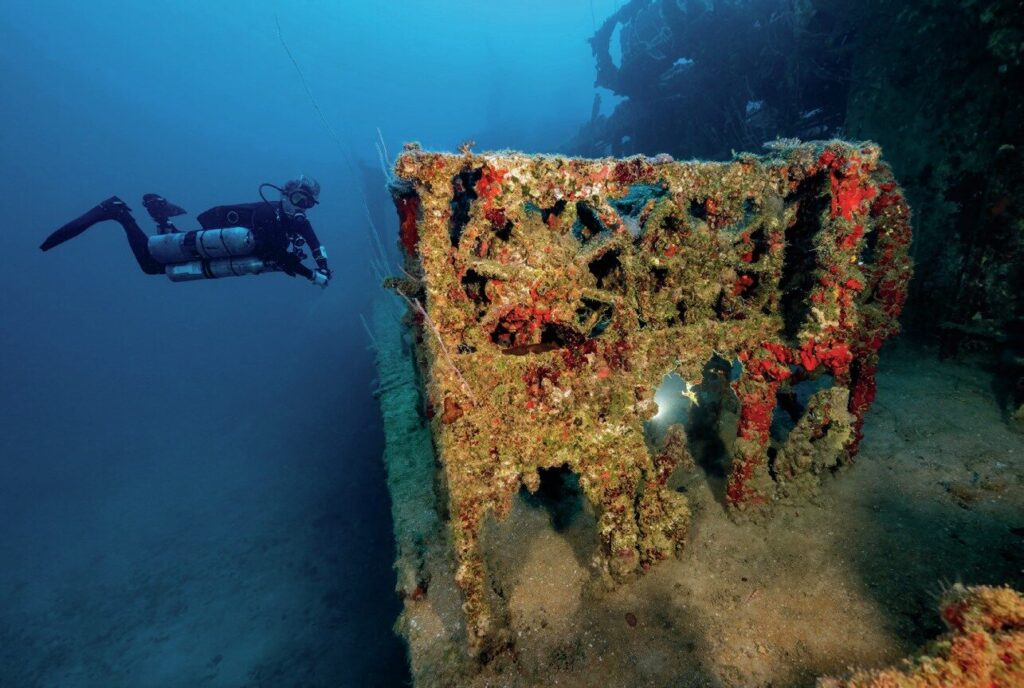
At 340 feet in length, the Lamson may seem somewhat longitudinally challenged in size compared to the larger capital shipwrecks at Bikini. But that compactness, combined with the several guns, torpedoes, bombs and generally good access to her upper decks, make her a really excellent dive!
USS Anderson
Commissioned into the US Navy in 1939, the USS Anderson was a Sims-class destroyer that served in the Asiatic-Pacific campaign during World War Two, earning an impressive ten battle stars.
Like the Lamson, the Anderson was deemed surplus to requirements after the war and was assigned to Operation Crossroads in January 1946.
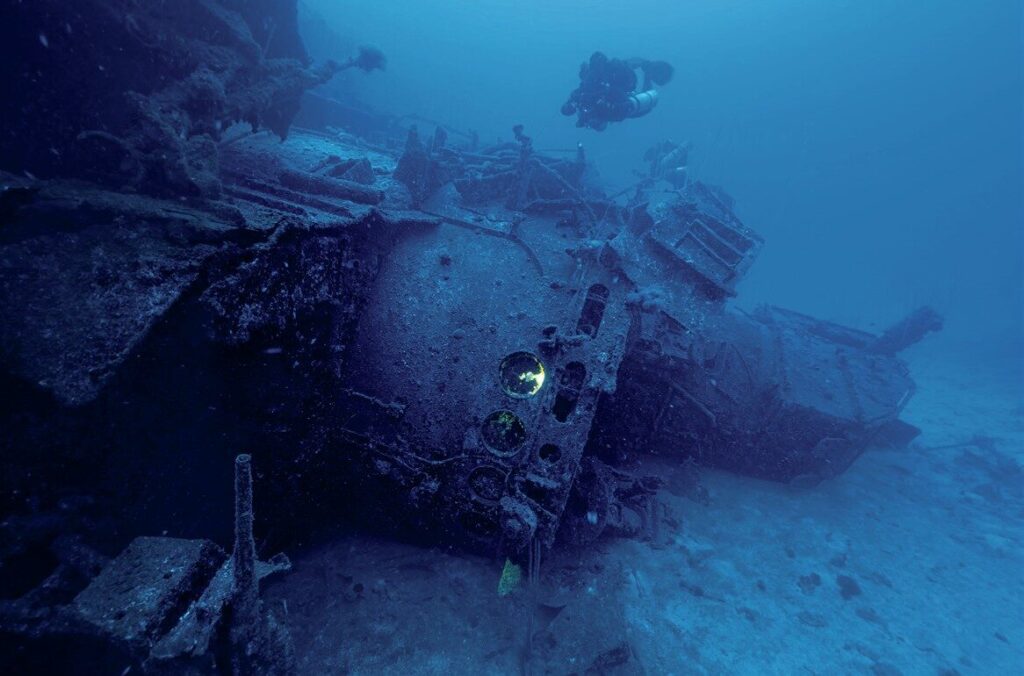
Sunk during the Able test, the ship now lies mostly intact on her side at a depth of 170ft. Measuring 347 feet in length, the Anderson is also relatively compact but offers an excellent dive. Highlights include the propellers, depth charge racks, gun turrets, and torpedo tubes.
USS Apogon
Although only commissioned in July 1943, the Balao-class submarine Apogon was assigned to Operation Crossroads in early 1946. Interestingly, before departing for Bikini Atoll, she was retrofitted with remote control technology.
For the Able test, Apogon was moored on the surface, relatively close to the blast centre, but sustained no significant damage. During the underwater Baker test, she was submerged to 100ft and maneuvered remotely to within 330 feet of the nuclear device, which was suspended from a moored landing craft. Amazingly, Apogon’s hull remained intact despite the nuclear blast. She sank due to the immense underwater pressure wave, which caused her watertight seals to leak, flooding the submarine.
Now resting upright at a depth of 157ft, Apogon is the only submarine that can be dived at Bikini Atoll.
Diving Bikini – Preparation, Challenges, and Rewards
Almost every aspect of diving the Bikini Atoll ‘nuclear fleet’ was an adventurous challenge for me – starting with just getting there and back again!
I had to get trained to dive safely to 180ft, then I had to do those dives safely as there is very little margin for error in such a remote location. Photographing large wrecks at depth proved a significant challenge I had not really anticipated, plus understanding what actually happened at Bikini and why it happened was much more complex than I had imagined.
Was it all worth it – Absolutely! Plus, it changed my overall game plan for the next few years. Before I even left the atoll I was planning my return and preparation for that, which all starts soon with CCR familiarisation training… but that’s for the next article!
Don Silcock
Don is Scuba Diver’s Senior Travel Editor and is based from Bali in Indonesia. His website has extensive location guides, articles and images on some of the best diving locations in the Indo-Pacific region and ‘big animal’ experiences globally.
Frequently Asked Questions
Why is Bikini Atoll considered the Holy Grail of wreck diving?
Bikini Atoll hosts some of the world’s largest and most historically significant wrecks — WWII battleships and submarines sunk during nuclear testing in 1946.
What were the Operation Crossroads nuclear tests?
Operation Crossroads was a series of US nuclear tests at Bikini Atoll designed to study the effects of atomic bombs on naval ships, resulting in the creation of the “nuclear fleet” wrecks.
What are the must-dive wrecks at Bikini Atoll?
Key wrecks include USS Saratoga, IJN Nagato, USS Arkansas, USS Lamson, USS Anderson, and submarine USS Apogon — all resting between 157ft and 180ft deep.
Is diving Bikini Atoll safe for recreational divers?
Bikini diving is strictly for experienced technical divers trained for deep, decompression, and trimix dives due to its depth, remoteness, and demanding conditions.
How can divers visit Bikini Atoll today?
The only operator currently running trips is Master Liveaboards, offering seasonal tech-diving itineraries to explore the lagoon’s world-famous nuclear wrecks.
This article was originally published in Scuba Diver Magazine
Subscribe today with promo code DIVE1 — enjoy 12 months for just £1!
