Hints and advice on how to avoid and manage dive boat separation
Photographs by Stephen Frink
It’s rare for divers to be left behind by a dive boat, but it happens. In addition, it’s not uncommon for divers to be temporarily separated from the boat.
Either event can be a scary and dangerous experience. Even in relatively warm water, hypothermia can set in, and currents can carry divers far from where they surfaced.
The best way to handle being left behind is to avoid the situation in the first place. Make sure the dive operator uses reliable tracking procedures to account for divers as they enter and exit the water.
Follow their procedures, and make certain your entry and exit are noted. Know the operator’s recall signals, and connect with your fellow divers before getting in the water to increase the chances of your absence being noticed later.
No matter how well you prepare, however, separations do occur. And when they do, having the right equipment can make the difference between a good story and a bad time. A diver on the surface can be a difficult target to spot from a boat.
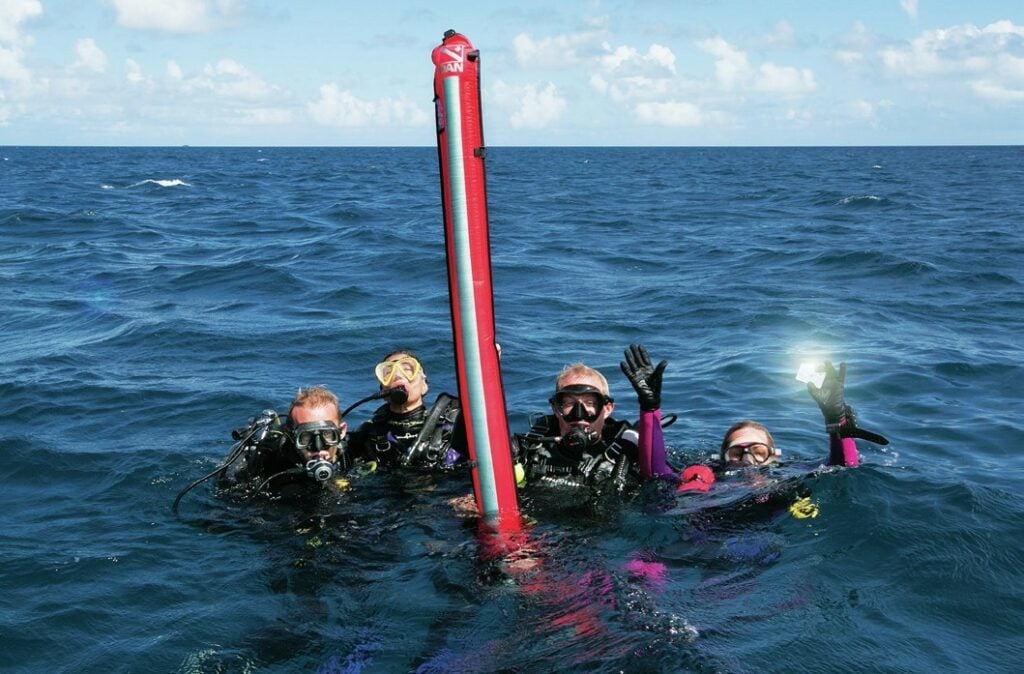
The key to getting rescued is making yourself as visible as possible. One of the best tools for doing that is a surface marker buoy (SMB), also known as a safety sausage. For maximum visibility, an SMB should be at least six feet tall.
A variety of accessories can enhance the performance of an SMB, including reflective strips and attached strobes. These additions become especially important as daylight fades.
An SMB or safety sausage can only be inflated once you surface – a DSMB (delayed surface marker buoys) can also be deployed from underwater, allowing for easy visibility and trackability by people on the surface.
One of the most compact and least expensive signaling devices is the signal mirror. While a signal mirror works only in sunny conditions, it can attract the attention of aircraft and boats at great distances.
Using a signal mirror is not difficult, but it does require knowledge and practice, so ensure you know how to use it before you hit the water. Another option that increases your visibility during a search, especially by air, is a rescue streamer.
A compact roll that fits in a BCD pocket, the device fans out when deployed and floats on the water, making a diver on the surface visible from above.
When would-be rescuers aren’t looking your way, an audible signal can attract their attention. If your BCD doesn’t have one already, attach a plastic whistle to it, preferably in a position that will allow you to use it without having to detach it.
As daylight fades, the best surface signal device might be one you already carry — a dive light. Shine the light on your SMB to make it more visible, or point the beam toward the dive boat or rescue vessel.
No single device can meet a diver’s needs in every situation, so the best bet is to carry an assortment of devices that provide a variety of options. Beyond that, remember to follow the procedures of the dive boat, and try to make an impression on the boat crew so they’ll be less likely to forget you.
www.diversalertnetwork.org
For an extensive range of diving health and safety information and downloadable resources, research studies, incident summaries, and free e-Learning courses, take the time to explore the DAN website.
This article was originally published in Scuba Diver NA#18
Subscribe today with promo code DIVE1 — enjoy 12 months for just £1!