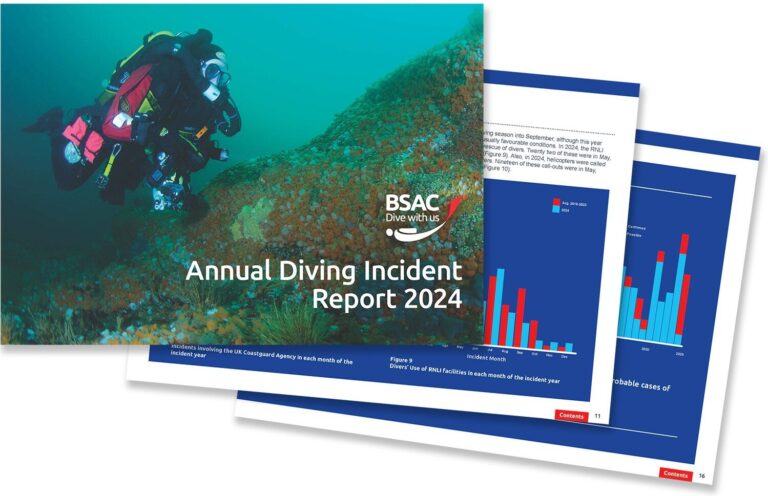
Decompression illness risks becoming more controllable, a wider grasp of IPO and its avoidance, and fewer early-season incidents are all noted in the just-published BSAC Annual Diving Incident Report 2024 – along with warnings about the risks of skimped drysuit training and hookah rigs.
The report, which year after year provides an illuminating snapshot of the state of scuba-diving safety, records a total of 239 UK incidents involving divers of all training agencies, including 12 fatalities, and analyses trends based on those reports.
The number of reported UK-based incidents has remained largely consistent since 2014 with the exception of the pandemic year. Overseas incident reports, which increased from 66 cases in 2022 to 113 in 2023 and numbered 92 in 2024, are also included but are not considered in the analysis data.
BSAC is the national governing body for diving and the report, compiled by Jim Watson and Ben Peddie, aims to spotlight trends that can inform training programmes and safety advice across the board.
Average age
The average age of the 12 fatalities was 57.4 years, and half of the divers had been either solo diving or became separated under water.
The number of incidents peaked in July but was also unusually high last September, a month of poor weather. There were also more reports than usual of incidents during November and December, most of these occurring at inland sites.
A decade ago there would have been an early-season spike in incidents but this feature has now disappeared, according to the report. Many of the incidents that do occur early in the season relate to buoyancy issues.
IPO awareness
A major positive aspect is that because of training improvements scuba divers are becoming increasingly aware of the dangers of IPO (immersive pulmonary oedema). This is resulting in earlier identification and resolution of problems arising in the water, rendering the outcome of such incidents less serious.
The condition can be difficult to identify but seven IPO incidents were medically confirmed in 2024, with one a possibility, and none of them was fatal.
“Like divers and snorkellers, open-water swimmers are now advised not to swim alone, and the community is becoming more mindful of the risks associated with IPO,” says the report.
“If you experience any breathing difficulties under water, terminate the dive, ascend safely and exit the water. If you observe signs of IPO in a buddy, assist them from the water as safely and promptly as possible.”
The club also emphasises the importance of divers who have suffered an IPO taking medical advice before diving again.
Repeat diving and DCI
The distribution of types of diving incident was broadly consistent with previous years. A continued decline in those beginning at the surface was noted alongside an increase in cases in which neither the starting nor maximum depth was reported.
There was a continued decline in reported incidents involving decompression illness and rapid ascents. With fewer cases of DCI linked to diving deeper than 30m, fast ascents or missed decompression stops, it seems that repeat diving is the increasing factor – clearly an avoidable one.
“This encouraging trend could be correlated with sustained focus on improving buoyancy control and dive-planning – measures aimed at minimising the risks associated with deeper dives and ascent-related errors,” says BSAC.
The report compilers identified 18 instances in the past two years in which divers lost control of their buoyancy and ascended feet-first or had to abort a dive because air migrated to their drysuit feet, occasionally even displacing fins and boots.
BSAC recommends that divers complete dedicated drysuit training and ensure that their suits fit well, especially around the feet and legs, to avoid loss of fin control and/or inversion.
Also causing ascent-related incidents had been underweighting and overweighting, and jammed DSMB reels.
“In recent years we have seen a range of unconventional diving-equipment configurations being offered on the Internet,” adds BSAC, reflecting one incident the inquest for which was reported recently on Divernet.
“Of note is equipment where small battery-operated compressors are mounted on floats above the diver and deliver air to second stage regulators on 9-12m long hoses. UK diving organisations and the British Diving Safety Group have all expressed significant concern over the efficacy of such equipment for use even in shallow depths.”
Rescue services
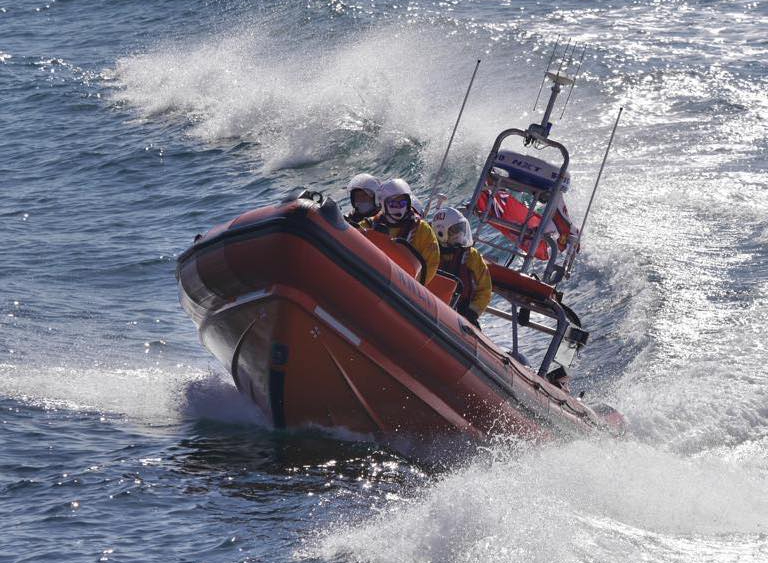
Lifeboats were called out 29 times to rescue divers in the UK, and helicopters 25 times, mainly in the summer months. There were a number of instances of false alarms made with good intentions, mainly reported by the Coastguard, but fewer cases of divers requiring accident-prevention advice.
The report notes that although Dive Leaders and Advanced Divers form a smaller proportion of the diving population, they were significantly represented in the incident data.
Though such divers might be argued to be diving more often than the majority, the club observes that this serves as “a valuable reminder that, regardless of qualifications or experience, no diver is immune to becoming involved in an incident”.
BSAC also publishes the Safe Diving guide, summarising key elements of safe diving practice. Additional data for its Annual Diving Incident Report 2024 was supplied by the Maritime & Coastguard Agency, RNLI, MoD Superintendent of Defence Diving and PADI EMEA. The full report can be downloaded here.
The club also urges divers of all agencies to report any incidents using its online form.

The BSAC club I walked away from, boasted that a dry suit course was not neccessary and do not give much attention in confined waters moving to teaching in open water, ocean diver. They then go straight into conducting the ocean diver course without giving specific instructions on how to use a dry suit in open water. They also disagree on BSAC ways of training and invent their own ways. Tackling anyone with concerns in BSAC clubs causes members of the committee to turn on individuals and they actively make individuals lives so difficult that there is no option but to leave. Members of the club committee forget that they don’t own the club and act as though they do.
Drysuit training should be a separate course that is completed before ocean diver begins in open water if ocean diver is to be conducted in a dry suit.
I have raised concerns with BSAC about the behaviours of clubs who seem to be stuck in a timeloop. I have received no response.
I completely agree, we are PADI trained and BSAC divers often think we are not as skilled. The PADI dry suit course is very comprehensive and equip us to dive competently in colder waters. On one trip to the Farne island we rescued a BSAC diver who had not followed instructions and had been swept away with the current. We trained as open water abroad then came home and did our dry suit training. I have seen unqualified divers entering the water for the first time in a dry suit without any training. It’s shocking 😮