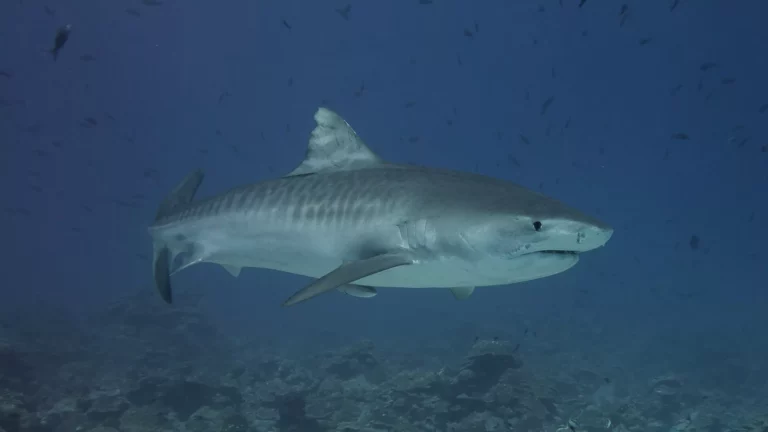
A scuba diver working at the Nassau Grouper Spawning Aggregation site off Little Cayman after sunset on 6 February was bitten on the thigh by a juvenile tiger shark – in an incident that the Cayman Islands’ government was quick to declare a mistake on the shark’s part.
The diver was later named by the Cayman Compass as Berkley White, a California-based underwater photographer who had been recording grouper activity using a video camera mounted on his DPV when the encounter occurred. The Department of Environment (DoE) said that he was working at the site as part of its partner research team.
In 1994 White founded Backscatter Underwater Video & Photo, which is now claimed to be the USA’s biggest underwater photographic equipment supplier. A photographer and feature-writer, he also runs underwater photo safaris and training events.
Only a few researchers were still working from the dive-boat Sea Keeper when the shark, reckoned to be about 2m long and three years old, sank its teeth into White’s thigh.
The diver sustained what were described as relatively minor puncture wounds that a nurse was able to treat at Little Cayman Beach Resort, though with no clinic on the island she recommended that he be transferred to Grand Cayman for further attention. Airlifted to hospital in George Town, he was reported to be recovering well.
February full moon
Thousands of endangered Nassau grouper assemble off the western tip of Little Cayman after the February full moon to spawn, an annual aggregation that also draws the attention of reef sharks. The area is protected from fishing activities during the spawning period.
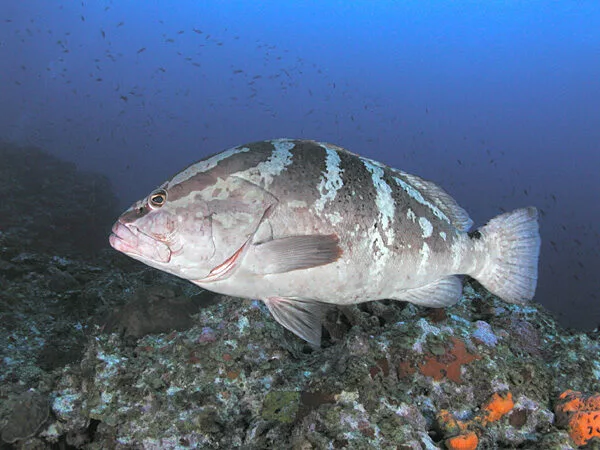
Researchers have conducted annual surveys of the spawning event for the past 25 years and this was said to be the first time such an encounter had occurred.
“While this incident was not expected, it is natural for sharks to be attracted to the activity of an aggregation site, and a young shark is less likely to have experience with groupers and divers,” stated the DoE.
“Coupled with the poor visibility of the site, the young shark mistakenly bit the diver but since sharks do not consider humans food, it fled and did not pursue.”
The researchers still at the site had managed the situation efficiently and safely, continued the department. “We are grateful to the amazing team of DoE research staff, HSA [health service], the Little Cayman Fire department and RCIPS [police] who all did an incredible job of responding to this unexpected event, ensuring the impact on the diver could be minimised,” it said.
“Shark bites are an extremely rare occurrence, particularly in Cayman waters. The risk of a shark mistaking a diver, swimmer or snorkeller as food is highly unlikely.”
Also on Divernet: Researchers track endangered Nassau grouper eggs