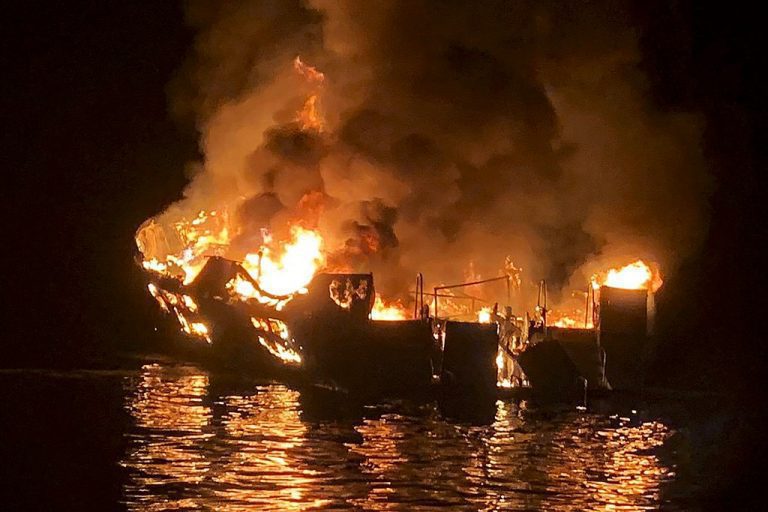
Jerry Boylan, captain of the Conception dive liveaboard on which 34 people died in a devastating fire off the California coast in 2019, has appealed against the manslaughter conviction that led to a four-year prison sentence.
Boylan, now 71, had been found guilty of gross negligence under a federal charge of misconduct or neglect by a ship officer resulting in death in 2023, but US District Judge George Wu had allowed him to remain at home pending the result of the appeal.
At a hearing before a three-judge appellate panel in Pasadena, Boylan’s lawyer, federal public defender Hunter Haney, argued that the conviction should be overturned on the basis that instructions to the jury had been flawed, as reported by Courthouse News Service.
Haney claimed that Judge Wu had failed to make clear to jurors that they needed to find that Boylan’s actions were the direct cause of the 34 fatalities.
He also argued that the trial had overshadowed Boylan’s defence by placing excessive emphasis on government maritime regulations rather than industry practice for dive vessels, thereby reducing the defence’s evidence “to a mere afterthought”.

The Conception had been anchored near the Channel Islands on 2 September, 2019 on the last night of a three-day dive-trip. All 33 passengers and a crew-member had been asleep in the bunk-room below decks with limited means of escape when fire erupted on the main deck at around 3am.
Boylan and four crew had been sleeping in the wheelhouse, with no night-watch set. Blocked by flames from descending normally, they had jumped to the main deck to find the saloon entrance already engulfed.
While the crew tried unsuccessfully to force entry, Boylan made a distress call from the wheelhouse before leaping overboard as smoke filled it. Trial evidence showed that the divers had still been alive at that point – a coroner determined that they had died of smoke inhalation, many in one another’s arms.
Ran past fire-hoses
The appellate court judges questioned whether any errors made by Judge Wu at Boylan’s trial had been significant enough to have altered the outcome.
US Circuit Judge Consuelo Callahan noted what she described as overwhelming, undisputed evidence of Boylan’s failure to train his inexperienced crew in fire response. Some of them had run past fire-hoses after being awakened, and Boylan had been quick to abandon the vessel.
“It would seem that it would be hard for a jury to do anything other than to convict,” said Judge Callahan.
Judge Lucy Koh highlighted the fact that only one of six fire extinguishers had been used – by a trapped passenger – and that neither fire-hose had been deployed. Boylan had failed to use the public-address system to warn those trapped below decks.
“So, why wouldn’t there be harmless error if Captain Boylan is first to abandon ship, doesn’t even notify any of the passengers that there’s a fire, and the PA system is right next to the phone where he called the Coast Guard?” Judge Koh asked Haney.
Assistant US Attorney Alexander Robbins dismissed the defence’s arguments as “hair-splitting,” saying that the disputed instructions had no impact on how either side argued the case. “It was literally irrelevant to the jury’s determination,” he said.
The appellate court has not indicated when it will rule on Boylan’s appeal.