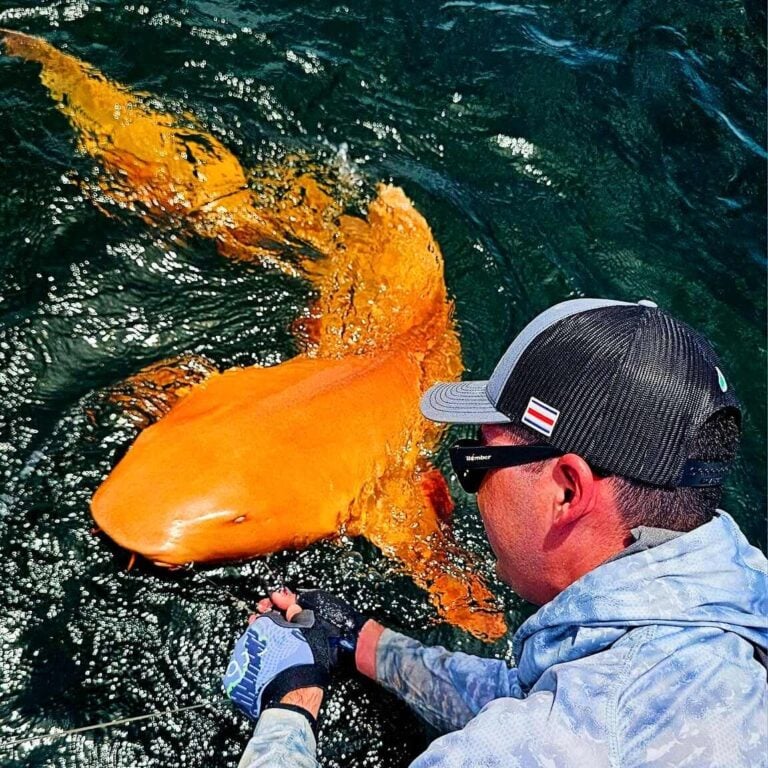
A bright orange nurse shark hooked by Costa Rican sea anglers marks the first time a rare pigmentation condition called xanthism has been documented in the species – or in any cartilaginous fish in the Caribbean.
The 2m shark was caught – and then released – at a 37m-deep site near Tortuguero National Park in August 2024, but a related scientific study has just been published by researchers at the Federal University of Rio Grande in Brazil.
As well as its all-over amber skin tones, the shark displayed signs of albinism, in that its eyes were white.
Camo question
The usually brown skin of Caribbean nurse sharks (Ginglymostoma cirratum) helps them to avoid standing out against a backdrop of reefs and rocks while hunting.
Catching prey unawares might seem a trickier proposition for a brightly coloured nurse shark, although the study has concluded otherwise, based on this one’s survival to adulthood.

Finding a willing mate could present another challenge, and the marine biologists are still not sure whether the orange shark is a one-off or the start of a new local genetic trend.
Xanthism and albinism (the absence of melanin) are both considered very rare in sea creatures, though they have been recorded in a few species of freshwater fish, reptiles and birds.
“Further research is needed to explore potential genetic or environmental factors influencing this rare pigmentation anomaly in sharks,” say the researchers.