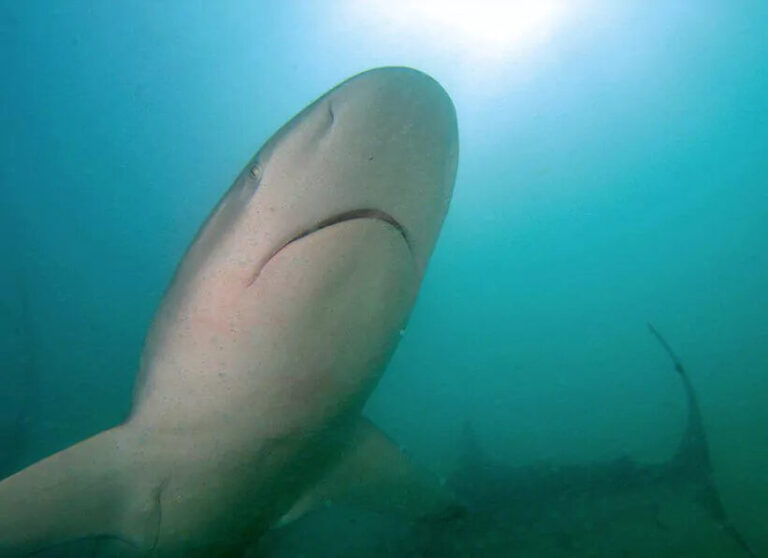
The sudden death of a male snorkeller in Hadera on Israel’s Mediterranean coast earlier this year involved at least two dusky sharks, a species never before linked with attacks on humans, and an uncharacteristic frenzy brought on by feeding competitiveness.
A report by two shark experts has concluded that regular feeding of the large assembly of sharks at the site had encouraged the animals to adopt “begging behaviour” that led to the fatal incident. The researchers want to see all feeding and spearfishing banned in the area – to head off any suggestion that the sharks should be culled.
Eric Clua of the Paris Science & Letters Research University and Kristian Parton of the University of Exeter wrote their report after studying witness statements and video footage of the rare incident.
The day after it occurred small quantities of human remains were recovered, with DNA evidence confirming that several sharks had been involved in the attack.
The snorkeller, 40-year-old Barak Tzach, was using a GoPro camera 100m off the beach when witnesses heard him shouting: “Help, they’re biting me!” He then disappeared as the water turned red and dorsal and tail fins appeared that suggested the involvement of at least two dusky sharks.
Camera signals
Video cameras emit a slight electro-magnetic signal that could lead certain sharks to identify the source as a potential prey item, say the researchers. Acquired begging behaviour could then drive a bold dusky shark (Carcharhinus obscurus) to approach a human seeking a reward, and trigger a “reflex/clumsiness” bite aimed towards the source of the signal.
The shark’s sharp teeth could cause severe bleeding, with the sound of the biting and smell of blood then attracting other sharks and triggering a frenzy as they engaged in predation bites. “Extreme competition” between individuals could temporarily override the fact that these normally placid sharks do not regard humans as part of their diet.
Clua’s theories on one of the various categories of shark bite – “defensive biting” – were explored on Divernet earlier this year.
According to the marine biologist the rare “predatory” bites, which are defined by large tissue loss and often the death of the victim, stand out from other types of bite such as reflex/clumsiness, in which wounds tend to be superficial and rarely fatal (though these can also foreshadow predation).
Shark-watching
With eco-tourism, shark-watching and inwater encounters with sharks becoming more popular globally, the risk of the bites also rises, say the researchers. The few shark species that might consider humans as potential prey include the white, mako, tiger, bull and oceanic whitetip.
Despite sometimes reaching more than 3.5m long the dusky and sandbar sharks as found at Hadera had never before been identified as killing a human anywhere in the world.

Seawater is used to cool the Hadera electricity power plant, with large volumes of warm water discharged back into the sea. Also a dump-site for desalination brines, each year the area attracts aggregations of 60-80 mainly female dusky and male sandbar adult sharks.
This has led to the development of unregulated shark-watching tourism and uncontrolled artificial feeding of the sharks, reducing their caution around humans. Spearfishing is also common, leading to potential competition between human and sharks for the caught fish.
The researchers argue that the begging behaviour that led to the fatal incident can be eliminated among the sharks by establishing and enforcing a total ban on artificial feeding by the public and on spearfishing. Their report is published in Ethology.

Any form of shark feeding should be banned. The shark is an unpredictable creature. Any thing that distracts it from its usual routine is fraught with danger. These creatures are always alert to changes and any hand feeding, spearfishing or excessive surface movement triggers their natural instincts.
Don’t do it. Simples