The first artefacts have been recovered from the wreck of the San José since the fabled Spanish treasure ship sank to a depth of 600m off Colombia more than 300 years ago.
The Colombian state used underwater robots to collect five objects and some archaeological fragments from what it has designated a cultural heritage site. The recoveries consist of a bronze cannon inscribed with the word ‘Sevilla’, a porcelain cup and three macuquinas or hammered coins, along with two porcelain fragments.


The recovery operation was carried out by the Colombian Navy (ARC) in co-operation with the Ministry of Culture (MinCultura), Colombian Institute of Anthropology & History (ICANH) and the Maritime Directorate (DIMAR) between 16 and 18 November.
The objects removed from the San José Galleon Protected Archaeological Area were revealed in the city of Cartagena on 19 November, as the start of the second phase of the “Towards the Heart of the San José Galleon” research project was announced.
Gold and silver
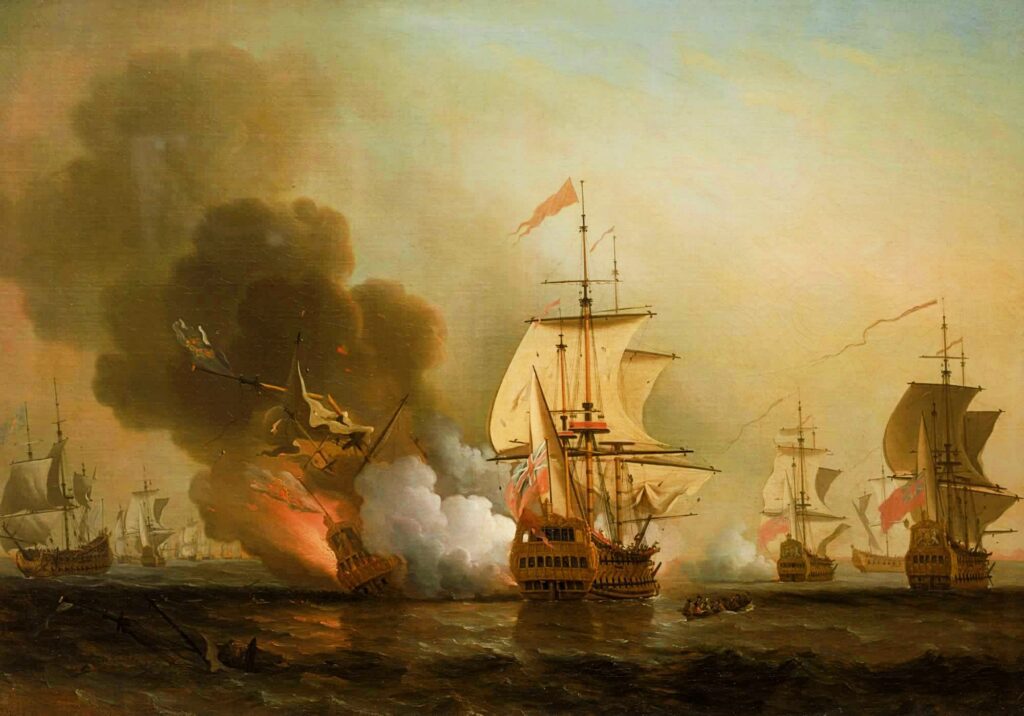
The ship, part of the Spanish fleet, sank off the coast of Cartagena in June 1708 following an attack by British privateers. Built 10 years earlier, the galleon was estimated to be carrying up to 11 million eight-escudo gold and silver coins when it was lost.


Acquiring knowledge rather than treasure-hunting is the aim of the project, insists MinCultura. The first phase had been a non-intrusive survey carried out to understand the distribution of wreckage and objects on the seabed and to identify levels of deterioration.
Surveying from the hull out to the perimeter of the site had confirmed that the shipwreck had not previously been disturbed by unauthorised salvage operations.

The second phase is intended “to delve deeper” through direct analysis of archaeological objects that have been stabilised and preserved. The long conservation process is being carried out in a laboratory at DIMAR’s Caribbean Oceanographic & Hydrographic Research Centre.
The researchers, from MinCultura, ARC, DIMAR and ICANH, want to determine the items’ specific origins, chronology, production techniques, transoceanic trade routes, formation of the wreck-site and what caused the galleon to sink.

“This historic event demonstrates the strengthening of the Colombian State’s technical, professional and technological capabilities to protect and promote underwater cultural heritage, as part of Colombian identity and history,” said culture minister Yannai Kadamani Fonrodona.
San Jose timeline
The Colombian Navy, working with Woods Hole Oceanographic Institution (WHOI), located the wreck-site in November 2015, and the following month Colombia’s president announced that the San José had been found.
In 2018 WHOI disclosed that its AUV had surveyed and confirmed the identity of the galleon through distinguishing features such as its cannon, but it was not until March 2024 that the government announced its plans for a scientific recovery operation.
In May this year researchers published a study of coins imaged in situ using ROV photogrammetry, dating the macuquinas to 1707.
Throughout this time a legal dispute over the wreck had been continuing, with Sea Search Armada, a US-based salvage company, continuing to claim its rights to the site, asserting that it had discovered it back in 1982 and seeking payment of US $10 billion.