
Since Nicolas Remy turned underwater photography into a career, he regularly gets asked that difficult question – what’s your most memorable dive? His answer is short – diving South West Rocks
Photographs by Nicolas Remy
South West Rocks, a small coastal town located between Sydney and Brisbane (same distance from either city) has become one of my family’s ‘happy places’. We’ve made friends there, tried many of the local eateries, have memories of fantastic hikes and have found our all-time favourite campground.
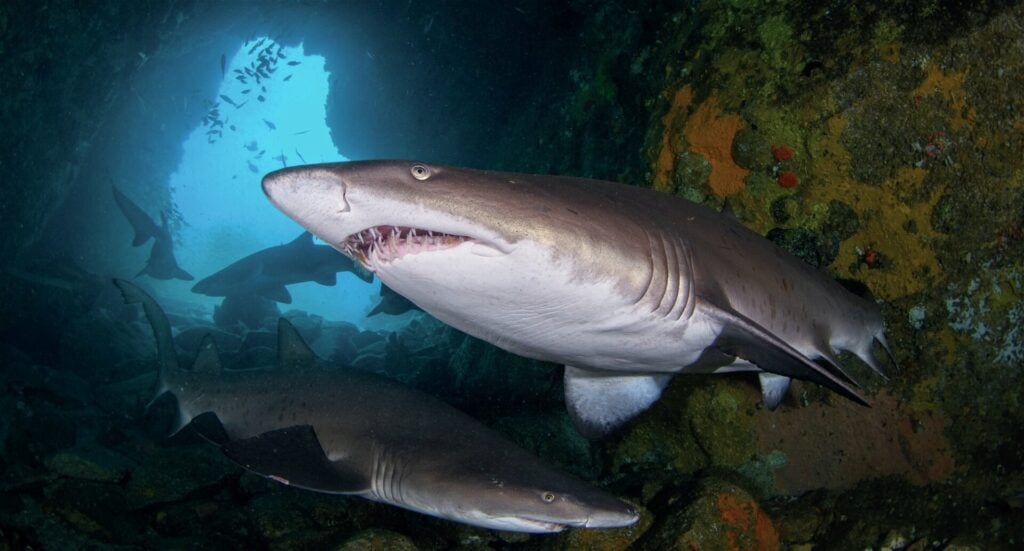
It all started with the diving though – my wife Lena and I initially came for Fish Rock Island, a dive site known for its 120-metre-long ocean cave and for being a major aggregation site for the majestic grey nurse sharks.
We were blown away by our first visit in 2018, and have kept coming back at least once a year since then. Each time we dove with Fish Rock Dive Centre, whose owners Peter and Bia are a couple of passionate ocean lovers, who go out of their way to accommodate our photographic needs.
Fish Rock
Fish Rock is an uninhabited rocky island which emerges about 2km from the shore (about 14km from the nearest marina). At the surface it looks barren, but its treasures are revealed to those who venture below the surface.
Underwater, the island transforms into a dramatic mix of gently sloping walls, gutters and canyons, with various dive sites offering depths from 7m to 35m, including the aforementioned 120-metre-long swim-through cave, which lets adventurous divers cut across right below the island.
What makes Fish Rock so special is the proximity of the East Australian current, which flows around the island, bringing nutrients and abundant fish life.
In turn, Fish Rock’s underwater topography offers refuges for many species and always has areas sheltered from currents, which is why so many grey nurse sharks aggregate there.
Indeed, during the day swim half-asleep and need places to rest, and when they fully wake-up at night, they don’t have to travel too far for hunting.
Dive Sites of South West Rock
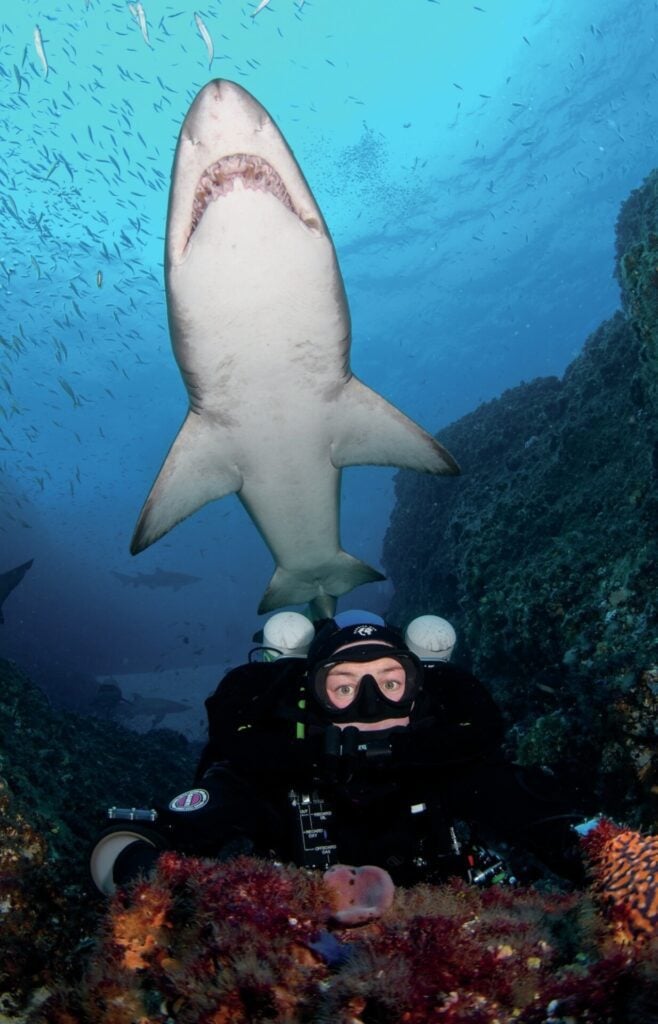
The Cave is certainly Fish Rock’s most-popular dive site. Its shallow entrance is a wide opening of about five metres across at about 10m depth, where grey nurse sharks are sometimes found circling, when a thermocline pushes them to seek warmth in the shallows.
The cave gets narrower towards the middle, which is where it becomes vertical (the chimney), a thrill-inducing passage which leads to another horizontal section, and on to the deep entrance at 24m.
As you journey through the cave, you can admire the sponge-encrusted walls, the large lobster which inhabit the central section and keep an eye out for the wobbegongs which are ambushed at the bottom (stay in mid-water).
You will observe various shoals of fish and possibly cross-paths with some larger animals. In my many travels through the cave, I have come across turtles, queensland grouper and swimming wobbegongs!
Did you know?
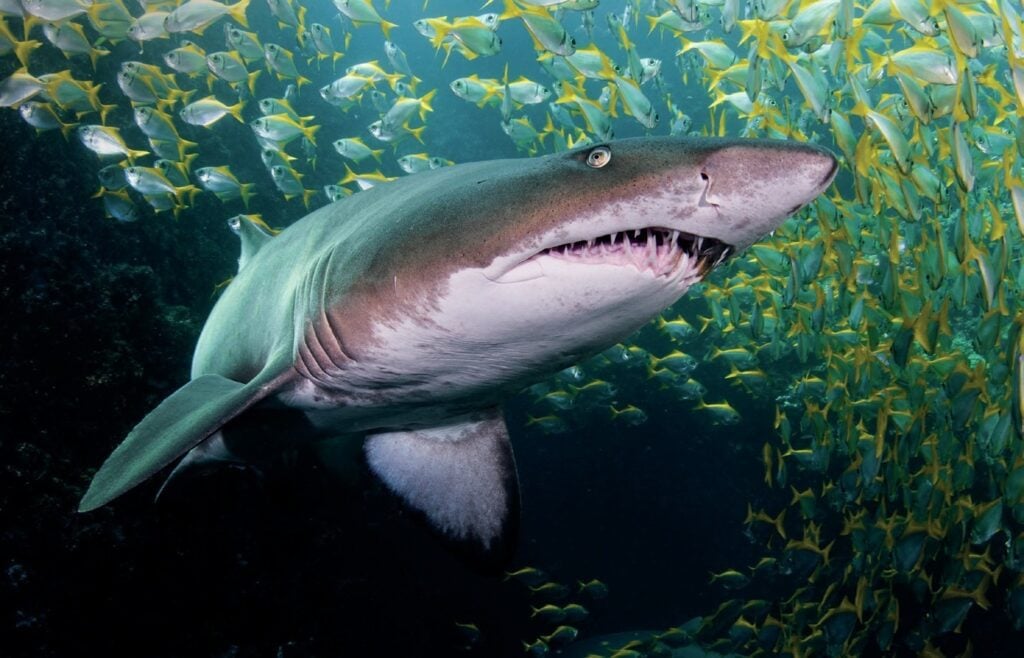
The grey nurse shark, with its distinctive rows of pointed teeth, is a species in grave danger in numerous regions across Australia.
My most vivid memory was literally bumping into a large bullray, in the narrowest section of the cave… Depending on the weather, surge can build up inside the cave and be quite noticeable in the shallow entrance – as the water moves, your dive computer indicates changing depths whereas you’re not moving up or down!
The Aquarium is another popular site which is also a beginner’s favourite (it is recommended to have at least 20 dives for the cave).
As its name implies, there are fish everywhere along the gently sloping walls, mostly small ones, but you’ll likely encounter blue groper, possibly a turtle and sometimes grey nurse sharks.
However anything can happen at the Aquarium -Lena and I have both crossed-paths with a hunting dolphin, I once saw a humpback whale on the move, and a couple of bronze whaler sharks passing by.
Also, this is where a large shoal of 200 scalloped hammerheads sometimes gets sighted (October to January), alas I was never lucky enough to see them myself… Smaller tropical species can also be found if you keep your eyes peeled, I have once been shown a peacock mantis shrimp in between rocks!

As you keep the island to your left, continuing from the Aquarium you’ll end up at the Shark Gutters, a series of underwater canyons (15m to 30m depth) which are often patrolled by grey nurse sharks – an ideal place to approach them and take photos.
Nearby lies Fish Bommies, a set of rocky boulders from 22m to 28m where large shoals of fish roam, performing mesmerizing underwater ballets around large wobbegongs. The proximity of the wobbegong and schooling fish also makes for great photo opportunities.
On the northern side of Fish Rock, the submerged Pinnacle (8m to 30m) and Colorado Pass are another two interesting dive sites, better attempted if you’re comfortable dealing with currents and possibly eddies.
Some of my fondest memories there include the largest shoal of kingfish I ever saw, turtles, and I know bull sharks are sometimes sighted at the Colorado Pass.
Best Time For Diving South West Rocks?
Fish Rock offers great diving all-year-round, and while there is seasonality in terms of temperature and marine life, the diving conditions really change by the day, according to wind and swell direction.
These determine which sites are exposed to currents, the water clarity, colour and temperature. If you come to Fish Rock, expect the unexpected…
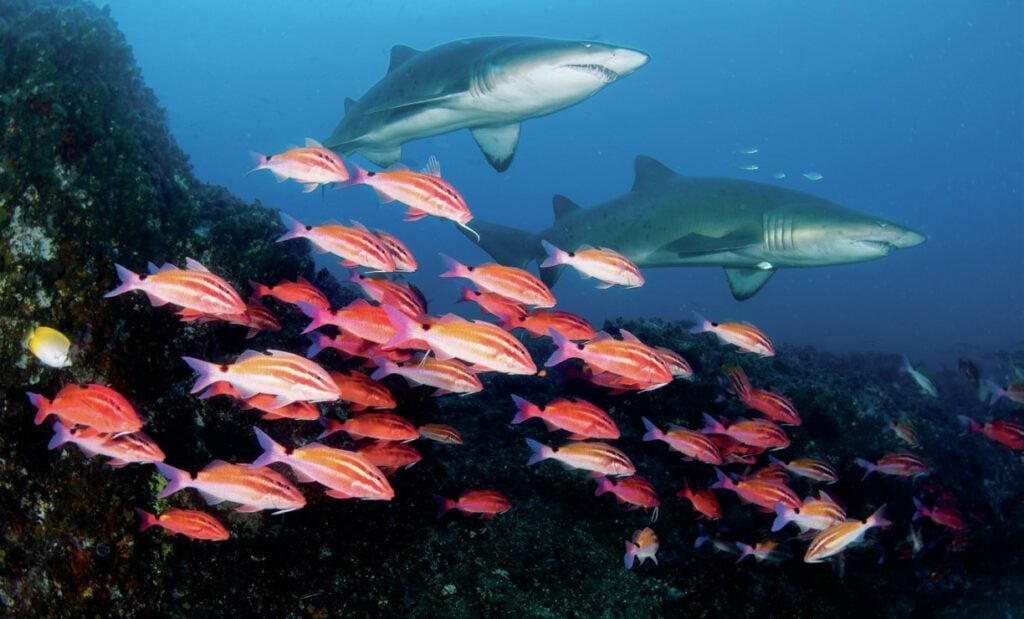
Summer is when we’ve had the easiest diving, with 25 metres of blue-water visibility, toasty 24-25 degrees C temperature, and grey nurse sharks everywhere! However, we’ve seen the water dropping to 17 degrees C overnight (and turning greener) with a change of wind!
This was good news because a sudden drop in temperature can (and did) push the sharks to aggregate in the shallows, a chance to see them inside the cave. We had some excellent dives from July to October too, with 18-19 degrees C water temperature and visibility ranging from ten to 20 metres.
In November we’ve had a dive with three metre clear green-pea soup, but a few days later others had clear blue waters and saw the schooling hammerheads! In terms of marine life, it is worth noting the grey nurses leave Fish Rock for a few weeks every year (around March-April) and migrate south, as the water becomes too warm to their liking.
If you want to try your luck at spotting hammerheads, target November to January, although they’ve occasionally be seen as early as September.
Finally, June and September are good months to watch the whales during their migration up and down the coast, and hear their songs accompany your dives, with the change for a swim if we were to encounter a curious cetacean.
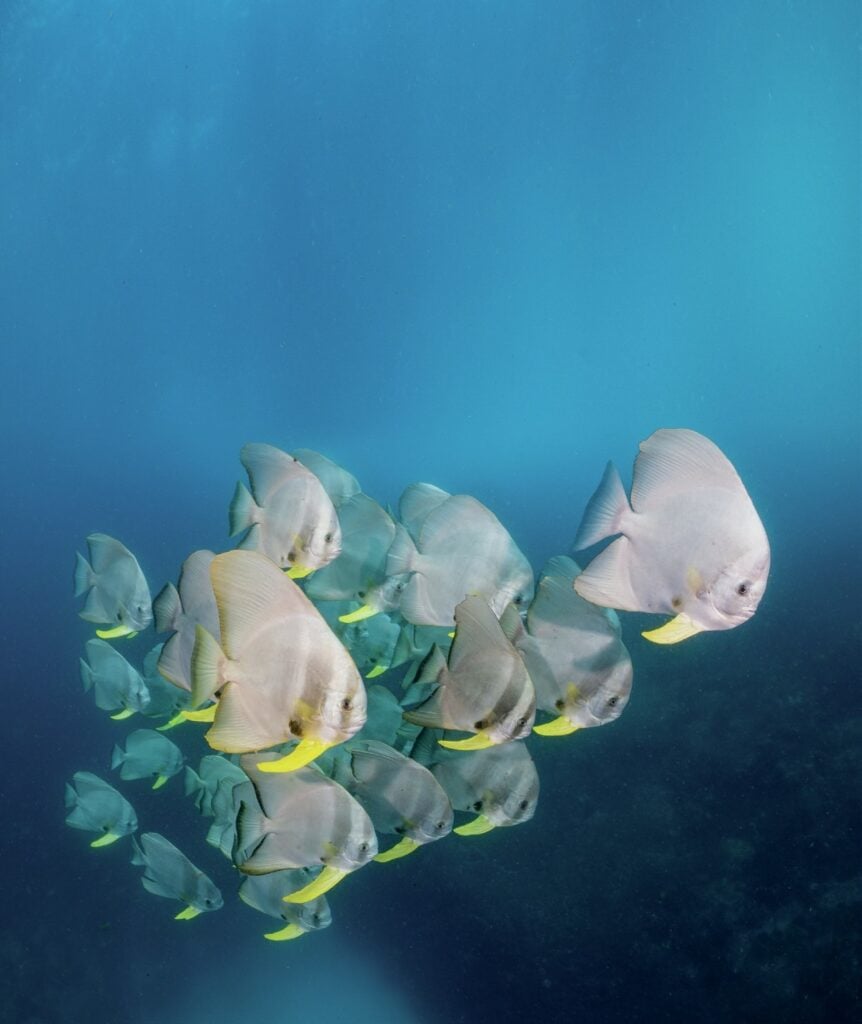
Green island, a hidden gem
On the way between South West Rocks and Fish Rock lies Green Island, a truly fantastic drift dive which is seldom visited, partly because divers insist for Fish Rock, partly because it is more weather dependent.
Fortunately, the team at Fish Rock Dive Centre love Green Island themselves and I was fortunate to dive it twice (July and September).
The drift starts between rocky boulders in about 12m depth, and straight away I couldn’t decide where to look and what to photograph! Wobbegongs on the seafloor, a myriad of fish including both temperate and tropical species, blue groper and a turtle swimming-by.
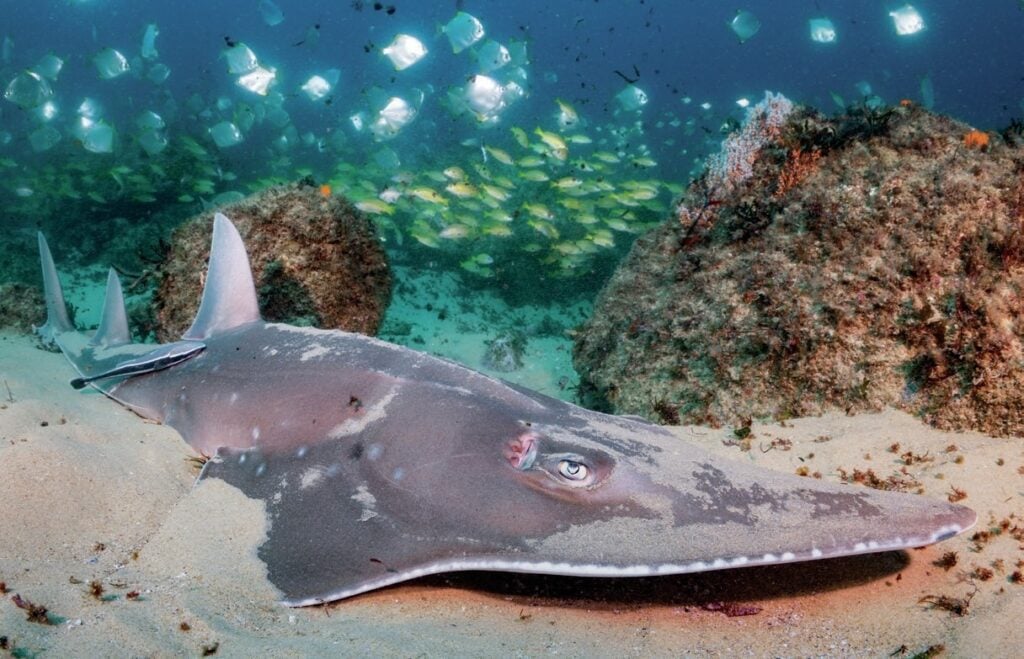
As I started to drift and follow the sand line (15m depth), I crossed-path with grey nurse sharks and each time spotted a couple of large guitarfish (also called shovelnose rays), over two metres in size!
Towards the end of the reef, the first time we stumbled across schooling white-spotted eagle rays and the other time, a silky shark, while whales songs were getting louder and louder.
Topside Adventures in South West Rocks
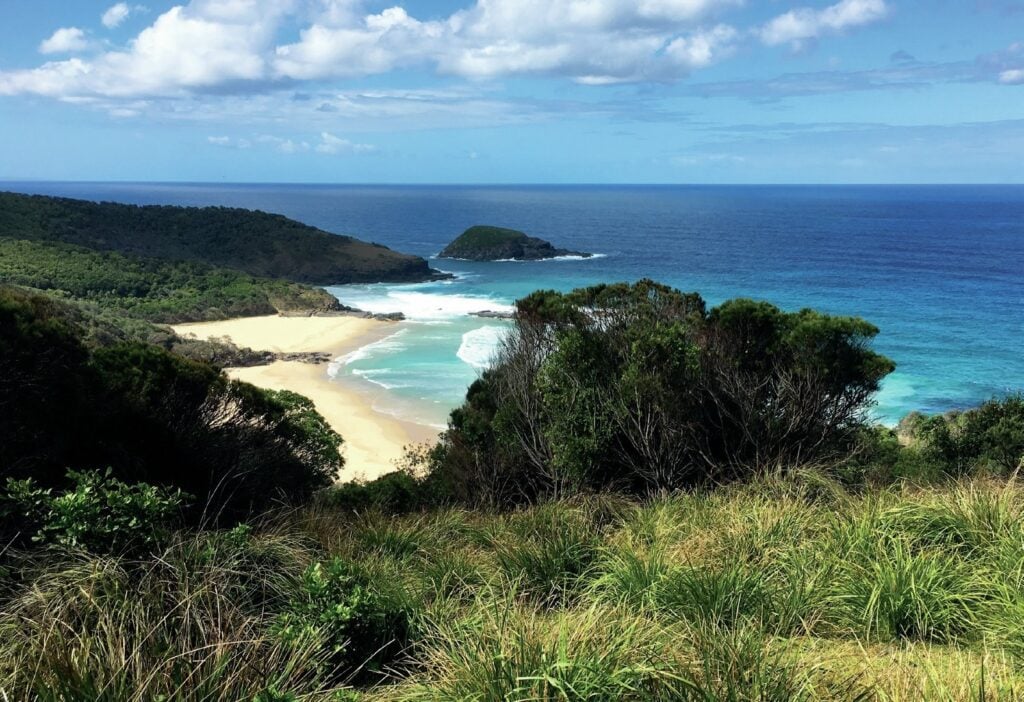
Whenever we’re on a boat in between South West Rocks and Fish Rock, we can’t help but marvel at the wild and awe inspiring coastline.
As far as the eye can see, long sandy beaches are boarded by lush rainforest, with the only signs of civilization being the township of South West Rocks, the nearby historic Gaol and the Smoky Cape Lighthouse.
I hope mankind resists the urge to over-develop this pristine chunk of coastline! The Gaol is well worth a visit, and the neighbouring campground is one of our very favourite, with clean and comfortable facilities, walk-in access to a sheltered beach and boat ramp.

It is possible to shore-dive from the boat ramp (12m depth) but we haven’t tried yet. Near the lighthouse a few picnic tables call for a celebratory drink, to enjoy the breath-taking vista.
The Hat Head national park offers a number of hiking trails of varying difficulty, leading to stunning beaches which you may well have all for yourself (summer school vacations aside).
Further south, Hat Head boasts some spectacular walks, as the lower vegetation makes it easy to appreciate the landscape, while finding your way in between grazing kangaroos.
Frequently Asked Questions
Why is South West Rocks famous for diving?
South West Rocks is best known for Fish Rock Island and its 120-metre underwater cave, which attracts large numbers of grey nurse sharks and diverse marine life.
Can beginners dive Fish Rock Cave?
The Fish Rock Cave dive is recommended for divers with at least 20 logged dives. Beginners can enjoy shallower sites like the Aquarium before attempting the cave.
What marine life can be seen when diving South West Rocks?
Divers may encounter grey nurse sharks, turtles, wobbegongs, eagle rays, kingfish, dolphins, and occasionally schooling hammerheads (Oct–Jan).
When is the best time to dive South West Rocks?
Diving is possible year-round. Summer offers warm water and visibility up to 25m. Hammerhead sightings are most common from November to January.
Is Green Island worth diving?
Yes. Green Island is a drift dive packed with sharks, rays, turtles, and tropical fish. It is less visited than Fish Rock but equally spectacular when conditions allow.
Conclusion
South West Rocks has long been an Aussie favourite dive location, but I truly think that Fish Rock and Green Island offer some of the best diving that can be found worldwide.
You will need a car to get there, and I can’t recommend enough that set time aside to explore what South West Rocks and the MacLeay Valley region has to offer for naturelovers and foodies alike.
Fishrock Dive Centre just celebrated 35 years as a PADI member. Fish Rock has long been a popular internationally known dive site, particularly in the last 20 years.
In this time we have seen the local ocean evolve. We have seen the return of schooling hammerheads, and declines and increases in grey nurse shark numbers and fish numbers.
The dive centre is also evolving, to become more focused on education, study and marine conservation, particularly focused on shark studies that commenced in March 2024.
Nicolas and Lena Remy
For more images from Nicolas and Lena Remy, visit their website or follow them on Instagram and Facebook @nicolaslenaremy. Keen to learn underwater photography, check their courses:
This article was originally published in Scuba Diver ANZ #63
Subscribe today with promo code DIVE1 — enjoy 12 months for just £1!
