The reputation of the Indian Ocean island of Reunion had come to revolve around lurid tales of fatal shark encounters – but sharks are hard to come by now, says PIERRE CONSTANT, and while the fish might be less numerous than they were, they still create an appealing environment for divers
Eight hundred kilometres east of Madagascar as the crow flies, and 200km west-south-west of Mauritius, the southern Indian Ocean island of Reunion has an elliptical shape.
With its surface area of 2,500sq km and 200km perimeter, it is the emergent tip of a volcanic mound that rises 7,000m above the ocean floor.
When the supercontinent of Gondwana broke up 160 million years ago, India splitting from the African mainland and drifting north, the Indian Ocean opened up. The Indian Plate was located precisely where Reunion Island lies today, and the birth of this hotspot led to exceptional volcanism.

The Indian Plate moved north, leaving behind the continental block of the Seychelles, and the hotspot bore the Maldives and Chagos archipelago.
A rift appeared between the African and Indian Plates 45 million years ago, and the hotspot moved under the former, lying dormant until it became active again 10 million years ago. That’s when it created the Mascarene Islands: Rodrigues, Mauritius – and Reunion.
Human history
Reunion erupted 3 million years ago. Composed of black basaltic lava, the 3,070m Piton des Neiges was the original volcano, followed by Piton de la Fournaise.

The Arabs charted the island as Dina Morgabin in the 12th century. Portuguese navigator Pedro de Mascarenhas disembarked in 1513 and left the island group his name.
The Frenchman Jacques de Pronis set up a colony on the deserted island that would become Reunion in 1642, naming it Ile Bourbon. In 1715 the governor initiated the culture of coffee, with African and Malagasy slaves shipped in to work on the farms. Some of these ‘marrons’ escaped and fled to the pristine forested highlands.
It was after the French Revolution that the island was named Reunion, referring to the reunion of the Parisian and Marseillais revolutionaries. Despite a slave mutiny in 1811, slavery was not abolished until 1848.
Sugarcane was introduced to replace the ailing coffee economy, and the planters brought Indian workers to the island. Indo-Muslim and Chinese immigration followed in the early 20th century and in 1946 Reunion became an overseas French departement.
Today the island has some 50 dive-centres, mostly on the west coast, with the busiest diving areas St Paul and St Pierre.

The shark reputation
I had met Laurent 17 years earlier on Madagascar’s Nosy Be island, where he operated the Oceane’s Dream dive-centre. He had relocated to Le Port, north of St Paul, where the first settlers arrived in the 1600s.
The famous marine cemetery in St Paul is the resting place of many settlers and slaves, including the infamous French pirate Olivier Levasseur. La Buse, as he was known, terrorised the Indian Ocean and was hanged in St Paul in 1730.

Diving in Reunion does not compare with the rich coral reefs of the tropics. Fish and marine life are a mix of Indo-Pacific and Indian Ocean fauna, though some species are endemic to the Mascarene region.
Since humans settled Reunion, the island has been drained of many of its fish and anything big, including sharks. Fishing-lines found under water are sad testimony to this.
Fish schools are limited to common species such as Bengal snapper (Lutjanus bengalensis), yellowband goatfish (Mulloidichthys vanicolensis), gold spot emperors, sleek unicorns, damsels, butterflyfish, triggerfish and surgeonfish. I didn’t see a shark on any of my dives.
Nonetheless, for the past 15 years violent encounters with bull and tiger sharks off its beaches have given Reunion Island a poor reputation. “It happened to bathers and surfers, not to divers,” points out Laurent.

The local government reacted with a massive shark-hunting and culling operation. Most beaches on the west coast are now protected by shark-nets.
Under water, basaltic lava flows have been carved into a maze of canyons, caves, swim-throughs and small arches, with many salt-and-pepper-coloured expanses of volcanic sand.

The diving community consists of French expats, with foreigners almost unheard of. Based in Le Port, the Dodo Palmé dive-centre, founded 25 years ago, is run by Manu and Laurent, a cool, happy-go-lucky team, offering French FFESSM dive training with the charming Malagasy-born Morgane.


Daily outings offer one morning and one afternoon dive, depending on wind, swell and sea conditions. After each dive, tradition dictates that Ti punch (rum and orange juice) is served at the bar. Weekends are the busiest.
Dodo Palmé uses an 8.5m aluminium boat that can take 12 divers. Night dives are conducted on Fridays, from just before sundown.
Cap Lahoussaye


Cap Lahoussaye lies 20 minutes south of Le Port and is a basaltic cliff pocked by caves. A school of black and white bicolour puller (Chromis dimidiata) could be seen among a school of yellowfin goatfish and convict tang (Acanthurus triostegus), creamy white with thin black bars.


Mimicking a sponge, a cute orange frogfish (Antennarius commersonii) lives on the seabed. A school of squid in stealth formation flew over the sand, curious about the divers.
The cave, an 80m tunnel, featured a cloud of golden cave sweepers (Pempheris vanicolensis) at the entrance and an oddity was an old cannon lying on the basalt reef.

La Barge is the wreck of a floating platform at a depth of 24m. A resident school of Bengal snapper hides inside the broken hull, and rusty anchors can be found in the sand.


Le Houlographe is a floating buoy designed to measure the swell. A deep dive along its anchor-chain to 34m left me marvelling at a forest of white gorgonians. A deepwater species here was the African butterflyfish (Chaetodon dolosus), with a black mask over the eye and a black band on the caudal margin.
A bearded scorpionfish (Scorpaenopsis barbata) wore a serious expression. Endemic to the Mascarene region, the Mauritian anemonefish (Amphiprion chrysogaster) was all-black with three white bands, orange belly and a white margin on the caudal fin.
Maharani
Maharani lies off the rocky shore and tiny beach of Boucan Canot, with big patches of lava between vast expanses of volcanic sand. Swim-throughs and small canyons add some spice to the dive.

An attractive black-banded hogfish (Bodianus macrourus) caught my attention. Peacock hind (Cephalopholis argus), sea chub and large yellowtail snapper roamed and the elegant unicornfish (Naso elegans) was a visual treat.

Le Vieux Fusil is a deepwater dive to a ledge at 39m. A cloud of black pyramid butterflyfish (Hemitaurichthys zoster) are the attraction, along with Indian double-bar goatfish (Parupeneus trifasciatus), crimson red, white and dark with thick lips, and clouds of red soldierfish.

Brown with white dots, a yellowmouth starry moray (Gymnothorax nudivomer) stared shyly from a hole. After 25 minutes on the bottom, an 11min deco-stop was compulsory.
Les Douanes

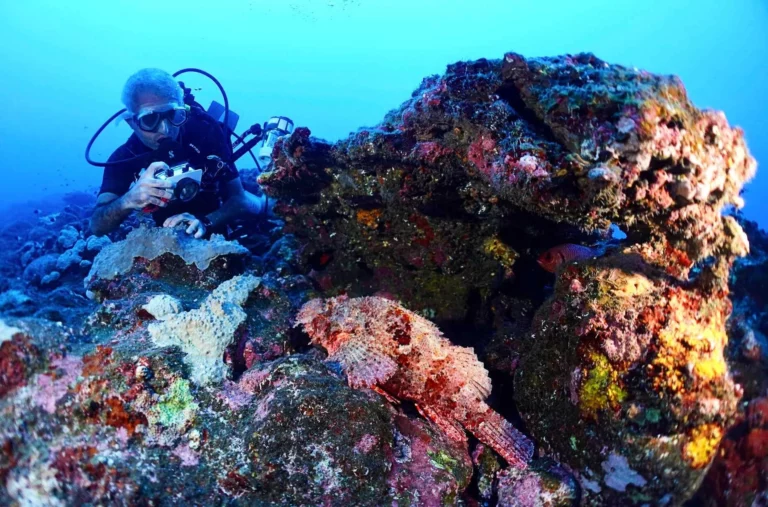
Near Le Port East, this site is marked by a collection of rounded boulders and a lot of brown sand at 18m. A grey and pink stonefish (Synanceia verrucosa) deserved a mention, along with the shadow butterflyfish (Chaetodon blackburnii), black with a yellow tail and a white face.

A Madagascar butterflyfish (Chaetodon madagaskariensis) had a criss-cross pattern on a white robe and an orange rear. A geometric moray (Gymnothorax griseus), grey-white with tiny black dots on the head, emerged inquisitively from under a boulder. Sticking between two rocks, a whitish leaf-fish proved not to be photographer-friendly.

St Pierre

I drove to St Pierre, 45 minutes south of St Paul. The Kazabul dive-centre run by Julien is on the harbour marina. He drove a 5.5m semi-rigid inflatable boat powered by a Suzuki 4-stroke outboard, with 10 divers happily fitted in like sardines in a can.

The Jardin de Corail site in Grambois’s Bay was a 12m-deep reef flat literally covered in hard corals. Further offshore was a wall at a depth of 20-30m decorated by purple-pink Dendronephthya sp soft corals.

Overlooking the sandy bottom, the drop-off was carved by gullies. Encounters included humpback and elegant unicornfish, eye-stripe surgeonfish (Acanthurus dussumieri) and Indian sailfin tang (Zebrasoma desjardinii), with mixed schools of Bengal snapper and gold-spot emperors (Gnathodentex aureolineatus).
I rejoined Dodo Palmé for more diving. Pain de Sucre was a thumb-shaped rock near Cape Lahoussaye and a shallow dive at 15m, with a maze of passages among rocky patches, narrow canyons, overhangs and caves.

Blacktail snapper (Lutjanus fulvus), bluefin jack (Caranx melampygus) in pairs and a couple of hawksbill turtles were present.
There were many species of surgeonfish, such as the eye-stripe (Acanthurus dussumieri), double-band (A tennentii) and epaulette tang (A nigricauda), dark brown with a white band on the base of the tail, as well as a brushtail tang (Zebrasoma scopas), greenish-brown with a pointed nose.

Several spiny lobsters (Panulirus longipes) hid in cracks, while crimson bigeyes (Priacanthus hamrur) loomed in the darkness like bloody ghosts.
Tahiti
Facing the big fuel tanks of Le Port east, a rocky shelf at 5m was covered with white broccoli-style hard coral. Beneath the overhang, curtains of Bengal snapper and red soldierfish abounded.


Giant cobblestones littered the slope, which plummeted to the sand at 40m. Big boulders at depth hosted gorgonians and circling schools of blacktail snapper.
A tame hawksbill turtle grazed between rocks and an exquisite Zebra moray (Gymnomuraena zebra), reddish-brown with thin white stripes, shared its hole with a little green moray.

In the shallows, clouds of sea goldies (Pseudanthias squamipinnis) an enchanting dash of orange (females) and pink (males), cheered up a rather austere landscape.
Myriam, a keen underwater photographer with a sharp eye for critters, gladly showed us tiny species we might have missed.


We had our last dive with Laurent at La Tour, in sunlight and with fabulous visibility, in an open space on the edge of a rocky shelf, with canyons, swim-throughs and boulders in the sand.

There were many grouper: masked (Gracila albomarginata), lyretail (Variola albimarginata) and blue and yellowfin (Epinephelus flavocaeruleus), which becomes dark and dull as an adult. A yellow-edged moray (Gymnothorax flavimarginatus) hid under rocks.


Volcanic trips
No trip to Reunion would be complete without a visit to the three volcanic cirques of Cilaos, Mafate and Salazie, lying within the eroded caldera of the Piton des Neiges volcano in the centre of the island.
You need to take a hire-car and then hike up into the mountains through the wet forest, with its beautiful endemic Cryptomeria conifers. Acacia trees bearing giant mosses and lichens are wrapped in fog.

The Piton de la Fournaise, better known as the Volcano, is a very active one and unforgettable. From Le Tampon and the lunar landscape of Plaine des Sables you reach the end of a potholed dirt road at Pas de Bellecombe. A sign on the gate announces: “An eruption could start in the next few days.”

![Warning signboard about a possible eruption, Piton de la Fournaise]](https://divernet.com/wp-content/uploads/2026/02/RUN_3609-Warning-signboard-about-a-possible-eruption-Piton-de-la-Fournaise-1024x684.webp "Diving Reunion: Drifter on the tropic 39")
You climb down into the caldera. On Pahoehoe lava flows you pass the charming red and black cone of Formica Leo on your way to the imposing central volcano.
A four-hour return walk leads you up to Cratère Dolomieu at 2,632m. The explosive pit, 350m deep, is all that was left after Piton de la Fournaise blew its top in 2007. Numerous eruptions have taken place since then, the most recent early this year.
Ancient lava-flows on the south-east coast attest to the various events over the years but mosses, lichens, ferns, shrubs and trees have colonised the new land over the years. Near Sainte Rose, the Notre Dame des Laves church was encircled but left standing by a 1977 lava flow. Local people pronounced this to be divine intervention.

Waterfalls on the forested slope or deep in the ravines are a big attraction on a hot day. Some are difficult to reach but Anse des Cascades near Sainte Rose and Cascades Langevin on the south coast are worth a look.
Taking to the air

I met Hans on a couple of the dives. CSI policeman by night and free bird by day, this native Réunionnais turned out to be a microlight flying enthusiast. Aware of the purpose of my visit, he surprised me by saying: “How about a flight over the island next Wednesday? I have a window.”
We met early in the morning at the Planetair 974 shed at Pierrefonds airport. The weather was awesome. Flashy cherry red, the little twin-seater rose above Rivière des Remparts towards the volcano as it emerged from a ring of clouds.

We circled the Dolomieu crater, headed towards the dented rim of Piton des Neiges, crossed Cirque de Cilaos towards Col du Taïbit, and aimed for the Cirque de Mafate.

Charming little villages spread out on diminutive plateaus, then we saw the balcony of the Maido, where I had been caught walking in fog, rain and wind.
The microlight finally glided down towards St Gilles on the west coast, over the pastel-green reef flats of Passe de l’Hermitage, the elongated La Saline lagoon and the town of St Leu.

This exhilarating eagle’s view of the island provided long-lasting memories. I might come back one day to explore more of this breathtaking hotspot, a jewel of the southern Indian Ocean.
Reunion contacts: Dodo Palmé (Manu + Laurent); Kazabul (Julien) Dive Centre in St Pierre Marina, tel +(33) 6 9313 7207; Hans (Microlight flights) hanstecher@gmail.com

PIERRE CONSTANT organises and leads trips with his company Calao Life Experience. Find many more of his extended dive-adventure features on Divernet.