What Are Devil Rays?
The genus mobula, comprising ten species of pelagic rays that roam the open ocean, includes some of the most-beautiful, fascinating, and enigmatic creatures in our seas. Known collectively as mobulids, two of these species are manta rays -the reef manta and the oceanic manta -while the remaining eight are more broadly referred to as devil rays.
All mobulids share key biological traits – they are long-lived, slow-growing, reproduce infrequently, and feed by filtering zooplankton, the tiny drifting animals suspended in the water column. These characteristics make them particularly vulnerable to overexploitation.
Manta rays are relatively easy to recognize due to their large size and have been extensively studied. In contrast, the smaller devil rays are harder to distinguish from one another and have long been shrouded in taxonomic confusion, exacerbated by a general lack of scientific knowledge. For example, the spinetail devil ray (Mobula mobular) was once thought to reach sizes comparable to the giant mantas. But in 2020, marine ecologist Giuseppe Notarbartolo di Sciara clarified that these assumptions were based on misidentified specimens in outdated literature.
A Confusing Taxonomic History
Until just a few decades ago, scientists didn’t even agree on how many Mobula species existed. Over the past two centuries, ichthyologists described devil rays under hundreds of different names – often duplicating species unknowingly. Only in 2016 was the genus formally revised and standardized into ten distinct species. That same year, the entire group was listed as endangered, primarily due to the growing demand for their gill plates in traditional Chinese medicine, where they are falsely believed to purify blood, detoxify the body, and neutralize excess ‘heat’.
Size, Spectacle and Breaching Behaviour
Devil rays are the smaller, more-elusive cousins of manta rays and are generally shy around divers, making them challenging to observe and study in the wild. But what they lack in size, they more than make up for in aerial theatrics.
During courtship events, some pygmy devil ray species – particularly Munk’s devil ray (Mobula munkiana) – gather in massive shoals, putting on one of the ocean’s most-astonishing displays. As the shoal grows, individual rays start launching themselves out of the water, reaching heights of over two metres before crashing back down in dramatic bellyflops. One by one, more join the performance until the air seems to be alive with leaping rays.
The purpose of this behaviour remains unclear but is widely considered a form of communication – possibly related to mating.
Where and When to See Devil Rays
Basically, this boils down to two basic options – rare, random encounters or one of the known annual aggregation sites.
Personally, I’ve had just two brief but magical random encounters, the first near Munda in the Solomon Islands about 12 years ago, and later in southern Raja Ampat near Misool. Both left me wanting more. True to their elusive nature, the rays didn’t return – despite my waiting until my tank was nearly empty. Then I heard about the annual aggregation of devil rays at La Ventana, on the east coast of Baja California, Mexico. In May this year, I made the long journey there to see if the rumours were true. They were.
La Ventana – A Rare Devil Ray Aggregation Site
La Ventana is a small, laid-back and slightly rustic coastal town located on the Sea of Cortez, about an hour to the southeast of La Paz.
Once upon a time, it was a quiet fishing village, but those days are long behind it… These days it has become a kind of hub for adventure tourism and the main reason to go there is watersports, specifically kiteboarding and wing foiling.
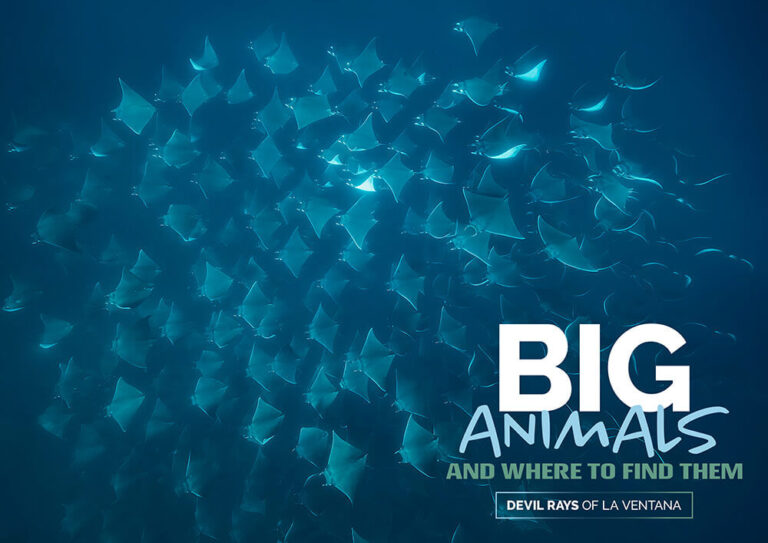
During the peak season from November through to April when the El Norte (northern…) winds blow hard, it can be hard to find accommodation as the place is so popular! But from late-April through to June, the calmer less windy months, the waters of La Ventana Bay host large schools of devil rays – principally Munk’s devil ray (Mobula munkiana). Why they gather here remains a mystery, but the most likely reasons are feeding on abundant plankton and small fish and to mate.
In-Water Encounters With Mobula Rays
Fishing is the lifeblood of La Ventana, and local fishermen use ‘pangas’ – sturdy, open fiberglass boats known for their speed and ability to launch straight from the beach.
During devil ray season, many of these fishermen pivot to tourism, taking visitors out to snorkel with the rays. It’s a model that works well – they know the waters intimately and how to time their outings before the afternoon winds pick up.
When the rays are present, they’re easy to spot thanks to their frequent breaches. Then it becomes a matter of how big the schools are, how deep they’re swimming, what the visibility is like and (most importantly…) how good a freediver you are.
Typical schools number in the hundreds, but multiple groups sometimes converge, creating a breathtaking spectacle of thousands of rays moving as one. Watching them shift direction in unison is like witnessing a ballet of the sea. Most pangas are chartered by specific operators running organized tours. So before booking, it’s essential to ask how many people will be on the boat with you.
My own trip to La Ventana was organized with my Italian dive buddy Filippo Borghi. He has a close friend based in Baja who connected us with a reliable skipper and a solid boat, allowing us to bypass the tour operators and organize our experience directly.
Photography and Freediving Challenges
Devil rays are captivating, photogenic animals – but they are also some of the most-challenging subjects to photograph underwater, especially head-on. La Ventana offers a rare and accessible chance to witness these elusive animals as they gather in remarkable numbers. It’s a bucket-list experience for any ocean lover, made all the more meaningful by the fragile status of these species.
Don Silcock
Don is Scuba Diver’s Senior Travel Editor and is based from Bali in Indonesia. His website has extensive location guides, articles and images on some of the best diving locations in the Indo-Pacific region and ‘big animal’ experiences globally.
Frequently Asked Questions
What is a devil ray?
Devil rays are pelagic rays in the genus Mobula, closely related to manta rays but generally smaller and more elusive.
How many species of devil rays are there?
There are eight known species of devil rays, alongside two manta ray species, making ten mobulids in total.
Why do devil rays breach out of the water?
The exact reason is unknown, but scientists believe breaching is a form of communication linked to courtship or social behaviour.
Where is the best place to see large numbers of devil rays?
One of the most reliable places is La Ventana in Baja California, Mexico, during late April to June.
Are devil rays endangered?
Yes. All mobulid species are listed as endangered, primarily due to fishing pressure and demand for their gill plates.
This article was originally published in Scuba Diver Magazine
Subscribe today with promo code DIVE1 — enjoy 12 months for just £1!
