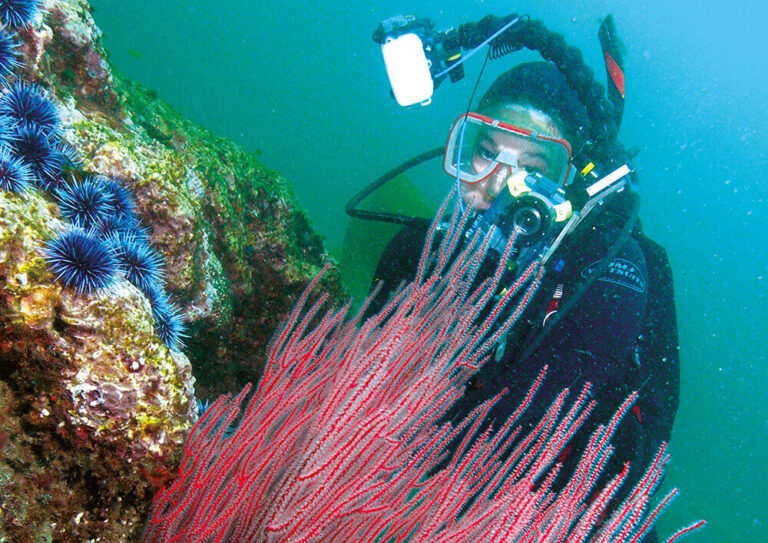
At the California Channel Islands, you’ve got to have a love-hate relationship with currents. In general, when they move in, they sweep out dirty water and replace it with clean, clear waters from the open ocean. At the same time, diving in strong current is difficult, if not impossible. Those locations far from shore benefit the most from this current cleansing action. Such is the case with Parallel Reefs at Anacapa Island.
Overview: Diving the Parallel Reefs
Skill Level: All as appropriate for the depth of the reef chosen. Current diving experience suggested.
Location: On the islands’ south side, stretching between Middle and West Anacapa. One particular high spot is located at GPS N33°59.986’, W119°24.841’ (Warning: GPS Coordinates are for reference purposes only. Not for navigation. Caution should be taken in using GPS coordinates since there can be errors in the accuracy of your receiver.)
Access: Boat only. A professional dive charter operation is suggested.
Depths: 30ft to 90ft, depending on which reef. Visibility: Excellent on outer reef, averaging 50 feet. Conditions: Beware of frequent strong currents.
Photography: Very good for both wide-angle around the small pinnacles and macro with many small fish.
Hunting: Fair to poor. Occasional halibut and a few lobsters in season.
Where the Parallel Reefs Are Located
As the name indicates, these are three reefs strips, parallel to one another, and roughly parallel to the island shoreline on the south side of this tiny three-island chain. They sit east-west where West Anacapa and Middle Anacapa Islands almost meet, separated by just a small gap of impassible water.
The outermost strip of reef is the best, but it is easy to dive two or even all three in one dive if water clarity permits, which it almost always does. Visibility averages 50 feet and is often 80 feet or better. Depending on location, the reefs are about 50 feet to 100 feet apart separated by sand. Move away from one reef and, with good vis, you should be able to see the other in the distance.
Reef Layout and Depths
The inner reef lies in 30ft of water, middle reef in 50ft. The outer ridge tops out about 45ft with a thin but healthy growth of kelp. Jumbles of boulders ramble down to bottom out in sand at 90ft on the outside and 65ft inside. While the reef does not have much of a profile, there are spires and pinnacles, even some mini-arches.

Mats of brittle stars often dominate sections of the reef giving the appearance of shag carpeting laid over the rocks. The upper pinnacles exhibit the most color, with crowding clumps of tiny corynactis anemones. Exhibiting hues of purple, orange, pink and red, the various colors compete for space to maximize the ability to feed from bits of food carried in the current.
Also adding to the color are numerous stands of red, golden, and purple gorgonians. The beautiful purple gorgonian have a very limited range, found in abundance only at this site and around West Anacapa Island. Colorful nudibranchs also like this upper area. In short, with sun streaming down through the clear waters, this is a visually stunning reef with its many multi-faceted colors.
Cabezon will settle on top of the rocks camouflaged so as to quickly pounce on prey
Marine Life on the Parallel Reefs
Fish life surrounding the reefs includes garibaldi, señorita, opaleye, treefish and gobies. Lucky fish watchers have been known to spot an elusive giant sea bass from time to time. Once considered a great game fish, the giant sea bass has now been protected for many years.

For real abundance, look to the smaller reef guys. In an unusual behavior pattern, the numerous small ghost gobies will come off the bottom to pick food out of the water column. Perhaps this is why it is not unusual to see their predator, the cabazon, perched on a rock overlooking their feeding areas. They are ready to pounce on one of their favorite foods. As they sit perfectly still, approach slowly and you could get a great fish face shot. Remember, get low, get close, and shoot up. Another good fish photo subject is the painted greenling. You’ll have to be patient, but their funny lips and big eyes give you a lot of material to work with.
Sand Flats: Rays and Halibut
If you have enough bottom time, venture out onto the sand to find rays and maybe some halibut. Don’t salivate too much over the halibut here. The larger flatties are few and far between. It is legal to spearfish, but game is sparse. In season, there are a few lobster.
Anacapa Island: A Small but Spectacular Wilderness
At only a little over one square mile, Anacapa Island is the second smallest of all the California Channel Islands, but more importantly, it is the closest to the mainland at just 11 miles. It is amazing how well it has held up over the years. Parallel Reefs are excellent example of just a small taste of this wonderful underwater wilderness. n
Tube anemones adorn the perimeters of the reefs. They vary in color from bright orange to purple to gray
Frequently Asked Questions
Where are the Parallel Reefs located?
The Parallel Reefs sit on the south side of Anacapa Island between Middle and West Anacapa in the California Channel Islands, accessible only by boat.
What skill level is required to dive the Parallel Reefs?
Depths range from 30–90 feet, making them accessible to most divers, but strong currents mean current experience is strongly recommended.
How is the visibility at the Parallel Reefs?
Visibility averages around 50 feet and frequently exceeds 80 feet, especially on the outer reef.
What marine life can divers expect to see?
Expect garibaldi, opaleye, señorita, cabezon, ghost gobies, nudibranchs, gorgonians, rays and the occasional giant sea bass.
Is photography good at the Parallel Reefs?
Excellent. Wide-angle works well on pinnacles and kelp, while macro lovers will find nudibranchs, anemones, and small reef fish everywhere.
This article was originally published in Scuba Diver Magazine
Subscribe today with promo code DIVE1 — enjoy 12 months for just £1!
