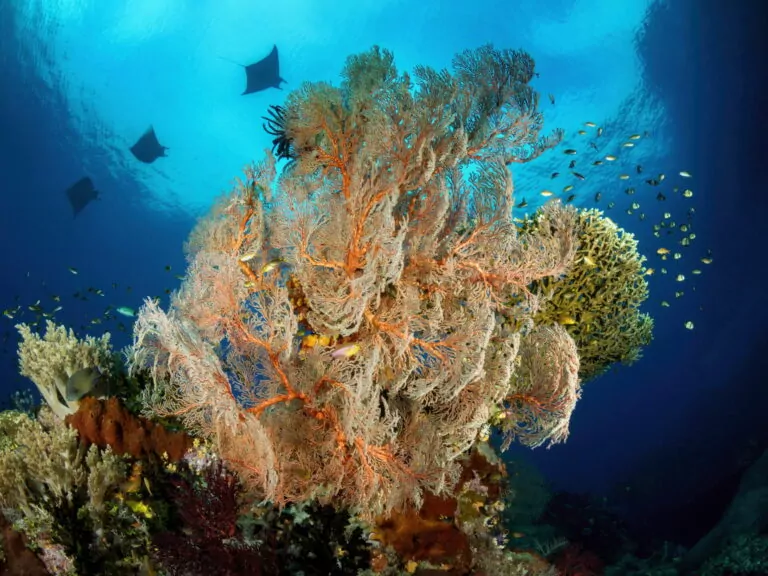
In just over two decades, Raja Ampat – the “Four Kings” of Indonesia’s remote West Papua region – has transformed from an obscure backwater into one of the world’s most coveted diving destinations.
When I first visited in 2005, dive operations were limited to a handful of liveaboards and makeshift eco resorts. Today, nearly 100 boats ply those waters during peak season, and accommodation ranges from basic village homestays to luxury resorts. What hasn’t changed though is the breathtaking landscape and the underwater biodiversity, which remains as vibrant as ever.
Back then, shark sightings were rare. Now, top predators have rebounded, and encounters with reef and oceanic manta rays are increasingly common and Raja Ampat is one of the few places on Earth where manta populations are growing.
Above water, infrastructure has improved just as dramatically. Sorong now has a modern airport and city amenities including malls and hotels. The question is: how did Raja Ampat grow so much, while protecting its environment?
The answer lies in a unique, community-cantered conservation effort led by passionate individuals. This article—the first in a series—focuses on one of those leaders: Mark Erdmann, whose blend of scientific expertise and deep cultural insight has helped shape Raja Ampat’s success.
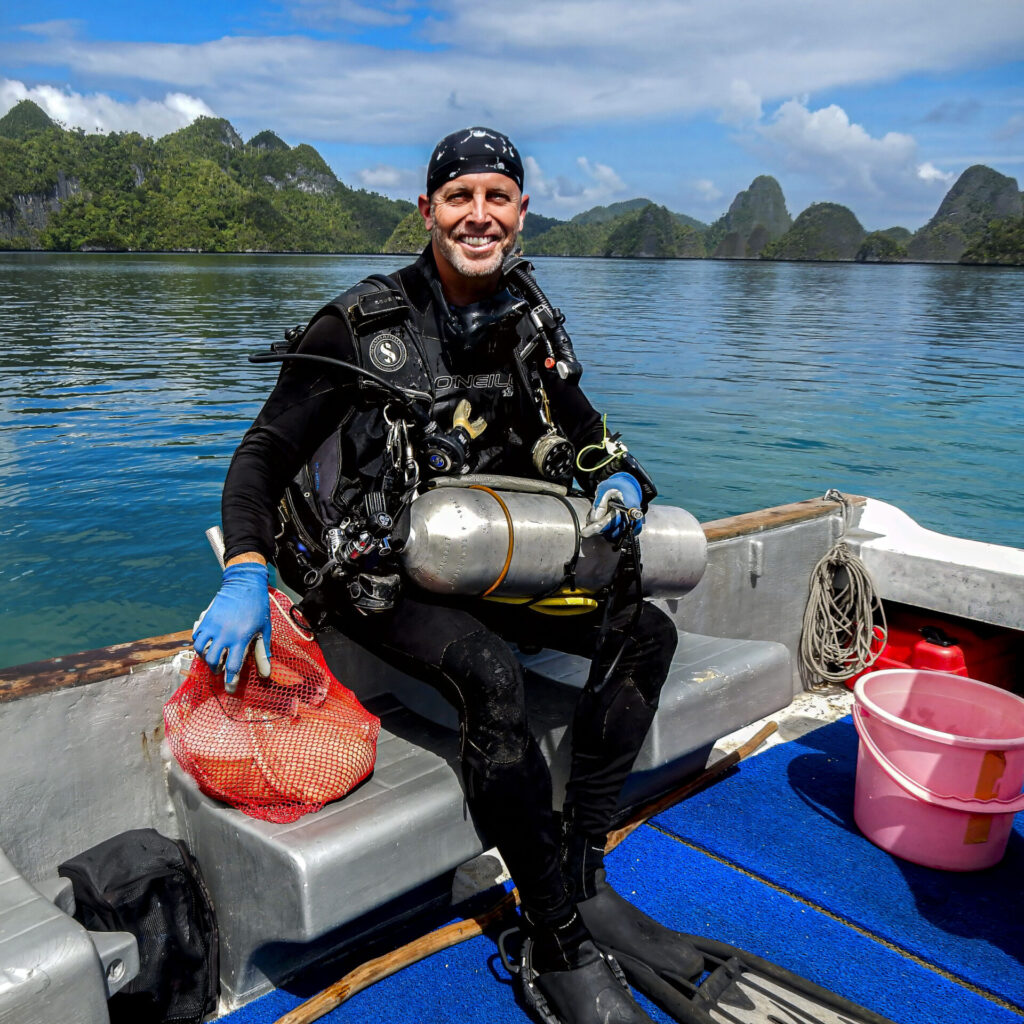
Who is Mark Erdmann?
An American coral reef ecologist with a Ph.D. from UC Berkeley, Erdmann lived in Indonesia for 23 years before relocating to New Zealand in 2014 with his wife and children. He is now Vice President of Asia Pacific Marine Programs at Conservation International (CI), where he oversees marine initiatives across the region.
Erdmann has logged over 14,000 dives and contributed to the discovery of 215 new species of fish, corals, and mantis shrimp. He’s authored more than 260 scientific papers and co-wrote the three-volume Reef Fishes of the East Indies with ichthyologist Dr. Gerald Allen.

Discovering Raja Ampat
Erdmann’s first visit to Raja Ampat came in 2002 as part of a Nature Conservancy expedition validating CI’s claim that the area was the global epicentre of marine biodiversity. Guided by local dive pioneer Max Ammer, Erdmann quickly confirmed the region’s uniqueness through his stomatopod (mantis shrimp) research.
But he also found clear signs of destruction – fish bombing, cyanide fishing, shark finning, and turtle poaching. It was clear to him that urgent conservation was needed and this was his calling.

Daunting Challenges
At the time, Raja Ampat was extremely remote, with little infrastructure and an undocumented yet sophisticated local culture. The region was under pressure from outsiders exploiting its resources, and law enforcement was almost non-existent.
Still, Erdmann saw a path forward, if proper funding and local support could be secured. In 2004, CI recruited him to help build a marine conservation program for Raja Ampat.

Building a Scientific Foundation
Erdmann understood that hard data would be essential to gain support. But how to survey a dynamic reef system and discover new species?
A turning point came in early 2005, when Erdmann teamed up with Dr. Gerry Allen during a tsunami damage assessment. Allen, a seasoned ichthyologist, had perfected the Rapid Ecological Assessment method to quickly estimate fish diversity.
They formed a partnership that continues today. Working as a two-man team, Allen surveys shallower reefs (to 40m) while Erdmann dives deeper (40–70m), using decompression stops to log cryptic species in the shallows.
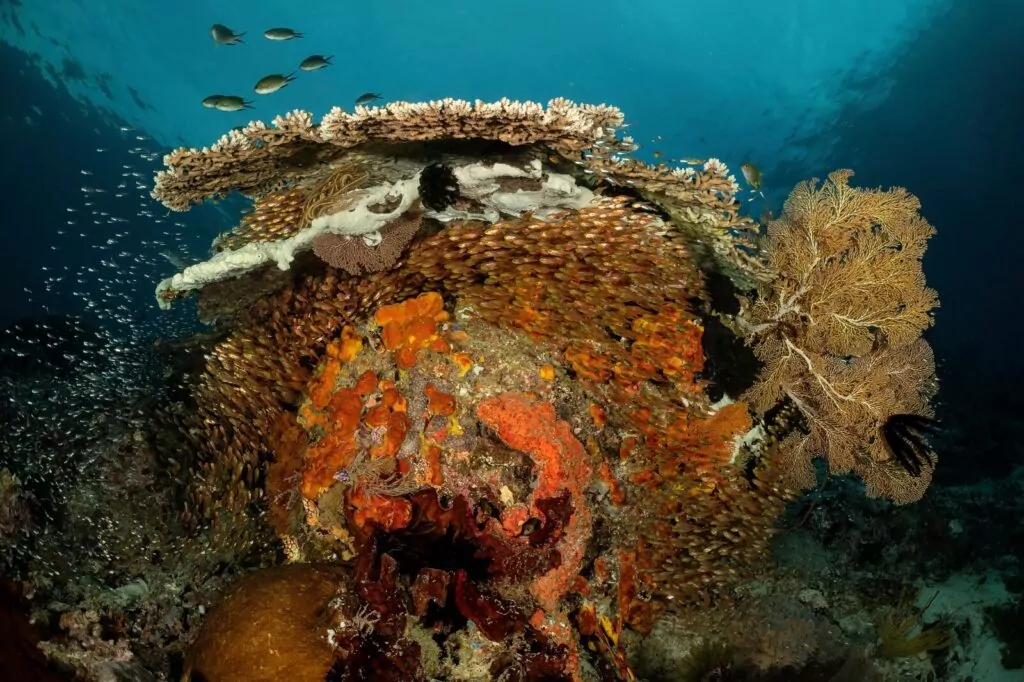
Their work confirmed Raja Ampat’s biodiversity: over 1,660 species of reef fish and 574 coral species, with at least 70 species endemic to the region. It cemented Raja Ampat’s reputation as a “species factory.”

A Holistic Conservation Strategy
Armed with compelling data, Erdmann and a dedicated team of Indonesian conservationists launched a holistic conservation strategy. Fluent in Bahasa and deeply familiar with Indonesia’s political landscape, Erdmann helped bridge local Papuan interests with national and international conservation goals.
Crucially, the team recognized that local Melanesian communities, who maintain customary marine tenure over their reefs, had to be at the centre of any solution. For them, conservation wasn’t just about biodiversity – it was about securing food and livelihoods.
Marine Protected Areas (MPAs) were introduced not as restrictions, but as legal tools to reinforce community rights. Communities helped define MPA boundaries, set the rules, and limited access by outside fishers.

Empowering Local Stakeholders
Instead of bringing in outside experts to run the MPAs, CI supported the training and employment of local Papuans as rangers and staff. While few had formal education, they brought deep knowledge of the reefs and a long-term commitment to their communities.
This community-driven model proved both effective and sustainable. It ensured local buy-in, preserved cultural traditions, and protected the marine ecosystem.
Legacy in Motion
Mark Erdmann’s legacy in Raja Ampat is one of visionary science grounded in local respect. By weaving together biodiversity data, grassroots empowerment, and strategic partnerships, he helped lay the foundation for what is now one of the world’s most successful marine conservation efforts.
This story is only the beginning. In future articles, we’ll meet other champions of Raja Ampat—people who, like Erdmann, continue to protect the heart of the Coral Triangle.
Written By Don Silcock
Don is Scuba Diver’s Senior Travel Editor, based in Bali and his website www.indopacificimages.com has extensive location guides, articles and images on some of the best diving locations in the Indo-Pacific region and “big animal” experiences globally.
Raja Ampat Conservation – FAQ
Who is Mark Erdmann?
Mark Erdmann is an American coral reef ecologist with a Ph.D. from UC Berkeley. He spent 23 years living in Indonesia, where he conducted groundbreaking marine research. Today, he serves as Vice President of Asia Pacific Marine Programs at Conservation International (CI).
What are his achievements in marine science?
Erdmann has logged over 14,000 dives, co-authored more than 260 scientific papers, and helped discover 215 new species of fish, corals, and mantis shrimp. He also co-wrote the three-volume reference work Reef Fishes of the East Indies.
When did he first visit Raja Ampat?
Erdmann’s first visit came in 2002 during a Nature Conservancy expedition. Guided by dive pioneer Max Ammer, he confirmed the region’s unparalleled biodiversity while also witnessing destructive practices like shark finning, fish bombing, and cyanide fishing.
What role did he play in Raja Ampat’s conservation?
In 2004, Erdmann joined Conservation International to develop a marine conservation program for Raja Ampat. He combined hard data collection with local cultural understanding to build effective, community-driven protections.
How was Raja Ampat’s biodiversity documented?
In 2005, Erdmann partnered with ichthyologist Dr. Gerry Allen using Rapid Ecological Assessments. Their surveys confirmed Raja Ampat’s status as the global epicentre of marine biodiversity, identifying over 1,660 fish species and 574 coral species.
What conservation strategy was used?
The approach was holistic and community-centred. Marine Protected Areas (MPAs) were introduced as tools to strengthen local Papuan community rights rather than impose restrictions. Communities themselves defined boundaries and rules, ensuring long-term support.
How were local people empowered?
Local Papuans were trained and employed as rangers and staff for the MPAs. This ensured conservation efforts were rooted in local knowledge, traditions, and long-term stewardship rather than outside control.
What is Mark Erdmann’s legacy in Raja Ampat?
His legacy is the creation of one of the world’s most successful marine conservation models. By combining science, community empowerment, and cultural respect, he helped transform Raja Ampat into a global symbol of biodiversity protection.
