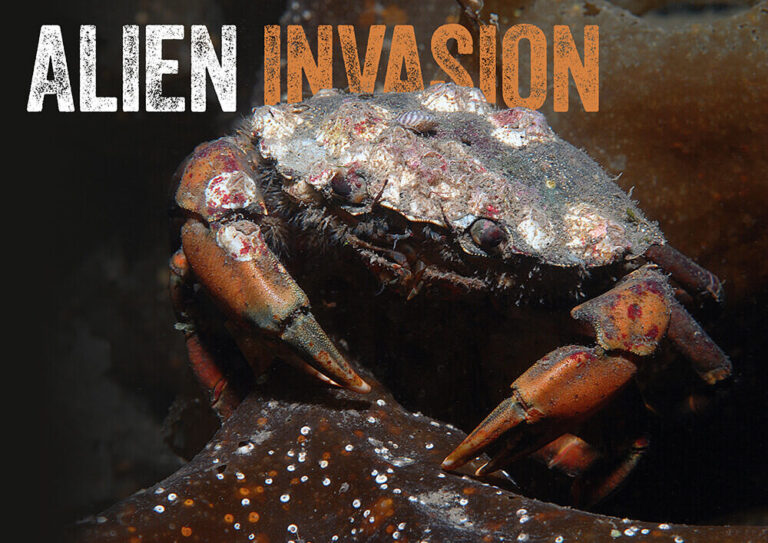
The humble green crab (Carcinus maenus) has been described by the International Union for the Conservation in Nature (IUCN) as one of the top 100 of the worst invasive alien species on the planet! Lawson Wood takes a closer look at this coastal favourite
Introducing: Carcinus Maenus
Around the UK shoreline is one of the most common and adaptable crustaceans that we all grew up with in rockpools, hiding under seaweeds, and generally giving you a nip if you got too close. Only growing to a maximum of 60mm long and 90mm wide across its back or carapace, this enigmatic shore crab is actually an alien invader!
It was first given the binomial name, Cancer maenas, by Carl Linnaeus in 1758 in his 10th edition of the Systema Naturae. Known by a number of local names such as the harbour crab; shore crab; European shore crab; common green crab; green crab and parten. It gets its Latin or proper name from ‘maenus’, which means ‘frenzied or raging woman’. The French refer to it as ‘le crabe enrage’, which translates as ‘raving mad crab’. In Norway, it is referred to as the ‘strandkrabbe’ and is the most-common intertidal decapod crustacean in Europe, the western Mediterranean, Portugal and north Africa.
Identification Guide: How to Recognise a Green Crab
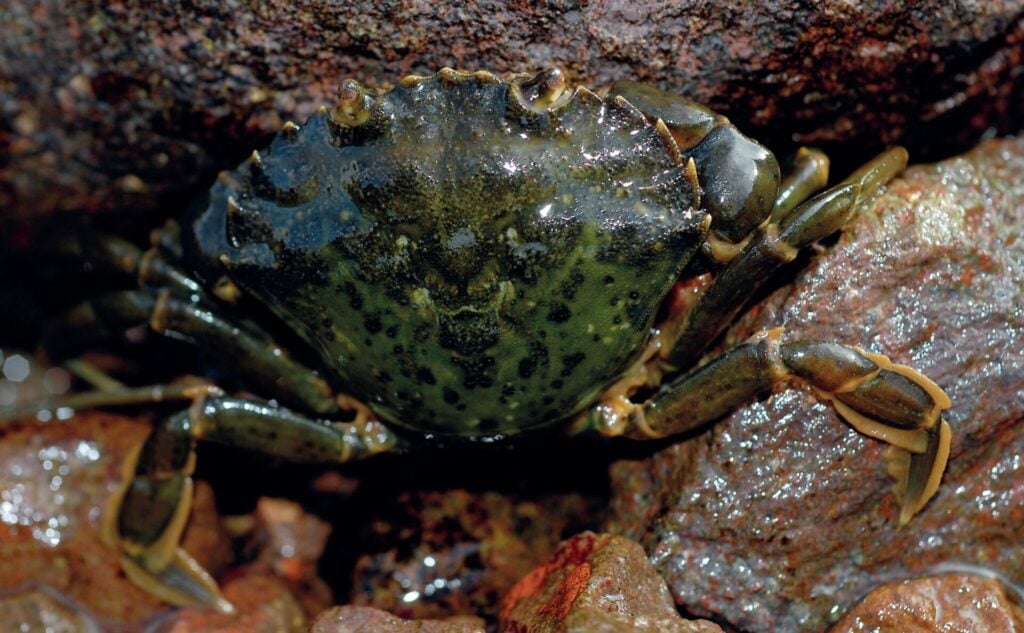
Although it is referred to as a green crab in colour, it also comes in a rusty orange hue and everything else in-between. The colour is usually dependent on the age and habitat of the crab. However, if there is a delayed moult, the crab becomes much more red in colour and subsequently, also more aggressive, but less tolerant of environmental stresses, such as salinity, temperature and oxygen.
The carapace or shell is much broader than long, with the front edge with five serrated teeth on each side of the eyes and has three rounded lobes between the eyes.

Females and males look identical from above, but when you are able to look at the underside, you will note that the male has a small triangular flap and the females have a much wider and rounded body flap, which they use to hold their eggs
As a decapod, it has ten legs, with the first pair of legs (periopods) developed into stout claws or pincers (chelae), it has a further six walking legs and the last pair are significantly flattened to allow it some further mobility in swimming.
What Makes the Green Crab a Highly Successful Invader
Most commonly known from around the shores of Britain and Ireland, there has been no stopping the march of this crab, whether it be through invasive introduction on ship’s hulls, planktonic larvae in water ballast, attached to seaweeds when transporting live bivalves for aquaculture, or the range and strength of ocean currents. Bearing in mind that each female can lay 185,000 eggs, with the crab larvae developing offshore, where they gradually change to a common crab shape and do a moult in the intertidal zone, where they live among seaweeds and seagrasses. However, they can be found as deep as 60m, showing their adaptability to almost any environment.

Females and males look identical from above, but when you are able to look at the underside, you will note that the male has a small triangular flap and the females have a much wider and rounded body flap, which they use to hold their eggs. They are omnivorous predators and scavengers and will eat anything they can get their claws on! Small molluscs and bivalves are particularly attractive, but most of all, they will scavenge around the rotting seaweeds on the seashore.
Global Spread of Carcinus maenas
It was first discovered off the coast of North America in Massachusetts in 1817 and rapidly spread northwards through the Carolinas and as far north as Placenta Bay in Newfoundland. Bounties were levied in Massachusetts, and over 10 tons were caught. However, it has been noted that the local blue crabs (Callinectes sapidus) in Chesapeake Bay have been able to fend off this invasion, and none of C. maenus are recorded.
It was discovered in San Francisco Bay in California in 1989 and was fairly confined in the bay, but soon expanded its territory and was found in Oregon in 1997; Washington State in 1998; and thenceforth to British Columbia in 1999. By 2000, it was very happy in Alaska, and by 2003, it had extended its range as far south as Patagonia!

As early as the 1850s, it was discovered in Port Phillip Bay in Victoria, Australia. It was a slow mover here and only reached New South Wales in 1971; South Australia in 1976 and Tasmania in 1983. Specimens have been discovered in Western Australia from 1965, but no more work has been done on this.
Meanwhile, in South Africa in Cape Town’s Cable Docks, they were also first found in 1983 and have since shown up in Salenha Bay in the north and Camps Bay in the south. Isolated findings have also recorded this intrepid invader in Brazil, Panama, Hawaii, Madagascar, the Red Sea, Pakistan, Sri Lanka, and Myanmar. Japan has also been invaded by a subspecies of the crab called Carcinus aestuarii, and the crab itself (C. aestuarii ) is also in the Mediterranean. The green crab still hasn’t been discovered in New Zealand, and the environmental officers are on high alert should this ubiquitous invader reach their shores.
Why Eradication Efforts Rarely Work
Just to give an indication of how virulent the green crab epidemic is, in 2019 it was discovered in Lummi Bay in the Lummi Indian Reservation in Whatcom County, Washington State. In a bid to eradicate the problem, the First Nations trapped them, but it soon became clear that this was completely inadequate and at the very best, it could only keep the numbers down, but that complete eradication was impossible, as in nearby Oregon’s Coos Bay in 2020, only 3,000 crabs were caught in traps. In only one year, over 79,000 of these crabs were caught in traps and the Lummi Indian Nation Business Council declared a national emergency and approached the Washington Department of Fish and Wildlife for emergency funding to trap the crabs and save their aquaculture livelihood.
From all accounts worldwide, it would appear that there is no stopping the seemingly global domination by this ubiquitous crab. So when you are exploring the rockpools or snorkelling around our shores, just remember that the little (yet aggressive) crab that you find is also in almost every other part of the planet. n
Frequently Asked Questions
Why is the green crab considered an invasive species?
The green crab spreads rapidly, adapts to nearly any coastal environment, and outcompetes native species for food and habitat, causing major ecological disruption.
Where did the invasive green crab originally come from?
It originates from Europe and North Africa but has now colonised coastlines worldwide, including North America, Australia, South Africa, and parts of Asia.
How does the green crab impact marine ecosystems?
It destroys seagrass beds, preys on native molluscs and bivalves, disrupts aquaculture, and reduces biodiversity by outcompeting local crustaceans.
How has the green crab spread so widely?
It travels on ship hulls, in ballast water, attached to seaweed used in aquaculture, and via strong ocean currents. Its larvae survive long distances offshore.
Can green crab populations be controlled or eradicated?
Complete eradication is unlikely. Trapping can reduce numbers locally, but their reproduction rate and global distribution make long-term control extremely difficult.
This article was originally published in Scuba Diver Magazine
Subscribe today with promo code DIVE1 — enjoy 12 months for just £1!
