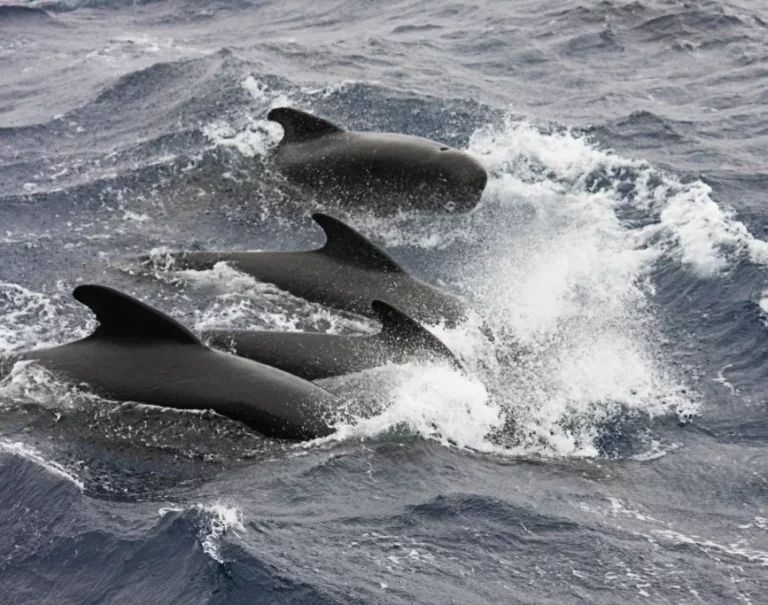
Recent research into the feeding behaviour of long-finned pilot whales by researchers at the University of Glasgow has shed light on one of Scotland’s biggest mass-stranding events.
The study, led by the university’s Scottish Marine Animal Stranding Scheme (SMASS), used stable isotope analysis (SIA) to reconstruct the feeding history of 55 deepwater pelagic cetacaeans that had stranded on the Isle of Lewis in July 2023.
Further mass strandings of long-finned pilot whales had followed that one in Scotland in 2024 and 2025, underlining the urgency of the research.
Post-mortem examinations had shown the pilot whales to be healthy and an investigation by the Scottish government’s Marine Directorate had concluded that a combination of biological, behavioural and environmental factors had contributed to the stranding.
The pod of highly social pilot whales appeared to have followed a female experiencing a difficult birth into dangerously shallow water, according to its report.
However, the SMASS study helps to explain why these deepwater animals might have been attracted to habitats that put them dangerously close to risky coastal topography which, with a steeply shelving bay, onshore surf and soft sand, combined to seal their fate.
Feeding history
The behaviour and movements of long-finned pilot whales are normally difficult to document, but in this case the SIA technique enabled their recent feeding history to be reconstructed from chemical signatures preserved in their skin tissue,
The pod were found to have been feeding mainly along the edge and slope of the continental shelf in deeper offshore waters – the first direct evidence that long-finned pilot whales feed seasonally in such habitats, which are thought to support substantial fish and squid populations in spring and early summer.
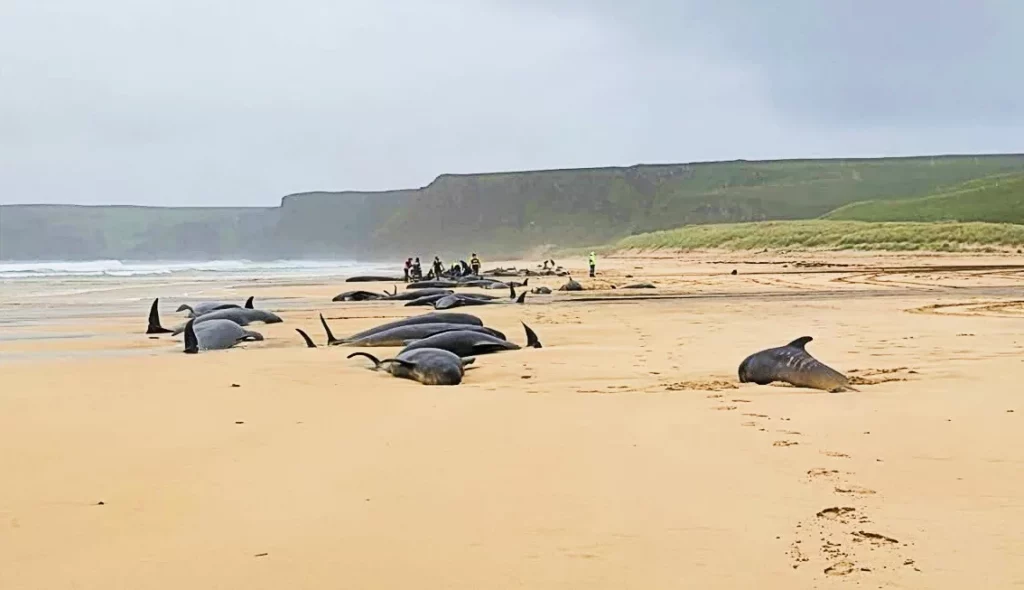
As a result the pilot whales had been in good nutritional condition when they died, yet their stomachs were empty. The research team say that because such habitats lie close to rapidly shallowing coastal zones they induce foraging animals to run the risk of stranding.
Their feeding patterns could be shifting in response to environmental change, they say, making it important to develop effective management strategies to minimise the risk.
“Post-mortem examination tells us about the animals’ condition at the moment of stranding; stable isotope analysis tells us where they had been and what they had been eating in the weeks before,” said SMASS director Dr Andrew Brownlow.
“Together, they allow us to move from asking what happened at the moment of stranding to asking what set these animals on a course towards it.”