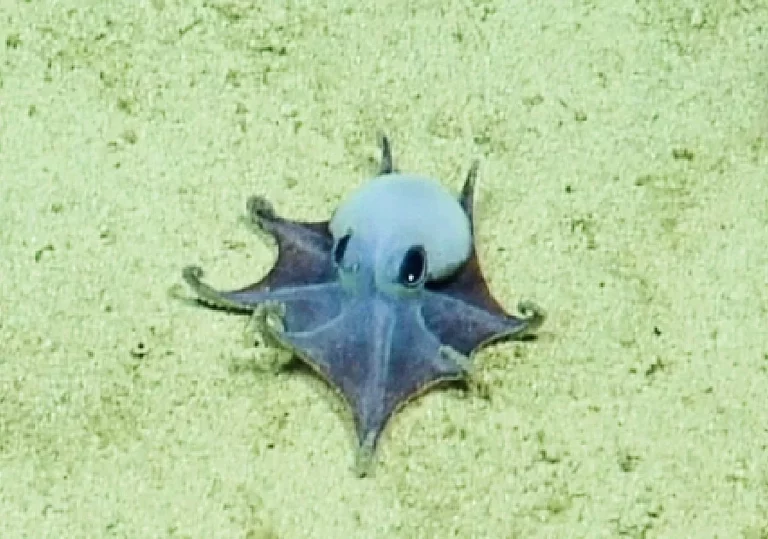
“He’s tiny!” and “It’s blue!” were the first recorded reactions of researchers when they saw an unusual-looking octopus picked up by their ROV’s camera at a depth of 1,773m. They had been exploring a sea-mountain near Darwin Island in the north of the Galapagos Islands.
Eleven years on the tiny blue octopus, spotted during a 2015 deep-sea expedition conducted from the expedition vessel Nautilus, has finally been described in a new study.
Research into what is now Microeledone galapagensis was carried out by the Charles Darwin Foundation (CDF) and Chicago’s Field Museum working with the Galapagos National Park Directorate after the ROV had been used to collect the golfball-sized octopus.
Baffled scientists at the CDF research station sent photographs of their find to the Field Museum’s associate curator of zoology Janet Voight, an octopus expert.
“Right away, I knew it was something really special,” says Voight, lead author of the new study. She asked to be sent the preserved specimen, which had a single row of suckers on its short arms, smooth light-blue skin on its back and a web coloured a deep purple.
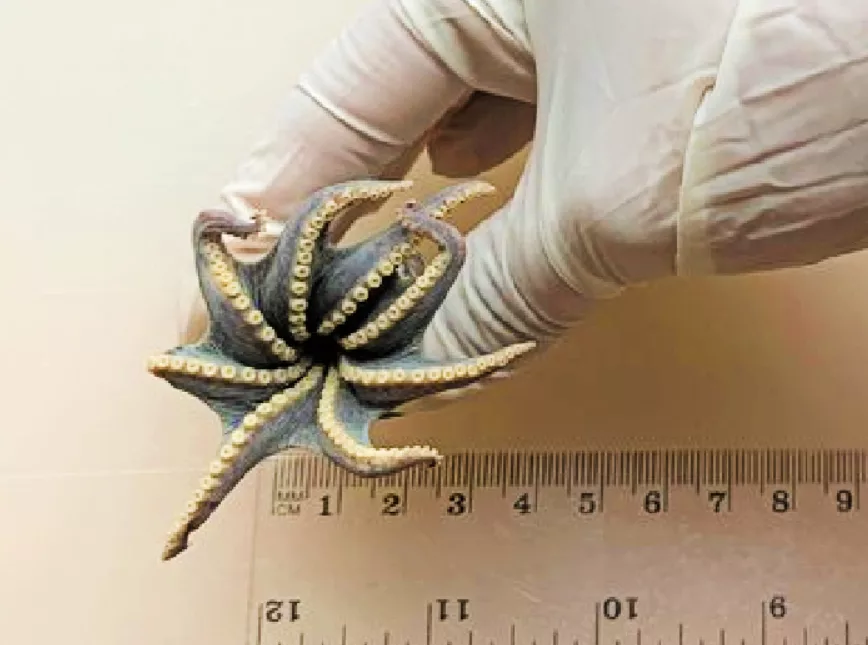
The closest-known equivalent lived off the Uruguayan coast on the opposite coast of South America, and Microeledone galapagensis would turn out to be the first time in her four-decade career studying cephalopods that she had officially led a team of scientists in describing a new octopus species.
“I’d never seen anything like it,” she says. “When you describe a new species of octopus, you have to look at all the parts, including the mouth, the beak and the teeth. And to see those things, you have to cut the specimen open.”
Digital slicing
Reluctant to carry out a dissection with only a single specimen available, Voight found an alternative approach with the help of Stephanie Smith, manager of the Field Museum’s X-ray computed tomography laboratory.
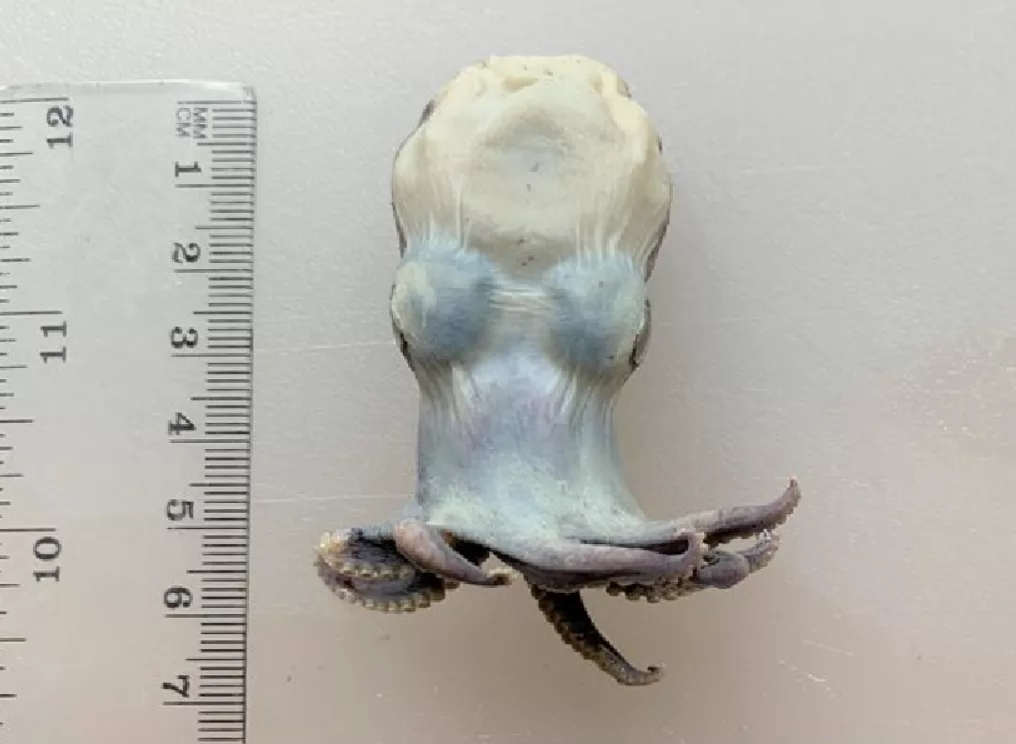
“Because CT imaging is non-destructive, it’s especially important for type specimens like this one,” says study co-author Smith. “And that’s great for me because people are often bringing me these incredibly rare and stunningly beautiful specimens that I get the privilege of virtually opening up.”
She processed thousands of X-rayed slices of the octopus digitally to create a 3D inside-and-out model. “What really struck me was that the scan of the little octopus revealed so much information on its internal organ systems… this made the 3D modelling of relevant organs a really easy task,” says University of Bonn researcher and senior author of the paper Alexander Ziegler.
The octopus was identified as an unusually diminutive member of the Megaleledonidae family, usually associated with the Southern Ocean in Antarctica. The scientific study has just been published in the journal Zootaxa.
Also on Divernet: 4 new deep-sea octopus species identified