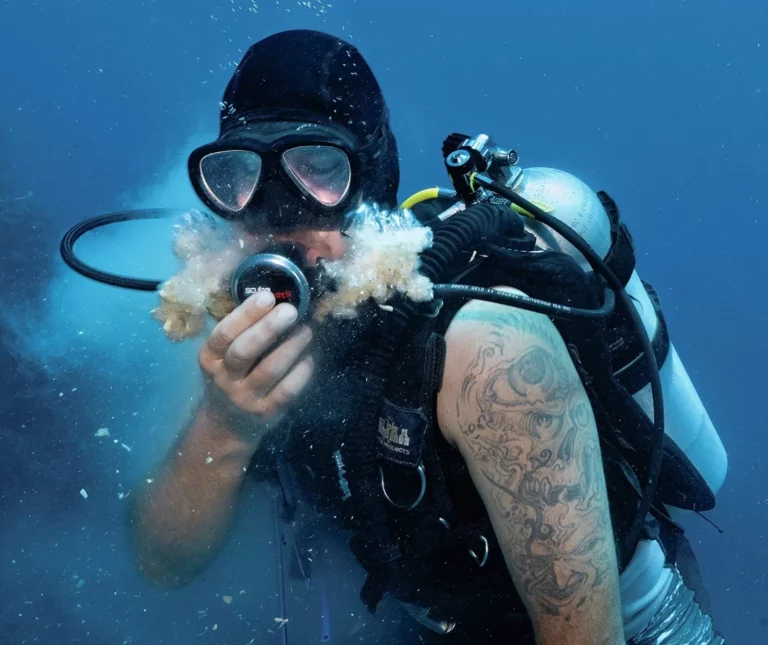
A DAN member recounts his experience of vomiting underwater and highlights the importance of regulator clearing.
When Things Go Wrong at Depth
Getting to the wreck of the Caribsea can take up to an hour and a half. While travelling to the dive site, I regrettably ate a prepackaged lunch I had purchased the night before.
After arriving on site and receiving the dive briefing, my buddy and I reviewed our dive plan while suiting up. We entered the water and spotted the silhouette of the wreck in the distance at the end of the anchor line. A multitude of sand tiger sharks and various other marine life engulfed it in a whirlwind of activity. We were both nervous and excited about the staggering number of sharks, but we carried out our plan of filming the sharks and searching for shark teeth.
Vomiting Underwater: Yes, It Happens
Roughly ten minutes into the dive and at a depth of 27m, I was suddenly overcome by an intensely upset stomach, and my mouth began to water as if I needed to vomit. My dive buddy was within arm’s reach, and I quickly got his attention to signal that something was wrong and that I needed him to remain close. He signalled that he understood and stayed nearby, preparing to assist with sharing air or any other help needed. I then involuntarily regurgitated the predive snack, expelling my lunch into the water around us through the primary regulator, which was still in my mouth. Fish immediately swarmed us to consume the freshly deposited food debris now suspended in the water column.

The flurry of activity around us was overwhelming and added to the apprehension rapidly building in my mind. The brief relief I felt from throwing up was quickly replaced by the immediate need to breathe in again. I also wasn’t sure if I was going to throw up more than once in rapid succession.
Why Keeping Your Regulator In Matters
With my primary regulator fouled, I resisted the urge to immediately switch to my secondary regulator. I knew if I removed my primary and involuntarily threw up again in the middle of the transition, I would have nothing but seawater to suck in between episodes. I was also concerned that a second bout of vomiting would foul the secondary regulator, and I would not have a clean regulator available to breathe through. Conscious of the potential danger of inhaling vomit or seawater, I forced myself to remain calm and fought to ignore the demand from my body to take a huge breath.
Regulator Clearing Under Stress
I was able to gently breathe around the chunks of debris that had filled the housing of my primary regulator, and with my first exhalation I displaced most of the debris trapped in the housing. When I felt confident that all involuntary reflexes had subsided, I switched to my secondary regulator. I performed the regulator-clearing skill on my primary several times to ensure there was no more trapped debris, that it wasn’t free-flowing, and that I could breathe through it without issue. When I was ready, we proceeded to the ascent line before heading to the surface.
Vomiting can cause involuntary inhalation and can be a singular event or have multiple subsequent occurrences in quick succession. Keeping your primary regulator in your mouth after vomiting at depth prevents you from unintentionally inhaling water, which may happen while transitioning to another regulator. Wait for the vomiting to be completely over before taking action, and switch to your secondary regulator only after all involuntary reflexes have subsided. My buddy remained nearby and was ready to share air if I had failed to clear my primary regulator or had fouled my secondary regulator.
Practice Panic Control and Breathing Discipline
Staying focused on the problem and remaining calm in this unexpected situation allowed me to breathe slowly and deliberately, minimising my risk of inhaling vomit or water. My instructors’ lessons on controlling panic and finding solutions to problems at depth helped keep me calm.
Relying on fundamental dive skills such as regulator clearing and managing a free-flowing second stage proved crucial for my safety. Regulator clearing is an essential skill that all divers should practice. Sadly, multiple published cases of dive fatalities describe a diver failing to clear a flooded regulator and then aspirating water, triggering panic and causing a flight to the surface. Take time to focus on the basics of diving.
For an extensive range of diving health and safety information and downloadable resources, research studies, incident summaries, and free e-Learning courses, take the time to explore the DAN website.
Frequently Asked Questions
Can you vomit underwater while scuba diving?
Yes. Divers can vomit underwater due to seasickness, food reactions, anxiety, or exertion, even at depth.
Is it safe to vomit through a regulator?
Yes, modern regulators allow vomit to pass through, but clearing the regulator properly afterwards is critical.
Should you remove your regulator if you feel sick underwater?
No. Keeping the primary regulator in your mouth reduces the risk of inhaling water during involuntary breathing.
What should you do after vomiting underwater?
Remain calm, breathe slowly, wait until retching stops, then clear the regulator before switching to an alternate air source.
Can vomiting underwater cause panic or drowning?
Yes. Poor regulator management or panic can lead to inhaling water, a known factor in several diving fatalities.
How can divers prepare for vomiting underwater?
Practice regulator clearing, free-flow management, and stress control during training to build automatic responses.
This article was originally published in Scuba Diver Magazine
Subscribe today with promo code DIVE1 — enjoy 12 months for just £1!

Happened to me on a recent trip. Could feel it coming on and settled in the water, held my primary in, to make sure I didn’t spit it out, and vomited. Cleared the primary and then switched regs. Once back on shore washed the primary out.