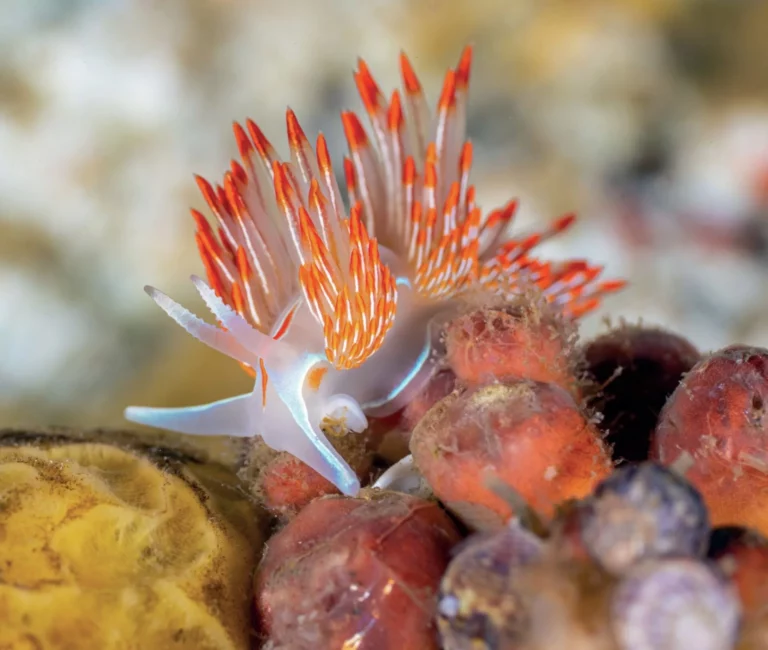
Master nudibranch photography with Alex Mustard.

The Allure of the ‘Little Things’ Underwater
The decorations are up and presents are piling up under the tree, as I write on this chilly December morning. And for certain members of the household, the focus is very much on the smaller parcels. Because as the experienced know, the best things in life often come in the smallest packages. The same is true underwater, because the longer we dive the more our focus shifts and we learn about the rich rewards from diving slowly, looking close, and appreciating the little things in life—the fundamental starting point for excellent nudibranch photography.
Perhaps the most-prized tiny treasures are nudibranchs – colourful, shell-less sea slugs. Despite some being smaller than the end of your thumb, their gaudy colouration and kaleidoscopic patterns make them irresistible to underwater photographers. And whether you’re exploring coral reefs in the tropics or shipwrecks in British waters, you’ve a good chance of spotting these captivating critters, if you take the time to look for them.
Nudibranchs appeal to photographers not just because of their beautiful colours, but also because of their fascinating biology. Nudis are hermaphrodites with a specialist mating behaviour and egg laying, harness a range of dramatic defence mechanisms and advertise them through striking colour, and display a remarkable diversity of food choices.
Essential Gear for Nudibranch Photography
Gear matters with sluggers for the simple reason that they are small and usually tucked down on the seabed. The starting point is a good macro lens, in calm, clear waters a longer focal length lens is better, but in lower visibility a shorter focal length works best. While nudis come in a range of sizes, most of the best shots require a little bit more magnification than a straight lens will give, especially when we want to fill the frame with a head on pose. You don’t need a super-powered underwater dioptre for this, and this where lower-powered, but high-quality supplementary lenses shine. Two I’d recommend checking out are the Nauticam MFO-1 and the Kraken +6 lenses.
The alternative approach is to gain that extra magnification inside the housing, either by adding a thin, autofocus compatible extension tube to your lens, or using a high-quality, non-underwater, supplementary close-up lens, like the venerable Nikon 5T. Both of these options are cheap to buy, but they do require a port extension, which frustratingly brings the total price close to those the expensive underwater lenses.

Nudis are usually attached to the bottom and often tucked down, not in the best position for a photo. So the best approach is a single, snooted strobe, to be able to spotlight the slug and leave the surroundings in the dark. The results are highly effective and allow the viewer an unobstructive view. I would just caution that some photographers become so focused on the perfectly posed portrait that they miss the bigger story of where the nudibranch is living and what it is doing.
While nudibranchs are generally slow moving, when we wind up the magnification and shoot them with a razor thin depth of field, they actually move through our narrow plane of focus annoyingly fast! It is crucial to focus precisely on the rhinophores, which are the distinctive, antler-like chemo-sensory organs on their heads. I like to us tracking autofocus on most subjects, but with nudibranchs I tend to favour a spot focus that doesn’t try and follow the subject, to ensure I get the focus nailed.
The Nudi-Hunter’s Guide
Before we get to the shooting, the first challenge in nudibranch photography is finding them. And there is definitely a knack. Nudibranchs are not distributed evenly through the oceans; there are definite hotspots and specific seasons where you’ll see far more than your fair share.
In the tropics, the Philippines – particularly around Anilao – is a renowned destination, though many other places come close. In colder waters, nudibranchs can be far more numerous, though biodiversity is lower.
In the UK, for example, it’s not uncommon to drop in during the spring and find the kelp covered in hundreds of slugs, often all from a single species. Nudibranchs are carnivores and feast on non-moving invertebrate life, so the best way to find them is to look for their prey. Non-moving invertebrates generally thrive in areas of water movement, which they rely on to bring their food. Therefore, our best chance of finding slugs is in areas of current, particularly on pinnacles, wrecks, and rubble. Often, the best giveaway is their large, brightly coloured egg ribbons, as they usually lay them close to where they are living.

The best way to learn to find nudibranchs is to dive with dedicated ‘nudi-hunters’. Around the world, nudispotting events take place, from liveaboard trips in Indonesia to the popular Nudibranch Safari in Gulen, Norway. The nudi-lover sub-culture is a surprisingly vivacious branch of diving, always keen to include new members and educate them in the ‘ways of the slug’.
Composition and Perspective
The most-dramatic angle to shoot nudibranch portraits is from dead ahead, framing the slug as it comes towards the lens. The aim is to have the rhinophores sharp in the foreground, framed against the colourful slug behind. A vertically framed picture is the best way to fill the frame with this composition, although being more awkward, this orientation is taken less. We should aim to get out camera right down to ‘eye’ level, which gives the strongest connection with the subject and throws the background further away. Both factors increase the impact of our picture. If the slugger is on the move then watch and wait for the moment it crawls up and over something for that decisive moment.
As a rule of thumb, the front-on angle works best with ‘sausage-shaped’ Dorid nudibranchs, while the side angle suits Aeolid nudibranchs – the ones with ‘lots of sausages on their backs’. Other angles also work well. If the nudibranch’s pattern is mostly on its back, shoot slightly down on the subject. When the nudibranch is on a particularly photogenic background, try a completely top-down angle.
Capturing Behavior
Behaviour allows us to take our shots up a notch and fortunately nudibranchs are usually up to something, once you learn to recognise it. We regularly see them paired up, right side to right side, mating, or going round in circles, laying their characteristic spiralled egg ribbons. Sometimes, you’ll even find other animals hitching a ride, such as beautiful emperor shrimp.
Photographing nudibranchs is both addictive and rewarding. Their diversity, beauty, and fascinating behaviours offer endless opportunities. So dive slow, look close, and let the ocean’s reward you with the best presents.

FAQs
How do you find nudibranchs for photography?
To find nudibranchs, look for their food sources (non-moving invertebrates) in areas with water movement, such as pinnacles, wrecks, and rubble. Their brightly colored, spiraled egg ribbons are also a major giveaway that a nudibranch is nearby.
Where should you focus when photographing a nudibranch?
The most critical point of focus is the rhinophores—the antler-like sensory organs on the head. Because macro photography has a narrow depth of field, keeping the rhinophores sharp ensures a compelling connection with the viewer.
What is the best lens for nudibranch photography?
A high-quality macro lens is essential. In clear water, a longer focal length is preferred, while shorter focal lengths work better in lower visibility. For extra magnification, use supplementary lenses like the Nauticam MFO-1 or Kraken +6.
Why is a snoot used in nudibranch photography?
Since nudibranchs are often tucked against distracting backgrounds on the seabed, a snooted strobe allows you to spotlight the subject while leaving the surroundings dark, creating a clean, professional portrait.
What are the best locations for nudibranch photography?
Tropical hotspots include Anilao in the Philippines, while colder waters like the UK (during spring) and Gulen, Norway, offer high concentrations of specific species.
This article was originally published in Scuba Diver Magazine
Subscribe today with promo code DIVE1 — enjoy 12 months for just £1!
